









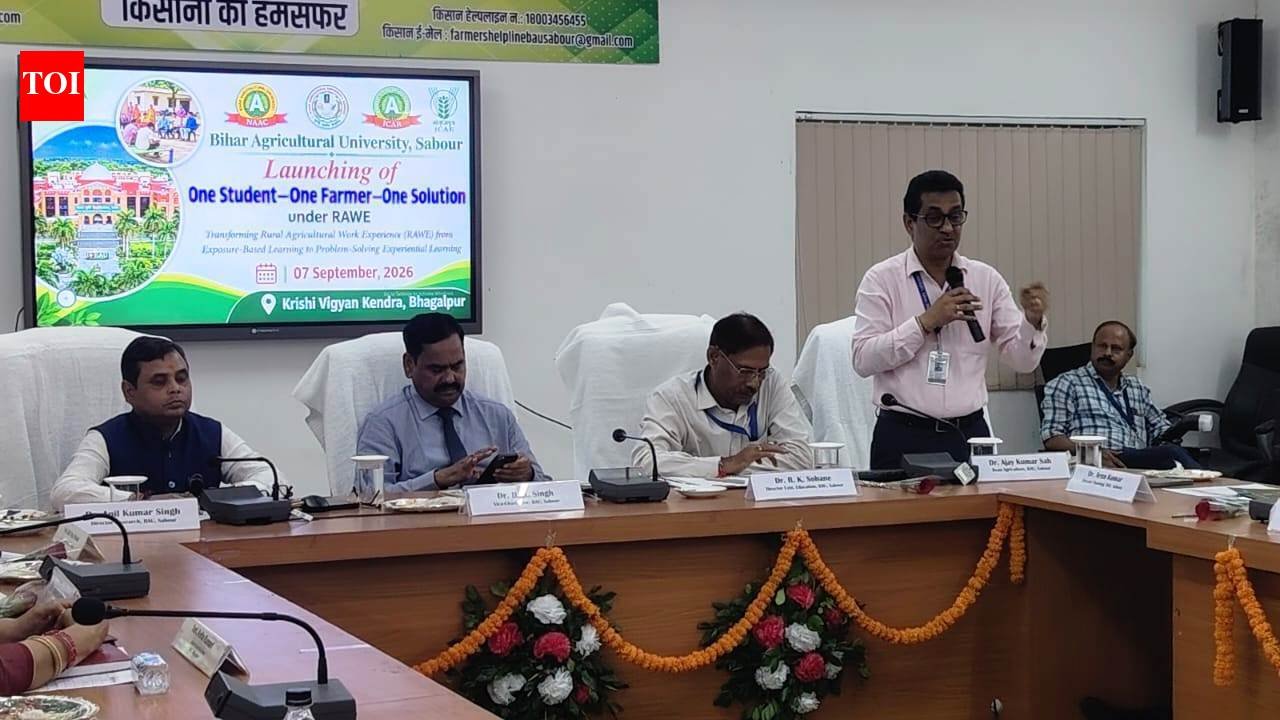
Bhagalpur: The Bihar Agricultural University (BAU), Bhagalpur, on Monday launched the ‘One Student-One Farmer-One Solution’ (OSOFOS) farm-field programme for agriculture students, aimed at providing them practical experience in identifying farming problems, diagnosing them scientifically and developing need-based solutions in collaboration with farmers.The six-month programme, covering one complete semester, was launched by BAU vice-chancellor D R Singh under the Rural Agricultural Work Experience (RAWE)-based national curriculum. The university said the initiative seeks to make agricultural education more field-oriented and problem-solving by turning conventional field exposure into interventions with measurable farm-level outcomes.A total of 398 agriculture students associated with different Krishi Vigyan Kendras (KVKs) under BAU are participating in the RAWE programme. Of these, 138 students from 19 universities are taking part, providing a platform for inter-university learning, farmer engagement and collaborative problem-solving, the university said.Under OSOFOS, each student will be linked to a farmer and he or she work with them to identify one priority agricultural problem and facilitate a practical, location-specific solution under the guidance of KVK scientists and university experts.Singh said a key feature of the initiative was the identification and documentation of grassroots innovations, indigenous technical knowledge and low-cost solutions in collaboration with farmers.Students will be encouraged to treat farmers as knowledge partners and innovators, document their practices and facilitate their technical validation and wider dissemination through KVKs, Singh said.He added that the programme would involve farm profiling, problem identification, technical diagnosis, joint development and field implementation of solutions, monitoring, impact assessment and documentation.The outcomes will be assessed using indicators such as technology adoption, productivity, production costs, farm income and resource-use efficiency, besides the replication of successful solutions, Singh said. The participation of students from 19 universities would also facilitate the sharing of technologies, experiences and grassroots innovations from different regions, he added.


