



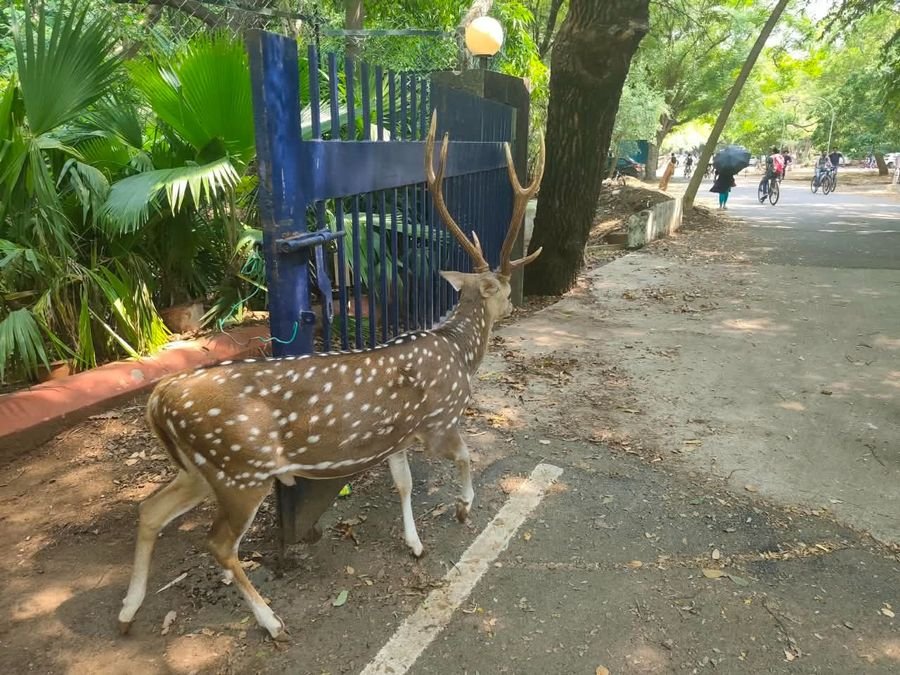
Chennai, Sep 15: There is a road inside IIT Madras where the traffic is not always the most interesting thing moving across it.
A herd of spotted deer can appear from the trees, cross the road and disappear into the campus again.
A few minutes later, there may be another group.
Students pass them on their way to class. Cars slow down. The deer keep moving.
For a visitor from Kashmir, the sight takes a moment to settle.
Kashmir has its own deer, the Hangul. But there, the animal is no longer an everyday sight across the Valley. Its numbers are counted, its habitat is watched and the routes it still uses have become part of a conservation effort.
The latest count, in 2025, put the Hangul population at 323.
That is up from 127 in 2008. It is also a long way from the thousands of Hangul that once inhabited Kashmir.
The difference begins with the animals themselves. The deer at IIT Madras are chital, or spotted deer. The Hangul is a subspecies of red deer found in Jammu and Kashmir and classified as critically endangered.
But for a Kashmiri looking at the animals in Chennai, the more striking difference is not the species.
It is the landscape.
At IIT Madras, the deer have continued to live in a place that has been built around them — or, at least, around a forest landscape that was here before the institute.
The campus covers about 617 acres and retains large stretches of wooded land. IIT Madras was established on land adjoining Guindy National Park, and the institute lists spotted deer and blackbuck among the wildlife found on its campus.
The result is an unusual daily scene for an engineering institute: laboratories and hostels on one side, a deer moving through the trees on the other.
The animals are not kept in an enclosure.
They use the campus.
That has meant adapting the campus to them as well.
IIT Madras has removed more than 2,500 metres of chain-link fencing around parts of the campus to allow wildlife to move between areas. It has opened up grassland for grazing and maintains water troughs for deer and blackbuck. Its 2024-25 annual report says there are now water troughs at 90 locations.
None of this makes the campus a sanctuary.
There have been deer deaths from road accidents and disease, while feral dogs, construction and other human pressures have also posed problems. A 2022 census cited by The Times of India put the spotted deer population at around 150 and blackbuck at about 50.
The IIT campus has therefore had to find a way of keeping a working institution and its wildlife in the same space.
Kashmir is dealing with a different stage of the same problem.
The Hangul has already lost much of the landscape over which it once moved.
Historical accounts place its numbers in the thousands. It was found in several parts of the Valley, but its distribution contracted over the decades. Dachigam is now its principal stronghold, with conservation efforts also looking at habitats and movement corridors beyond the protected area.
The population trend of the last decade offers some hope: 183 in 2015, 214 in 2017, 237 in 2019, 261 in 2021, 289 in 2023 and 323 in 2025.
But the recovery in numbers has not restored the old range.
That is why conservation work around the Hangul increasingly goes beyond counting animals. Protecting the places where they feed and breed, and keeping different habitats connected, are central to efforts to rebuild the population.
The comparison with IIT Madras is not a claim that the two landscapes are alike. They are not.
One is a 617-acre institutional campus inside a major city, with a population of adaptable chital. The other is a fragmented Himalayan landscape where a critically endangered red deer is struggling to recover.
What the Chennai campus offers, instead, is a glimpse of something that has become much harder to see in Kashmir: wild deer moving through an inhabited landscape without being an exceptional sight.
