



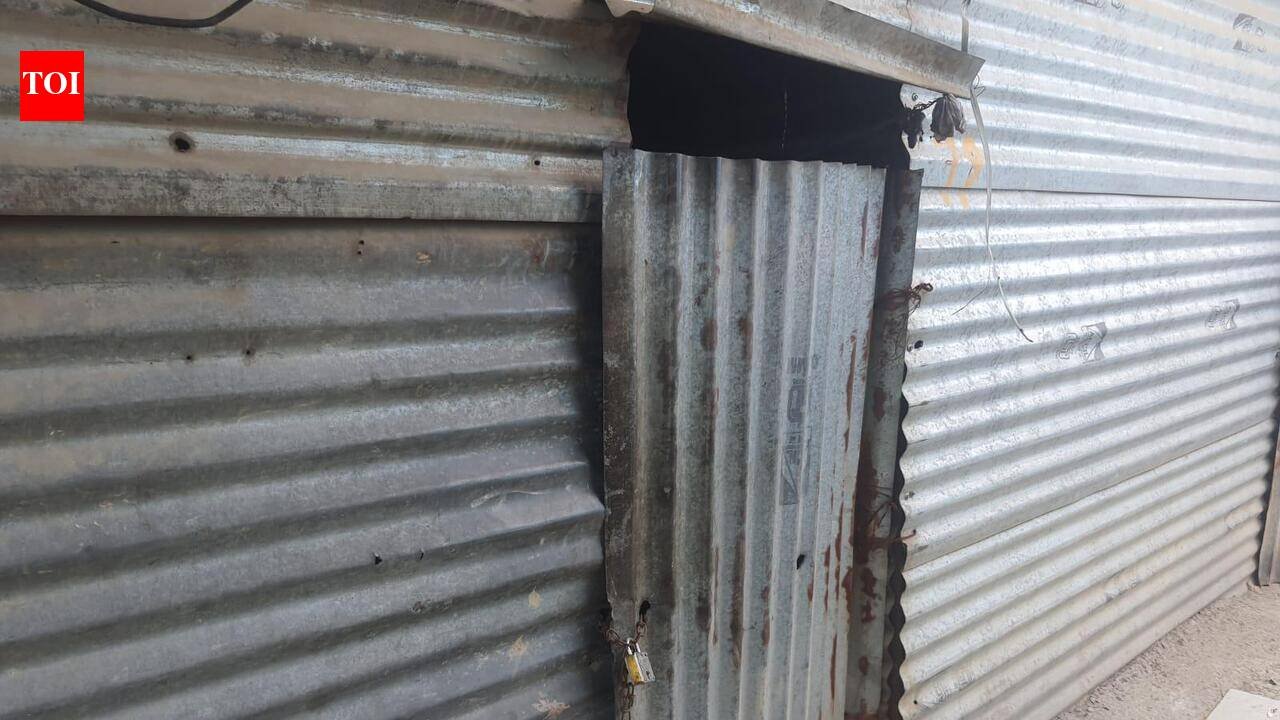
Ghaziabad: A tin sheet separates a jhuggi settlement from a mall being built 200 metres away, where a seven-year-old girl was raped, savagely assaulted and murdered earlier this month. The child was snuck away by two men, both workers at the mall site, people she knew.Nearly 50 families — mostly migrant workers from Bihar, West Bengal, Madhya Pradesh and Jharkhand, brought in by contractors to plaster, paint, and lay wires and bricks for the mall— live in rows of one-room shanties. Many of these families have two or three children. The rooms hold little more than a bed and a few utensils. Two washrooms at the end of the compound serve everyone, their gates left open and unattended. A single pipe supplies the water for cooking, washing and drinking.There is no crèche at the site. So, like the child who was raped and murdered, all other children living here are on their own through the day as parents go to work from 9 am to 5.30 pm. For most of the day, they play in ones and twos, dragging empty plastic bottles tied to string or simply passing around mobile phones.It is often the oldest children who fill in for the parents. Nandini, who came to the city from Madhya Pradesh, said her 14-year-old daughter looks after her two younger siblings when she is at work. “There’s no facility for us here,” she said. Since the rape-murder, she has told her children to stay inside, to speak to no one when she is away. “Everyone is a stranger here. We do not know who to trust,” she said. Her husband has suggested she stop working entirely, at least until they find someone to watch the children.Khushbo (26) from Bihar’s Saharsa district said staying at home was not an option for her. “We are poor people, we’ve come here for work, and if one of us stays back to look after the children, who earns for the family?” she said. “We cannot take them to the site. We work between bricks and cement.” She hopes to enrol her three children in a school, but the nearest one, a govt-run composite school, sits in the neighbouring Sikri Kalan village. A girls’ inter college lies four or five kilometres off, in Raj Nagar and Shastri Nagar. “For most families here, that distance is itself a kind of wall,” she said.Lal Babu, a migrant from Bengal with two children, said restrictions have also been imposed on the movement of labourers at the site since the incident. The only tin gate to the settlement closed after 6 pm, a measure, workers said, meant less to protect the families than to keep them from speaking to the media.“But there are many small girls here. They run to play around, and we cannot run after them all day,” Babu said. Many families, he said, were now weighing whether to leave altogether.The jhuggi where the murdered girl lived with her parents and two elder brothers for the past two years now stands locked. The family has moved out. Neighbours said no one had seen the two men lead her into the mall on the evening of July 11.The girl suffered more than 25 injuries, including 17 to her head and two fractures to her left leg, the autopsy found. She was allegedly assaulted with an iron rod before her body was thrown into a shaft from the mall’s third floor. Two labourers, Vinay Kumar (18) and Sahibuddin (22), have been arrested so far. Police said Vinay had often played with the girl and her brothers, offering them chips and toffees, and that both men lured the child on the promise of snacks and a soft drink. They were sent to judicial custody on Sunday.Nandu, another worker, said all they could do was pray that nothing happened to the kids while they were at work. “Since the girl’s death, my mind keeps going back to my own daughter, alone at home. Every evening when I come back, I check on her first before I even wash my hands,” he said.DP Singh, the security in charge at the site, said the workforce had thinned considerably since the incident. “Most of the workers have left after the incident, and more people are leaving every day,” Singh said. “Security has been tightened at all entry and exit points,” he said.Two guards now stand at the front entrance around the clock, frisking everyone who enters or leaves. At the rear entrance, closer to the jhuggi cluster, two more guards have been posted behind an iron barricade to control movement and keep out unauthorised visitors.Assistant labour commissioner Krishan Avatar said the site had passed an inspection two months ago, and that a fresh one would follow this week. The law, he acknowledged, requires toilets, water and a creche at sites where women bring their children to work, but says little about what is owed to families who do not merely work at a site, but live there. “Since they still fall under the ambit of the construction firm, we will get it checked,” he said.Under Section 35 of the Building and Other Construction Workers Act, 1996, a creche must be provided if there are 50 or more female workers at a construction site. It also requires the facility to cater to children below six years with trained caregivers and basic standards of hygiene, ventilation and accommodation. However, the obligation lies with the employer or developer, not the government. Currently, neither Noida nor Ghaziabad, both witnessing rapid expansion of residential and industrial projects, maintains data on the number of registered creches at construction sites.
In Noida, additional labour commissioner Rakesh Dwivedi acknowledged that compliance with creche-related norms at construction sites remained poor. “We have proposed certain changes to the existing rules, and we will get the number of creches at construction sites verified at the earliest,” Dwivedi said, adding around 900 creches at factory sites in the district are presently functional.Devendra Jha, founder of a Noida-based NGO People’s Association, said there was virtually no compliance with the mandatory creche provision at construction sites in both NCR cities. “Builders routinely violate these norms, pay the penalties if required, and continue without ensuring basic facilities for workers’ children. It is only after a tragic incident occurs that the issue receives attention,” Jha said.


