



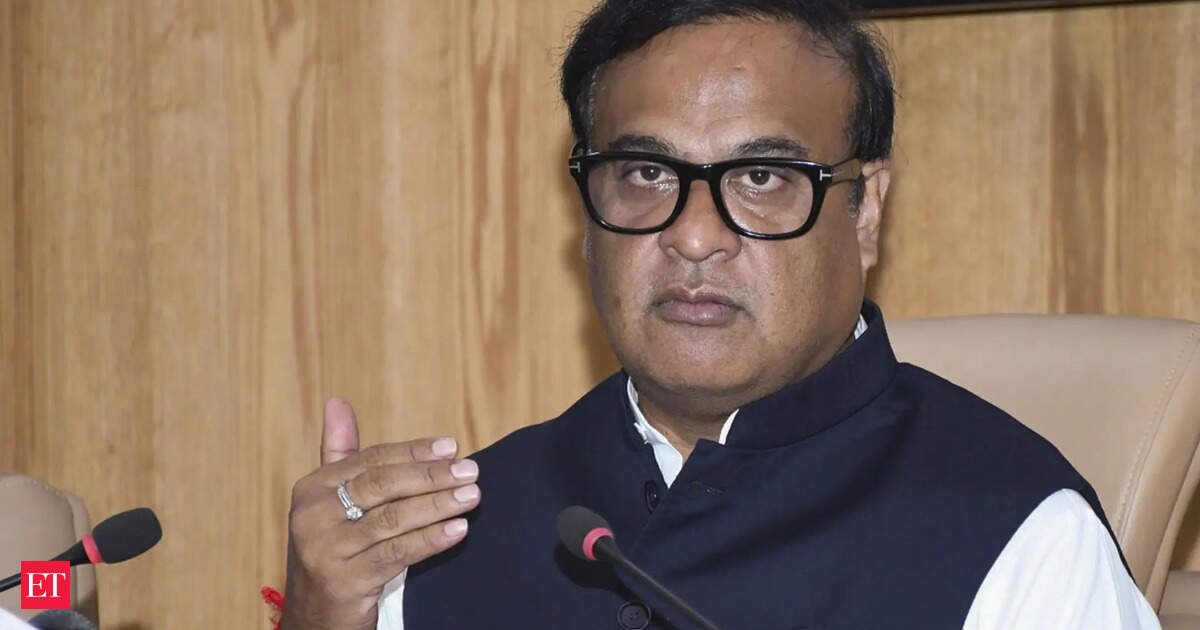
He also launched “Mukhya Mantrir Nijut Babu” scheme and virtually inaugurated 31 advanced “Udyog 4.0” Technology Centres across different parts of the State.
It may be noted that with the objective of easing the transition from education to employment, the State Government has launched the “Mukhya Mantrir Jibon Prerana” scheme. Under this initiative, 48,319 fresh graduates from public institutions in Assam will receive financial assistance of Rs. 2,500 per month for 12 months. This support will provide economic relief to young men and women preparing for competitive examinations or pursuing entrepreneurial ventures.
Moreover, to promote intellectual excellence in the state, financial grants have been extended to 212 research scholars under the “Mukhya Mantrir Jibon Anuprerana” scheme, including 13 Divyang (specially-abled) researchers. Through Direct Benefit Transfer, general research scholars have received a one-time assistance of Rs. 25,000, while Divyang scholars have been granted Rs. 40,000.
In an effort to prevent dropouts in higher education, the State Government has also implemented the “Mukhya Mantrir Nijut Babu” scheme from today. A total of 47,395 first-year undergraduate and postgraduate students from families with an annual income below Rs. 5 lakh will benefit under this scheme. Undergraduate students will receive Rs. 1,000 per month and postgraduate students Rs. 2,000 per month for 10 months in an academic year. It may be noted that earlier, over 2.5 lakh girl students have been benefited under the “Nijut Moina” scheme.
Further, to equip the youth with world-class skills, 31 state-of-the-art Technology Centres have been inaugurated today in 17 ITIs and 14 Polytechnics in collaboration with Tata Technologies Limited. These centres will offer courses in advanced manufacturing technology, automation, and digital design.
The Government aims to complete 24 more such centres by June this year.Sarma stated that approximately Rs. 3,000 crore has been jointly invested by the Government of Assam and Tata Technologies for this major initiative. He said that these ambitious projects mark a continuous effort to transform Assam’s conventional education system into a more outcome-oriented and future-ready framework. He further informed that an MoU with Tata NELCO will soon be signed to set up these Technology Centres in high schools and higher secondary schools across the state in phases.
The Chief Minister announced that Dassault Aviation will establish a special centre at Assam Engineering College in Guwahati, where students will receive training in aeronautical engineering and maintenance of Rafale aircraft. He also said that the establishment of Assam Skill University at Mangaldai will broaden skill-based education imparted through ITIs and Polytechnics. Institutions such as Kokrajhar University, the Indian Institute of Information Technology at Palashbari-Mirza, the Indian Institute of Management at Palashbari, and the National Forensic Sciences University at Changsari are set to provide new direction to the state’s education system.
Referring to the rapid rise of Artificial Intelligence (AI), the Chief Minister observed that AI is reshaping human intelligence itself. Tasks that once required consulting teachers can now be performed through platforms like ChatGPT and Gemini. From agriculture to forest conservation, AI has become integral to various aspects of life. In hospitals, robotic surgeries are becoming common, and in factories, robots are increasingly replacing manual labour. Speaking about his experience during his visit to Japan, he mentioned a semiconductor plant where chips are manufactured entirely through automated robotic systems, underscoring the growing demand for technology-driven skilled youth.
He further said that with the advent of 6G and eventually 10G technologies, doctors from the United States may remotely conduct surgeries at Guwahati Medical College. He noted that robotic surgery facilities are already available at GMCH, where surgeons guide robots via computers to perform operations. In this rapidly evolving world, he emphasized that merely earning degrees in conventional subjects may not guarantee employment. While 20 percent of students may continue to pursue core subjects, the remaining 80 percent must prepare for a technology-driven future.
The Chief Minister also stressed that special emphasis has been placed on advanced manufacturing technology and automation in ITIs to ensure that students remain competitive in a changing global landscape. He highlighted the need for skilled youth to operate automation systems in industries such as the Gas Cracker Project and Numaligarh Refinery. In collaboration with Tata Technologies, advanced Industry 4.0 labs have already been set up in various institutions. IIT Guwahati has introduced Data Science courses, and the Higher Secondary Education Council has developed an Artificial Intelligence curriculum along with teacher training programs.
He also informed that the Government is also establishing a semiconductor industry at Jagiroad and maintenance centres for Boeing and Airbus aircraft at Guwahati Airport. Hindustan Aeronautics Limited has set up an MRO facility at Nagaon’s Misa. Efforts are also underway to establish industries related to motherboards, chips, and solar panels in the State.
The Chief Minister reiterated that students must be provided not just education but relevant, employment-oriented training so that they do not have to wait for jobs after graduation. He stated that a transparent recruitment environment has been created, and over 1.60 lakh youths have been provided government jobs in the past five years. In the next five years, 1.5 to 2 lakh additional youths will be recruited, including 55,000 positions for teachers and professors. High-paying job opportunities in manufacturing industries across the country are being secured for ITI graduates, along with provisions for learning Japanese and Korean languages, the Chief Minister added.
Highlighting the Government’s commitment to addressing unemployment and preventing dropouts due to financial hardship, he stated that just as the “Nijut Moina” scheme supports girl students, the “Nijut Babu” scheme has now been introduced for boys. Under this initiative, undergraduate students will receive free admission and Rs.1,000 per month for 10 months, while postgraduate students will receive Rs. 2,000 per month. Moreover, under the “Mukhya Mantrir Jibon Anuprerana” scheme, students will receive Rs. 2,500 per month as stipend support, along with one-time grants of Rs. 25,000 for general researchers and Rs. 40,000 for Divyang researchers.
The Chief Minister concluded by stating that despite limited resources, the Government is continuously striving to build Assam as one family and urged everyone to make themselves relevant in the rapidly changing world


