






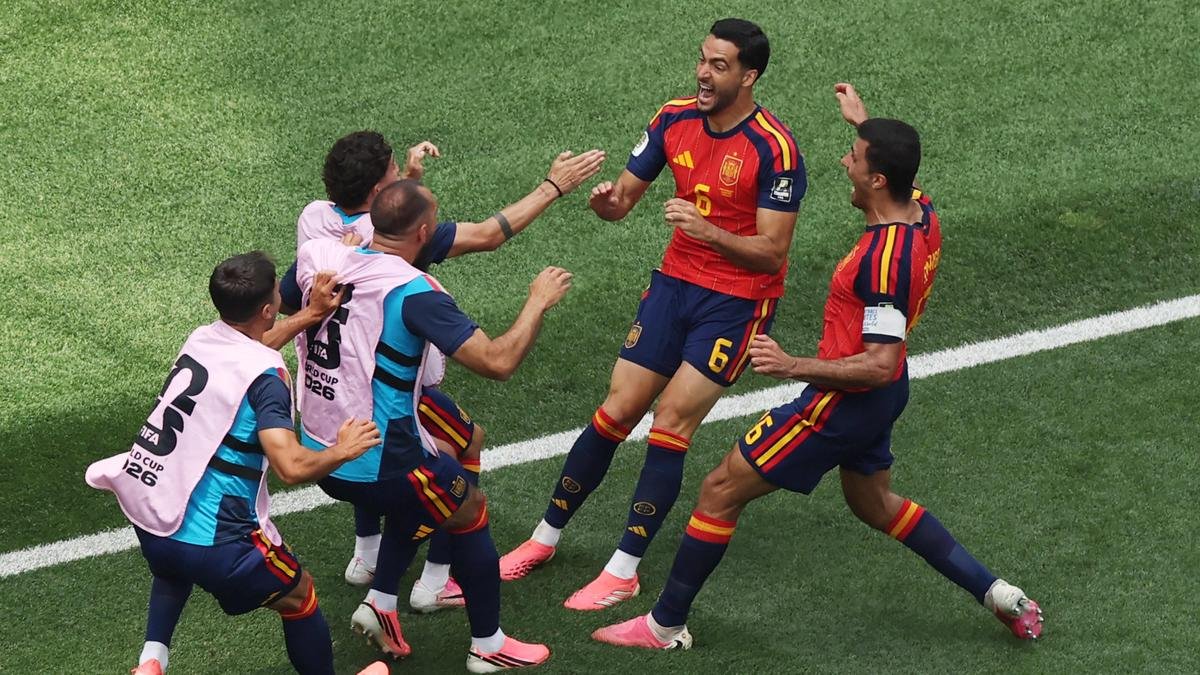
Mikel Merino celebrates with teammates after scoring the match-winning goal against Belgium.
| Photo Credit: AFP
Two knockout games. Two goals. Nine minutes of actual playing time between them. If you’re looking for the quickest route to World Cup folklore, Mikel Merino has just written the blueprint — and Arsenal, whether they meant to or not, built the cannon that’s firing it.
Merino arrived at the Emirates as a central midfielder — a ball-winner, a passer, useful but unremarkable in the final third. Injuries and Mikel Arteta’s tactical improvisation pushed him further forward, first as an auxiliary striker, then as something closer to a genuine centre-forward, scoring against giants like Liverpool and Real Madrid and other Premier League sides like Chelsea and Newcastle along the way. Arteta spent two years turning a midfielder into a finisher; Spain has spent two knockout games cashing in the dividend.
Against Portugal, Merino came on in the 85th minute and needed six to end Cristiano Ronaldo’s World Cup with an injury-time winner. Against Belgium, he waited until the 86th minute — and this time needed only 117 seconds to end Kevin De Bruyne’s career with Belgium, pouncing on a spilled save from Manchester United’s Senne Lammens for his second touch of the match. Two knockout games, two matches decided by a player who’d barely broken a sweat before scoring, and a piece of history nobody had managed before him: the first player to score a World Cup knockout-stage winner as a substitute in consecutive matches.
At this point, De la Fuente holding Merino back until the 80th minute isn’t a substitution — it’s Spain sitting on a wildcard and waiting for the exact right moment to play it. Two knockout games, two goals, nine minutes of work: that’s not a hot streak, that’s a cheat code, built patiently by Arsenal and now being cashed in with a World Cup on the line.
Published – July 11, 2026 08:50 pm IST


