



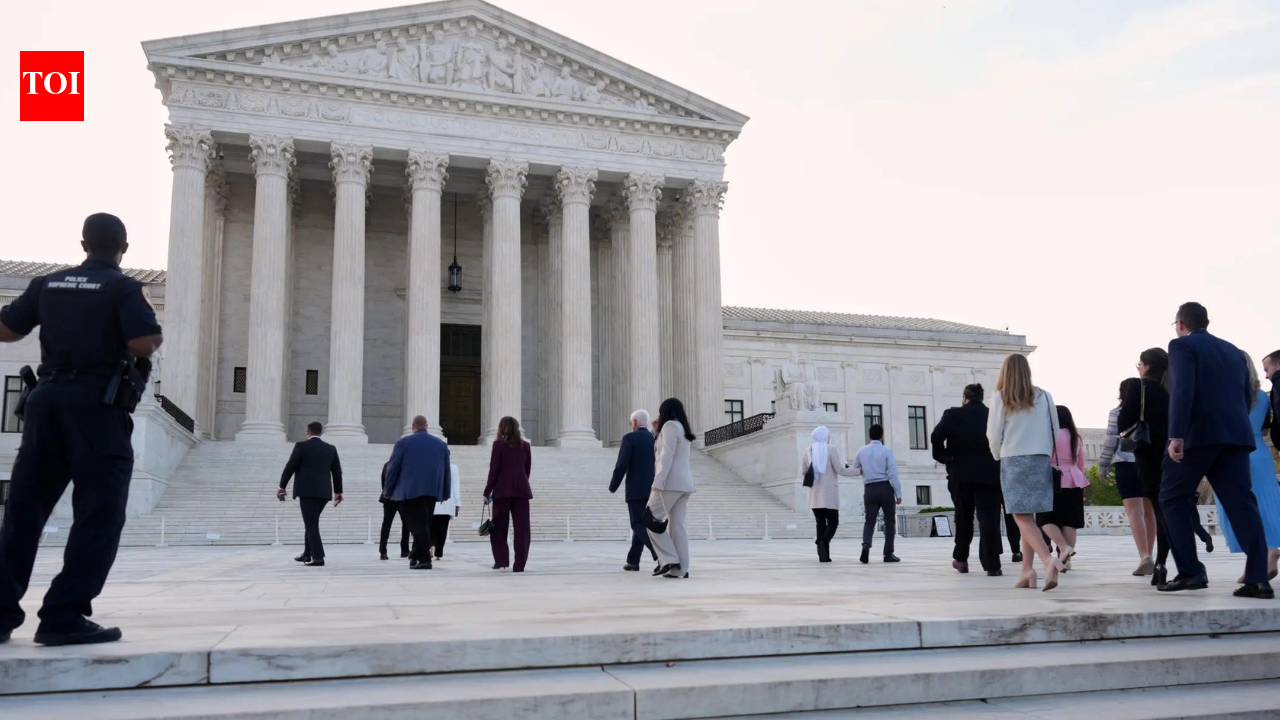
A coalition of South Asian advocacy groups has appealed to the US Supreme Court that curbing birthright citizenship could push thousands of children into “statelessness” and legal uncertainty, with disproportionate impact on Indian-origin families and the wider South Asian diaspora.Even before the executive order was signed by President Trump, TOI was one of the first news outlets to have stated that it would spell a huge set back for the Indian diaspora which is caught in a decades-long employment-linked green card queue. At least one parent would be required to be a US citizen or green card holder, else the child born in US would not get US citizenship.
Read also: https://timesofindia.indiatimes.com/business/india-business/citizenship-by-birth-to-be-curtailed-by-incoming-president-trump-will-impact-1-mn-indians-in-green-card-queue/articleshow/115010569.cmsBirthright citizenship has played a key role in shaping the Indian diaspora in the United States. According to an analysis of the US Census (2022) done by Pew Research, the US was home to about 4.8 million Indian Americans, of whom 34% or 1.6 million were born in the US (and became American citizens by virtue of birth).In an amicus brief filed in the ongoing case challenging an executive order on citizenship, led by the South Asian American Justice Collaborative (SAAJCO), organisations argued that the move undermines the long-settled guarantee under the 14th Amendment, which confers citizenship to those born on US soil.‘Revives era of contingent citizenship’The brief contends that linking a child’s citizenship to parental immigration status effectively reintroduces a system of “contingent citizenship”, a concept the amendment was designed to eliminate.Drawing on history, the groups pointed to the United States v. Bhagat Singh Thind ruling, delivered in 1923, which had held that Indians were not “white persons” eligible for naturalisation despite earlier scientific arguments classifying them as Caucasian. This judgment had led to a wave of denaturalisation, stripping South Asians of citizenship and exposing them to legal and economic precarity. The brief argues that ‘Thind’ is a cautionary precedent showing how citizenship tied to subjective notions of identity can be reversed (revoked), warning that the current order risks reviving similar uncertainty in a modern context.Impact on Indian diaspora, visa backlogsThe amicus brief underscores that South Asians, particularly Indians, would be among the worst affected due to structural features of US immigration law.An annual limit for employment-based green cards pegged at 1.40 lakh plus any unused family-sponsored green cards that are passed on to this category, with a per-country limit of 7% has led to a massive backlog for the Indian diaspora.Read also: https://timesofindia.indiatimes.com/world/us/citizenship-by-birth-curtailed-even-for-legal-immigrants-over-1-million-indians-in-green-card-queue-impacted/articleshow/117419508.cmsCiting studies done by Cato, the brief points out that Indians represent 63% of the green card backlog and thus bear most of the burden of this system. As of Nov, 2023, over 1.2 million Indians were waiting in the EB-1, EB-2, and EB-3 employment-based green card queues. Without reform, the Indian backlog could exceed 2.2 million by 2030. And new applicants from India will face a lifetime wait—indeed, more than 4 lakh will die before they receive a green card.Such children would fall directly within the scope of the executive order, the brief argues, exposing them to denial of citizenship despite being born in the country.Economic and workforce implicationsThe amicus brief also flagged broader economic fallout, noting that South Asians play a critical role in sectors such as technology, healthcare, transport and small businesses.Indian-origin professionals form a significant share of the US STEM workforce, while Indian Americans account for a disproportionately high percentage of doctors. Any policy that creates instability for immigrant families could deter skilled migration and trigger a “brain drain,” the amicus brief cautions.‘Legal limbo from birth’Perhaps the most serious concern raised is the risk of statelessness. The brief argues that many South Asian countries such as Nepal and Bhutan do not automatically grant citizenship to children born abroad, while bureaucratic and legal hurdles in countries like Afghanistan could leave children without nationality.Ending birthright citizenship could result in an estimated 255,000 children annually being born in the US without citizenship, it notes, adding that affected families would face complex documentation requirements and loss of access to basic services.“The result is legal limbo at the moment of birth,” the brief states, warning that such uncertainty could shape access to education, healthcare and employment for years.Call for court interventionThe coalition has urged the court to strike down the executive order, arguing that the Constitution does not permit citizenship to hinge on administrative interpretation.


