



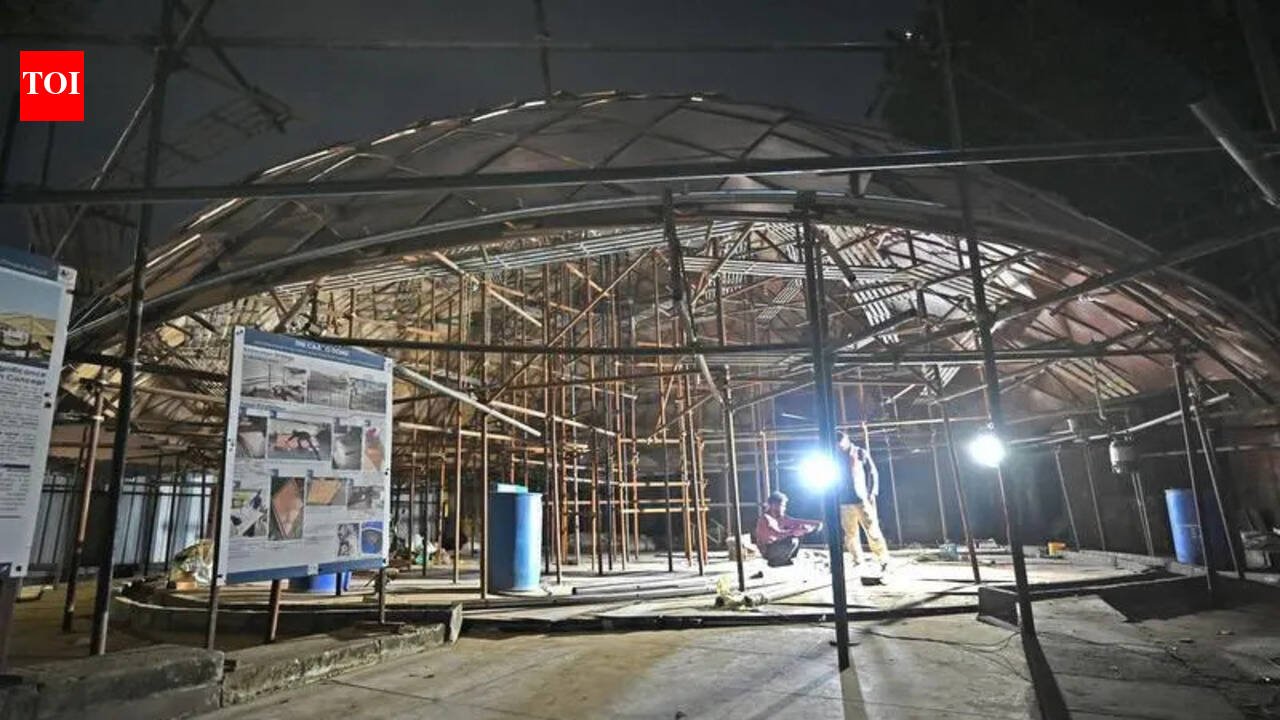
Ahmedabad: The restoration of the famed Calico Dome on Relief Road— widely regarded as India’s first experimental space frame structure or geodesic structure — is under technical review after a consultant’s report raised concerns that recent work may have diverged from the dome’s original design logic. Senior officials at the Ahmedabad Municipal Corporation say, “the findings are being examined and the restoration process remains open to consultation and corrective changes.” Built in 1962 as an exhibition space for Calico Mills, the dome is a significant marker of post Independence Indian modernism. It was conceived by Gautam Sarabhai, then chairman of Calico Mills and a key patron of modern design in India, along with his sister Gira Sarabhai, co founder of the National Institute of Design. Inspired by Buckminster Fuller’s ideas, the structure was designed as a lightweight, self supporting shell made up of 380 diamond shaped plywood panels that lock together through geometric precision rather than external support. Fuller was an American architect, engineer, inventor, systems thinker, and futurist, best known for inventing and popularizing the geodesic dome.A 15 page technical dossier submitted to the Ahmedabad Municipal Corporation (AMC) after a site inspection on March 24 records a breakdown not only in engineering discipline but also in project monitoring. The dossier has demanded “an immediate halt to the restoration,” a senior AMC official said. The inspection was ordered after construction activity began “without the knowledge or approval of the appointed Project Management Consultant (PMC), Vadodara Design Academy (VDA).” The report further states that “an unauthorized consultant had bypassed the appointed experts to issue new, unvetted drawings.”The official said the report also flags that key design elements — including rubber gaskets and structural sleeves intended to protect joints and allow controlled movement — “remain unused despite being integral to the original system.” According to the PMC’s observations, this could affect both durability and long term behaviour of the shell.The report further criticises the absence of the apex cap that locks the structure at the top. “Without the apex element in place, the shell remains structurally unresolved,” the AMC official said, quoting the dossier. It also questions the proposal to introduce a steel pipe framework above the dome, describing it as an external intervention that runs contrary to the principle of a self supporting shell. The dome was handed over to the AMC in 2009 following a Gujarat high court directive after Calico Mills’ liquidation. By then, the plywood geodesic structure had suffered prolonged neglect, partial collapse in the 2001 earthquake, and monsoon damage in 2003. The AMC assumed custody with a mandate to restore it as an industrial heritage landmark.Municipal officials emphasise that the inspection was commissioned at the AMC’s own insistence, after restoration work began without formal clearance from the appointed PMC. “The intent was to understand whether the work underway aligns with the original design,” the senior official said. “If deviations exist, they need to be discussed calmly and corrected where necessary.”Responding to criticism that the report outlines problems without offering solutions, the official said the administration was open to constructive engagement. “Consultation has to be forward looking. If experts are willing to guide how the project can move ahead while respecting the original design, the AMC is open to that. Any changes should be in the interest of the structure itself.”An experiment that combined mathematical precision, strengthPaul.John@timesofindia.com Ahmedabad: Barely a fortnight before its planned inauguration, the under-restoration Calico Dome is now at the the centre of a serious engineering debate. The structure, designed in the early 1960s by Gautam Sarabhai and Gira Sarabhai was an experiment in how materials could behave when used with mathematical precision and restraint.Sarabhai’s dome was conceived as a thin-shell concrete structure — its strength derived not from mass or internal columns, but from geometry. “The curved surface was designed to distribute its weight evenly across its shell, transferring loads smoothly to the ground through compression rather than bending. In simpler terms, the structure works like an eggshell — light, hollow, but remarkably strong when forces flow as intended,” says a senior AMC official.The dome relied on continuity. “Any interruption — extra supports, uneven thickness, or altered curvature — disturbs this equilibrium, rerouting stresses to places never meant to bear them,” said the official. Engineers familiar with the design point out that Sarabhai deliberately minimized reinforcements and avoided intrusive load-bearing elements, allowing form to perform the work that steel typically would. Restoration, by definition, demands intervention, but with experimental structures, even small deviations can carry consequences. “If stiffness is added in the wrong location, or if the shell no longer behaves as a single surface, it could harm the structure incrementally,” the official said.


