


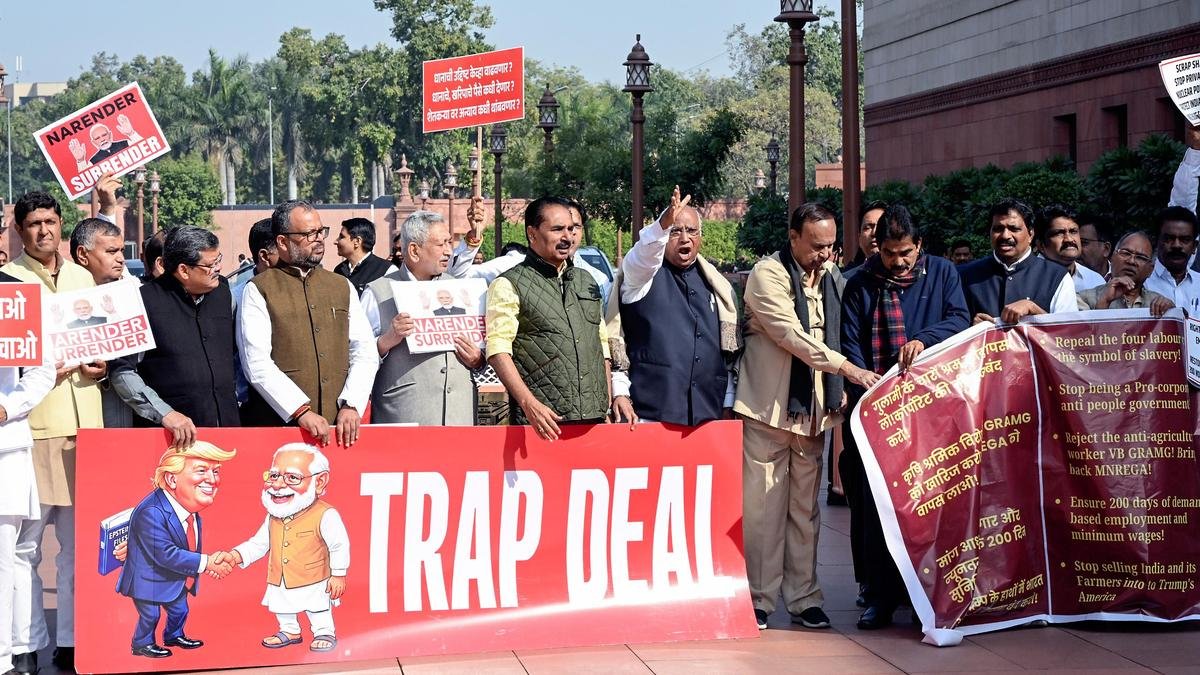
Congress President and Rajya Sabha LoP Mallikarjun Kharge with other opposition MPs protest outside Parliament’s Makar Dwar opposing India-U.S. interim trade deal, in New Delhi on February 12.
| Photo Credit: ANI
Almost a year after India agreed to launch negotiations for a bilateral trade agreement with the U.S., the two countries took the first step by agreeing on an interim agreement. This agreement ends a period of fractured ties between the two strategic partners that began in August 2025 when U.S. President Donald Trump imposed 25% tariffs on imports from India, and additional tariffs of 25% as penalty for importing Russian crude oil.
As per the interim agreement, the U.S. will reduce tariffs on India’s imports from 50% to 18% while India makes three significant concessions. First, India will eliminate or reduce tariffs and non-tariff barriers on its imports of all industrial goods and a wide range of food and agricultural products from the U.S. Secondly, India, as per Mr. Trump’s Executive Order issued alongside the Joint Statement, has made a huge commitment to stop “directly or indirectly” importing Russian oil (which Indian officials are yet to confirm). And finally, India has expressed its intent to “purchase $500 billion of U.S. energy products, aircraft and aircraft parts, precious metals, technology products, and coking coal over the next 5 years”. Mr. Trump has imposed this condition to ensure that henceforth, India cannot maintain the positive balance in its trade with the U.S., which it currently enjoys.
The interim agreement has found support in some quarters of the country. Advocates of the agreement point out that the reduction in U.S. tariffs would provide opportunities to Indian businesses to expand their presence in the world’s biggest economy. They argue that India’s labour-intensive products, especially textiles and clothing, would enjoy a competitive edge over the products of its neighbours in South and Southeast Asia since they face higher U.S. tariffs. But this purported advantage would be considerably diluted as the U.S. and Bangladesh have also announced their trade deal on February 9, under which certain textile and clothing products from Bangladesh would enjoy duty-free access into the U.S.
Protecting farmers interests
The interim agreement raises several uncomfortable questions on a wide spectrum of issues, from its likely impact on several key stakeholders in India, particularly farmers, to the ability of the Indian government to take sovereign decisions in critical areas.
One, the interim agreement does not explicitly state that India would not reduce tariff-sensitive agricultural products, especially cereals, as has been the case in all its Free Trade Agreements (FTAs), including the recent EU-India FTA. Does this absence of a clear statement that tariff protection on cereals would be maintained, suggest that India has yielded to Mr. Trump’s pressures to comprehensively open India’s agricultural market to U.S. agri-business? Serious doubts arose regarding this possibility when the U.S. Secretary of Agriculture, Brooke Rollins tweeted that the U.S.-India deal would help “export more American farm products to India’s massive market, lifting prices, and pumping cash into rural America”. The Government of India must ensure that the final deal with the U.S. unambiguously states that imports of cereals from the U.S. would not be allowed, which is the sole guarantee for protecting farmers’ livelihoods and also the country’s hard earned food security. This is also critical for the government’s credibility as Prime Minster Narendra Modi during last year’s Independence Day speech had assured farmers that their interests would be protected in a trade deal with the U.S.
Unanswered questions
Two, the interim agreement states that India would address the long-standing Non-Tariff Barriers (NTBs) to trade of U.S. food and agricultural products in recognition of the importance of working together to resolve U.S.’s long-standing concerns. The U.S. has consistently opposed India’s refusal to import Genetically Modified (GM) food products, long considered as India’s most significant NTB on food products. By agreeing to resolve “long standing concerns” in the interim agreement, has the government allowed imports of GM food products?
Three, why has the government accepted the most unequal trade agreement by eliminating tariffs and non-tariff barriers on U.S. imports, while allowing the U.S. to impose 18% tariffs on India’s exports? It may be noted that before Mr. Trump began his tariff war, average U.S. tariffs on India’s exports was around 2.5%, implying that India has allowed a seven-fold increase in tariff protection on its exports to the U.S. Four, why has India accepted such an unequal deal when the legitimacy of Mr. Trump’s tariffs are been questioned in U.S. courts, and, more importantly, when several countries, including Brazil and China have refused to yield to Mr. Trump’s pressures? And finally, why has the government allowed the Trump Administration to maintain surveillance on India’s oil imports? Mr. Trump has directed his administration to reimpose 25% additional tariffs if India resumes its Russian oil imports. This raises a much larger question; hasn’t the Government of India’s acquiescence opened the door for U.S. surveillance to extend to more sensitive areas that could challenge India’s sovereignty?
Biswajit Dhar is former professor, Jawaharlal Nehru University.
Published – February 16, 2026 08:30 am IST


