



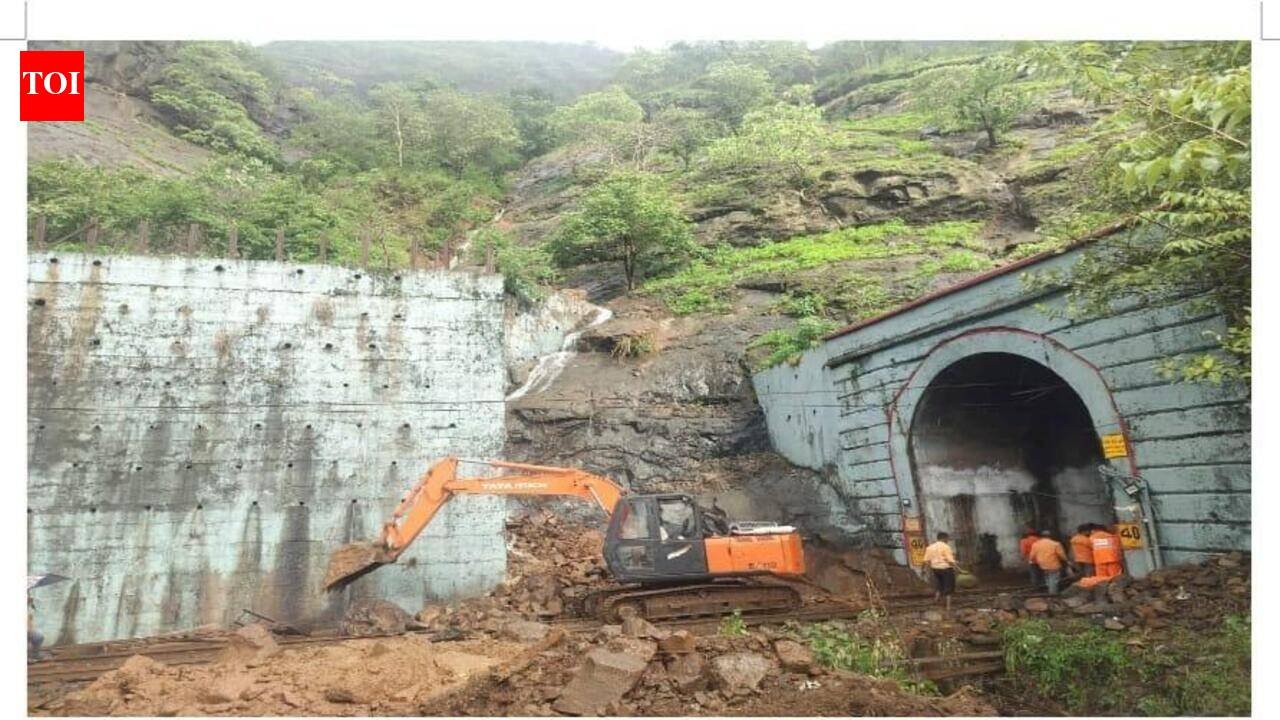
Pune: Rail operations on all three lines — UP, DOWN and MID — in the Karjat-Lonavla ghat section are fully functional, with the final UP line between Khandala and Monkey Hill being declared safe and reopened to movement on Monday evening, said Central Railway officials.The massive restoration efforts involved nearly 11,700 personnel working over 23 days.On Tuesday, Central Railway chief public relations officer Swapnil Nila said, “The UP line was certified safe and train services resumed at 6.42pm on Monday. Extremely heavy rainfall of 327mm on July 5, followed by 600mm-670mm on July 6, had triggered multiple landslides across the Lonavla-Karjat ghat section. It had severely disrupted train operations. All three lines were badly damaged, forcing cancellation, diversion, rescheduling, short termination and short origination of train services between July 6 and 28.” The disruption affected around 665 train services, he said.Nila said restoration teams battled relentless rain and treacherous terrain to restore connectivity. “The operation was an uphill battle against nature. Continuous heavy rainfall from July 6 triggered repeated landslides, boulder falls and large-scale embankment failures. Even after initial clearance, fresh muck repeatedly slid onto the tracks, hampering work. On July 8, fresh landslides occurred due to persistent downpour. In order to prevent further erosion and slope failures, engineers covered vulnerable hillsides with large tarpaulin sheets to block rainwater ingress and stabilise the terrain,” he said.The worst damage was reported on the Khandala-Monkey Hill UP line, where 10 critical locations were affected. The most challenging site involved a 130m stretch, where the embankment had subsided by up to four metre — leaving the track completely unsupported. On the Monkey Hill-Thakurwadi DOWN line, a massive landslide from a 200m-high hillside sent a huge boulder crashing into a retaining wall, causing its collapse and washing away nearly 50 metre of track formation to a depth of 20 metre.“It took over 11,700 personnel, 40 heavy machines and over 1.4 lakh man-hours to restore the section. Apart from the large workforce, an extensive fleet of machinery was deployed throughout the operation,” Nila said.The restoration required over 46,460 cubic metres of granular sub-base material and 2,600 cubic metres of boulders to rebuild and stabilise the damaged formations.While the MID line was restored on July 7 and the DOWN line on July 14, the UP line proved to be the most complex due to the scale of damage. “Permanent strengthening works are underway though train services have resumed on all three lines. These include the construction of 1,200mm diameter bored cast-in-situ piles and reinforced cement concrete retaining walls at vulnerable locations to improve long-term resilience of the ghat section,” Nila added.


