



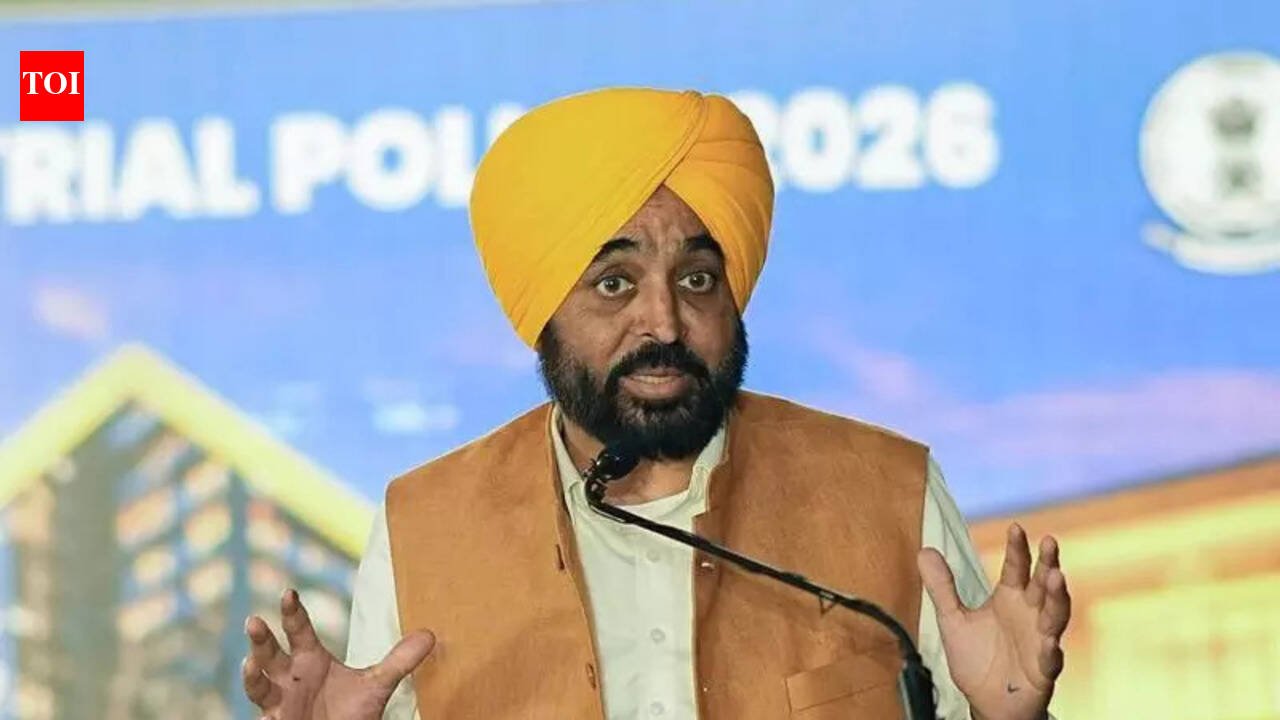
Chandigarh: Punjab chief minister Bhagwant Singh Mann unveiled the state’s new Industrial and Business Development Policy 2026 at an event in Ludhiana on Saturday, asserting that the state aimed to emerge as the country’s top investment destination through reforms and a flexible incentive framework tailored to industry needs.Mann, who was speaking to industrialists, explained why the policy allowed investors to choose up to 20 incentives and design customised packages suited to their business models. He said industries have different cost structures. “Pharmaceutical companies need different support than EV manufacturers. A data centre has different costs than a textile plant. The policy recognises these differences and allows incentives to be optimised for sector and scale,” he said.Highlighting another feature, Mann said the policy introduced capital subsidy for the first time in the state. “If someone is planning a Rs 100-crore plant, without capital subsidy the entire investment is their risk. With capital subsidy, the government co-invests a portion upfront, reducing the capital at risk.”He said the policy also addressed a gap in traditional industrial policies that focused mainly on new investors. “Most policies are designed for greenfield projects and companies being wooed from other states. Businesses already operating are usually an afterthought. The new policy extends incentives to modernisation and expansion projects as well.”Mann said the policy provided long-term stability, with incentive support of up to 15 years, longer than the typical five-to-ten-year window in many states. He added that the definition of fixed capital investment (FCI) has been expanded to include land, labour housing, R&D facilities, effluent treatment plants, sewage treatment plants and zero liquid discharge systems.The chief minister said the policy also made incentives more accessible to smaller businesses by lowering the EGS eligibility threshold. “Punjab’s industrial backbone is not only large plants. It is the thousands of small manufacturers in Ludhiana, Jalandhar, Batala and Gobindgarh who employ 30, 40 or 50 people on thin margins. Bringing them within the EGS framework will support businesses that generate the most jobs per rupee of investment,” he said.He added the policy promoted inclusive employment practices, offering higher EGS support for businesses employing women, SC/ST and persons with disabilities, as well as for IT/ITeS and global capability centre (GCC) units.Mann said the govt had also introduced additional incentives to promote industrialisation in under-invested regions. “Twenty-five percent additional incentives have been provided for nine thrust sectors and for industries located in border and Kandi areas,” he said. “Punjab is now compensating investors for that risk in rupees, not reassurances,” he said.The chief minister also announced that several sectors will have dedicated policy frameworks, including IT/ITeS, GCC, EVs, ESDM, semiconductors, filmmaking and tourism, prepared through consultations with industry experts.


