






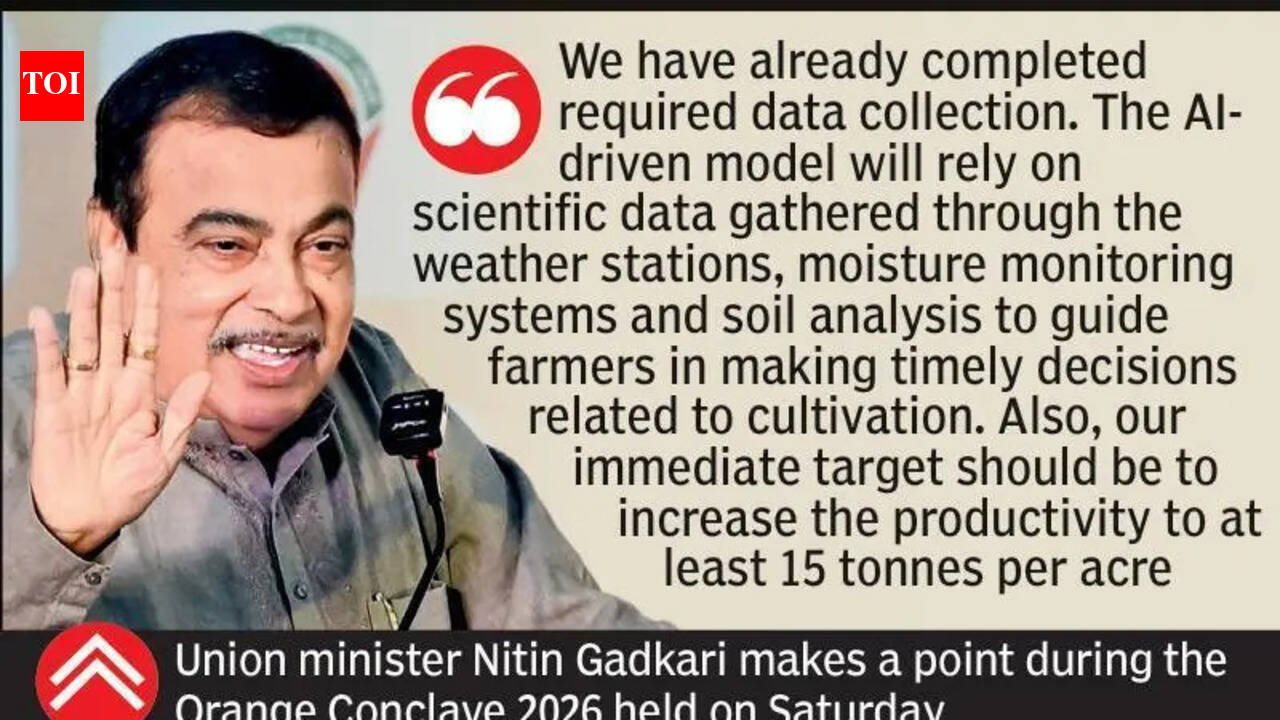
Nagpur: Union Minister Nitin Gadkari on Saturday announced that a comprehensive Standard Operating Procedure (SOP) integrating artificial intelligence (AI) with orange cultivation will soon be rolled out, aiming to significantly improve productivity, fruit quality, and farmers’ incomes across Vidarbha. Addressing the Orange Conclave 2026, organised by The Times of India and Maharashtra Times, Gadkari said the SOP has already been prepared, covering both new plantations and existing orchards.“We have already completed required data collection. Weather stations and moisture stations are essential for precision farming,” he said, adding the AI-driven model will rely on scientific data gathered through weather stations, moisture monitoring systems and soil analysis to guide farmers in making timely cultivation decisions.Gadkari noted orange growers in Vidarbha currently produce only 3-5 tonnes per acre. “Our immediate target should be to increase productivity to at least 15 tonnes per acre,” he said. “Most nurseries today do not produce quality planting material. We need to develop at least 50 world class nurseries,” he said, adding discussions with minister of state Ashish Jaiswal have already taken place and a new nursery policy is expected to be announced soon.Gadkari revealed 268 farmers have already enrolled in the AI based orange farming initiative and that an Agrovision lab and training centre will soon be established to train growers in scientific cultivation practices. Estimated cost of implementing the AI package is around 20,000/acre, but he assured farmers savings and increased yields would allow them to recover the investment within 1-2 years.He called for dedicated orange stalls at airports and stated Mother Dairy’s 1,000crore orange processing project, now approximately 70% complete, would help create value-added products using Nagpur oranges.Scientist Vivek Bhoite from Baramati’s Krishi Vigyan Kendra said that the team, in collaboration with Microsoft and Oxford University, developed India’s first AI based crop management model after analysing over 100 years of sugarcane data collected from ICAR and other research institutions. The platform integrates soil test reports, satellite imagery from Sentinel satellites, GPS mapping, weather stations, field sensors and farm-level observations to generate a 3D digital blueprint of every farm. The AI then provides farmers with precise recommendations on irrigation, fertiliser application, pest and disease management, and harvest planning.He added the model helped increase sugarcane yields from national average of around 38 tonnes/acre to 118-150 tonnes/acre in demonstrations, while reducing water usage by nearly 40%, saving about 1.5 crore litres.


