





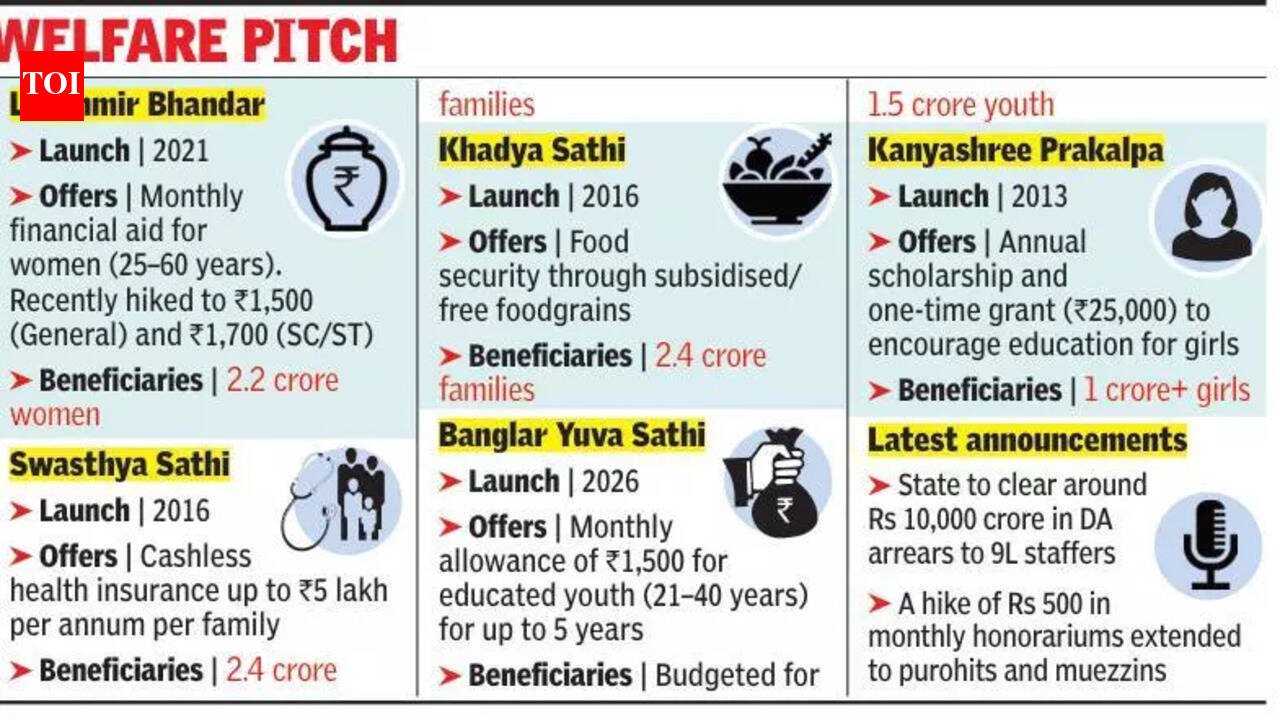
Kolkata: After hiking Lakshmir Bhandar amount and rolling out Yuva Sathi in the 2026 vote-on-account, CM Mamata Banerjee on Sunday put wind in Trinamool’s sail by announcing the DA arrears payout for state employees and hiking the monthly honorariums for imams and muezzins. These back-to-back steps, party seniors said, were aimed at offsetting any SIR-related fallout that party workers might have to battle until the late April elections.Even before the poll schedule was announced, mayor Firhad Hakim on Sunday began an election campaign in the Bhowanipore assembly constituency, which is represented by the CM. Hakim alleged that the BJP, if voted to power, would oppress the Bengali community and loot the state’s resources, adding that the very existence of Bengal was at stake. “BJP is coming here to oppress; it is coming to loot the state. Bengalis will be oppressed. Accounts will be settled, one by one. We tell our people that we must stand together, for we have to win back Bengal,” declared Hakim.Party seniors said that the four-and-a-half-month SIR phase has given them a chance to work closely with the people. Party spokesperson Kunal Ghosh said: “During the SIR process, people saw only Trinamool workers assisting voters. The BJP was nowhere to be found.”After the two-phase poll schedule was announced, the party appeared extremely confident. “Even if the polls had been announced in a single phase, we would have won. We are confident that Mamata Banerjee will return with a clear mandate for a fourth term, and our party will secure over 250 seats. With an eight-phase election, they managed only 77 seats. Even with a two-phase election, they will not get more than 27,” said Ghosh.The party is betting big on cash transfer schemes, which have re-emerged as the biggest talking point this poll season. When Lakshmir Bhandar — a monthly direct cash transfer scheme — was announced ahead of the 2021 poll season, it drew skepticism and occasional ridicule. But after her party rewrote electoral outcomes with it, the opposition chose to embrace the strategy aggressively. Despite occasional critique of “revdi” (freebie) politics, social schemes are now a permanent fixture as parties vie to win over women and economically vulnerable voters. The BJP, Congress, RJD, and AAP have all emulated such schemes.Economist Achin Chakraborty said welfare programmes provide crucial support to low-income households in a state where stable employment remains scarce. “The criticism that cash transfers discourage work does not hold strongly in this context,” he said. Chakraborty expressed concern about the youth allowance scheme, noting that identifying unemployed individuals in India is difficult because work is often irregular and self-reported. “As a result, a very large number of people could become eligible for a youth allowance, which may expand far beyond initial estimates and create a significant fiscal burden,” he added.


