






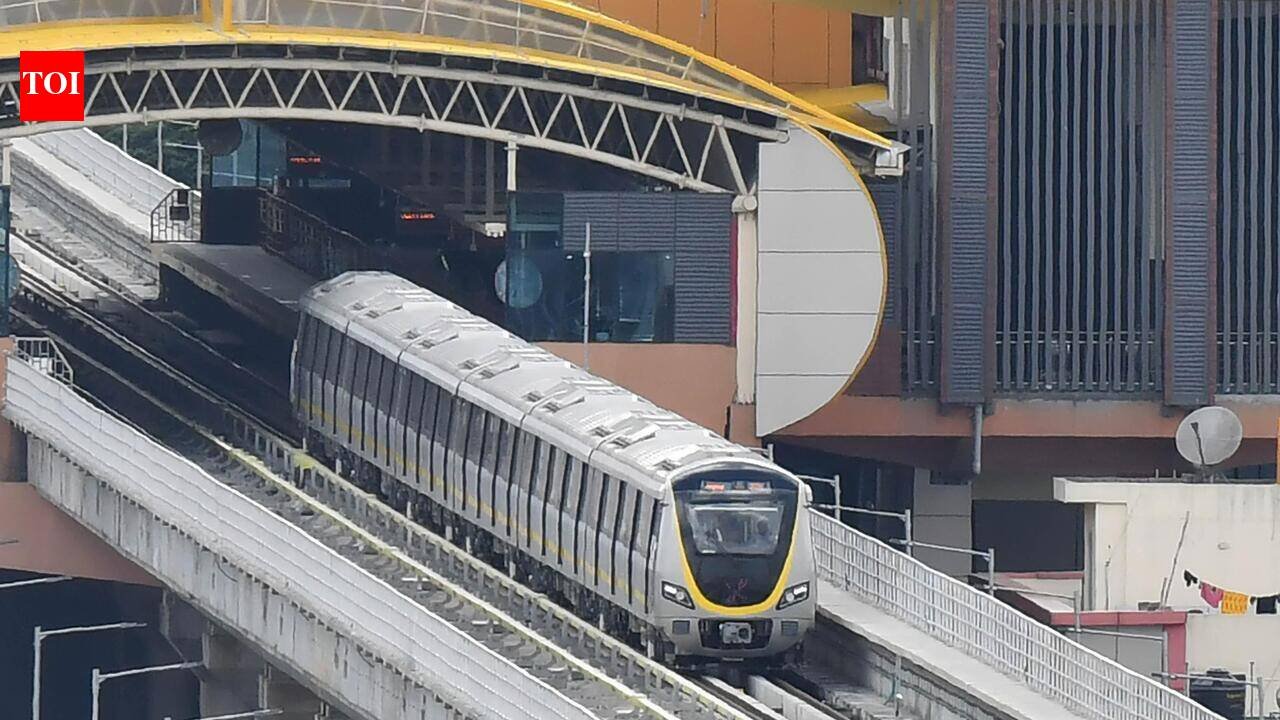
Bengaluru: A year after its launch, Namma Metro’s Yellow Line has emerged as a key public transport link to Electronics City, one of Bengaluru’s major IT corridors.In its first year of operation, the 19km line has carried over 3.8 crore passengers, translating to an average daily ridership of more than 1 lakh. The steady rise in patronage has come despite the line initially operating with only three trainsets and a long frequency of around 35 minutes, owing to delays in the supply of Metro coaches.Bangalore Metro Rail Corporation Limited (BMRCL) started the commercial operations on Yellow Line in Aug 2025. Its chief public relations officer BL Yeshwanth Chavan said the average daily ridership during the first month of operations in Aug 2025, when services ran for 21 days, stood at 81,365. By July this year, the number increased to 1.2 lakh.The launch of Yellow Line also helped Namma Metro cross the 10-lakh daily passenger ridership mark on several occasions. However, the delayed supply of trainsets prevented BMRCL from operating the line at its originally planned capacity. BMRCL had initially planned to deploy 15 trainsets for full-fledged operations on the corridor. However, this did not materialise as scheduled, with Yellow Line’s 15th and final trainset received only in July this year.BMRCL now operates 10 trains on the line, with a frequency of around seven minutes during peak hours and 10 minutes during non-peak hours. Chavan said the induction of additional trainsets would allow the operations wing to further assess traffic demand. “With the induction of additional trainsets, BMRCL’s operations wing will assess the traffic demand and deploy an adequate number of trains on Yellow Line. This is likely to help reduce the peak-hour headway by around six minutes. Some trainsets will be kept in reserve to ensure operational reliability and to facilitate scheduled maintenance in accordance with prescribed requirements,” he said.Hosur Road stations drive ridershipBarring RV Road, the interchange station connecting Green and Yellow Lines, the highest passenger footfall on Yellow Line is being recorded at stations along Hosur Road.“Among the passengers, the highest number use the Metro to travel towards Electronics City, and higher footfall is being seen at stations located along Hosur Road,” an official said.Yellow Line has also triggered efforts by companies and industry bodies in Electronics City to encourage employees to shift from private vehicles to public transport. Biocon recently said that more than 1,300 employees participated in its Corporate Commute Nudge programme over three months from April and completed over 77,000 rides. The initiative helped avoid an estimated 99 tonnes of carbon emissions.Hical Technologies also rolled out a corporate commute initiative to promote the use of public transport among its employees, while Electronics City Industrial Township Authority (ELCITA) has been working on measures to improve first- and last-mile connectivity.A senior BMRCL official said Yellow Line ridership is expected to increase as train frequency improves. “With increased frequency, the line is expected to attract more passengers. Once the Blue and Pink Lines become operational, the Namma Metro network will become a game changer as it will connect all the major IT corridors of the city,” the official said.“BMRCL is also engaging with companies to encourage greater use of public transport. In the future, the corporation is exploring partnerships with companies for co-branded smart cards and facilitating bulk purchase of cards for employees as part of efforts to promote public transport,” the official added.Over 15,900 use feeder buses dailyBMTC is also strengthening last-mile connectivity along the IT corridor by operating feeder services from several Yellow Line stations. Officials said BMTC currently operates 28 scheduled feeder services, making close to 300 trips a day. More than 15,900 passengers use these services daily.Among the feeder routes, Electronics City-Tin Factory service records the highest patronage, with more than 3,400 passengers using the route every day. A BMTC official said the feeder network was being operated based on passenger demand and Metro connectivity requirements, with services being reviewed to improve access to major employment hubs and residential areas along the corridor.


