



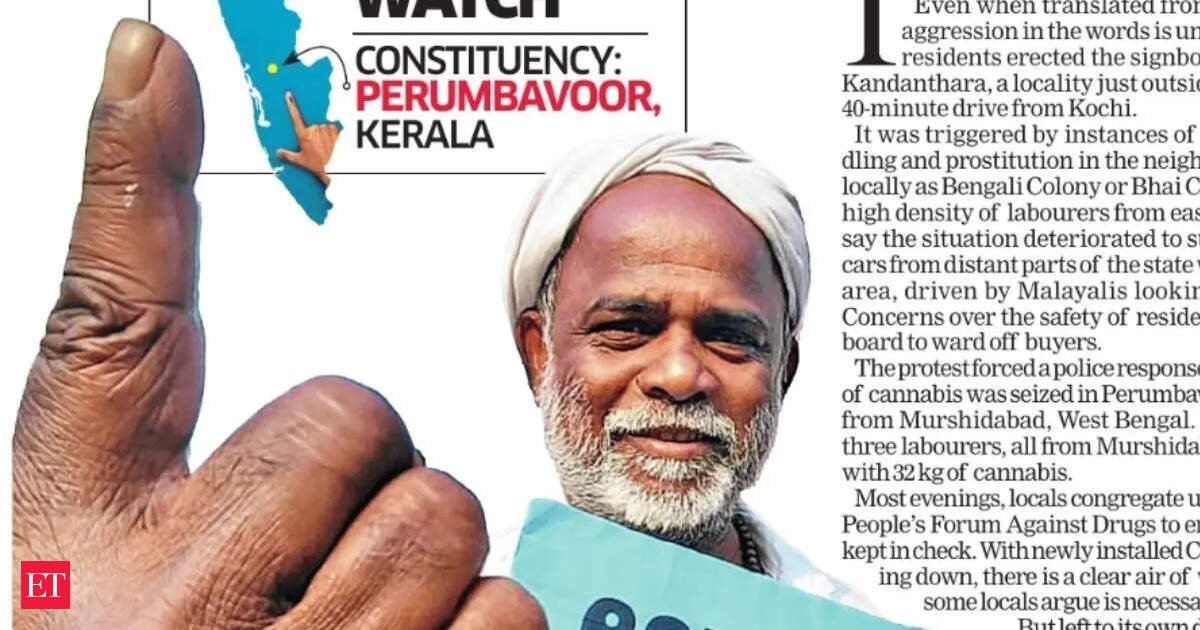
Even when translated from Malayalam, the aggression in the words is unmistakable. Local residents erected the signboard in January in Kandanthara, a locality just outside Perumbavoor, a 40-minute drive from Kochi.
It was triggered by instances of alleged drug peddling and prostitution in the neighbourhood, known locally as Bengali Colony or Bhai Colony, owing to the high density of labourers from eastern India. Locals say the situation deteriorated to such an extent that cars from distant parts of the state were spotted in the area, driven by Malayalis looking to score drugs. Concerns over the safety of residents led to the signboard to ward off buyers.
The protest forced a police response. In February, 51 kg of cannabis was seized in Perumbavoor from a worker from Murshidabad, West Bengal. Close on its heels, three labourers, all from Murshidabad, were arrested with 32 kg of cannabis.
Also read: Sabarimala issue: ‘Even God is not safe’ in Kerala, alleges FM Sitharaman
Most evenings, locals congregate under the banner of People’s Forum Against Drugs to ensure such trade is kept in check. With newly installed CCTV cameras peering down, there is a clear air of vigilantism, which some locals argue is necessary.
But left to its own devices, the friction bubbling beneath the surface in Perumbavoor could spark more trouble and dent the state’s efforts to cultivate an image of welcoming migrant labour and calling them “guest workers”. It exposes a failure to manage the predictable pitfalls of mass migration—ghettoi sation and a lack of social integration. The issue is systemic and needs systemic solutions.
Yet for all the unease evident in the town and surrounding areas, theissue doesn’t figure prominently in the elections, scheduled for April 9, as it should. The candidates of the major parties weren’t exactly brimming with ideas when asked about plans to tackle this friction.
Therein lies the problem. Perumbavoor embodies a contradiction at the heart of Kerala’s economy. The town depends heavily on migrant labour to power its industries, even as anxiety over crime, social integration and cultural distance fuels resentment among locals. With assembly elections around the corner, this tension has exposed a political blind spot—a problem that is too significant to ignore, yet too sensitive for parties to confront directly.
TIMBER BOOM
For decades, migration of workers to Kerala were mostly from neighbouring states. That changed in the mid-1990s. The trigger was a Supreme Court order in 1996, seeking to check massive deforestation, restricting forest-based plywood production. The plywood industry in Assam, which catered to a large slice of India’s requirements, was severely impacted.
For Perumbavoor’s struggling timber industry, this order was a boon. They saw an opportunity to use rubber wood from plantations rather than forest wood as raw material and converted local mills into plywood factories, with machines bought from Assam.
The labour-intensive industry didn’t excite Malayalis, and the companies had to mobilise skilled workers from Assam and unskilled workers from Odisha. Eventually workers arrived from West Bengal and the rest of the region as well.
Perumbavoor became a hub for migrant workers, with the area boasting the highest density of workers from other states. What started in this town eventually spread to the rest of Kerala, which has been suffering from an acute labour shortage.
Kerala’s ageing population makes migrant labour a necessity, not a choice. “There is hardly anybody to do physical labour. One out of four workers in Kerala is a migrant worker, and in the commercial hub of Ernakulam, they are one in two,” says Benoy Peter, executive director, Centre for Migration and Inclusive Development. Today, about 40% of the migrant workforce in Kerala is from West Bengal and about 20% from Assam, with other states making up the rest, says Peter.
Also read: Kerala polls 2026: 38% candidates face criminal cases; 39% crorepatis, says ADR report
A study by Panjab University, submitted to the Kerala State Planning Board in 2021, says the population of migrant workers could touch 5 million in 2030, from 3.2 million in 2017-18. Peter estimates the current number to be around 4 million.
Not all of these workers stay all year, with 80% of migrants believed to be moving for less than three months at a stretch. That means they are often underestimated in the National Sample Survey and the census’s migration data.
The big attraction for these job seekers, according to the study, is the relatively higher wage rates and the markedly better quality of life in Kerala. These days, plywood factories pay as much as ₹1,000 a day, which may be 3x what daily wage labourers get in West Bengal. In many cases, accommodation and food are taken care of as well, leaving most of what they earn as savings.
The arrangement has been mutually beneficial, and the prosperity evident around Perumbavoor—with massive villas—is built by this workforce.
Yet, over the last two decades, the integration of migrant workers into the local way of life has been less than ideal. While the government has tried to be welcoming by calling them “guest workers”, Peter believes that the term doesn’t reflect the essential nature of the workforce in Kerala and results in “othering”.
This lack of integration is often cited by locals and officials as a factor behind concerns over drug abuse, AIDS and prostitution. There is also a public health dimension. Local officials point to concerns around sanitation and access to healthcare among migrant populations. There have also been reported cases of HIV, which social workers say underline the need for better outreach and healthcare delivery.
A key problem in solving it effectively, a local says, is the lack of trust between the Malayali and the worker.
ELECTION PARADOX
It is against this backdrop that Assam, West Bengal and Kerala are all preparing for elections this month. For many businesses in Kerala—from restaurants to the timber industry—the upcoming election in Assam and West Bengal has brought with it a nightmarish situation.
With the Election Commission’s controversial Special Intensive Revision (SIR) of the electoral roll underway, many migrant labourers, 70% by some estimates, have left for their hometowns.
Many have been warned by relatives and politicians back home that their name would be deleted from the electoral rolls if they don’t vote this time. If that happens, the fear is that they will lose their citizenship.
SIR, an exercise intended to curb fraudulent voting, has become a headache for many who don’t have the requisite papers that will help them trace their parent’s or grandparents’ names in previous electoral rolls.
Meanwhile, some local officials suggest that around 10% of workers in Kerala might be Bangladeshis. While this is not officially verified, the claim is supported by one political party—Twenty20, which is part of NDA.
Over the past few weeks, a number of buses have departed from Perumbavoor, headed to the east of India, filled withmigrant workers who paid anywhere between ₹2,000 and ₹3,000 for the journey. The few who could grab a ticket in trains have done so.
For folks like Dileep (who refused to share his last name) from Malda, going back is a matter of survival, even if it means a three-day train journey and loss of wages. The fear of losing citizenship, lest he doesn’t cast his vote, is apparent on his face.
For local industries dependent on migrant workforce, the sudden outflow is a warning of how fragile the arrangement is.
MM Mujeeb Rahman, state president of the Sawmill Owners and Plywood Manufacturers Association, says 95% of plywood factories have had to stop work as the migrants are going home. “It is a major financial loss across sectors, not just plywood. We don’t have any option but to wait for them to come back.”
This also leaves the migrant population in a bizarre position—they don’t stay where they have a vote, and where they stay and earn a living, they don’t have a vote. This lack of political voice extends to their workplaces, as trade unions, traditionally strong in factories, are not keen because they are not part of the vote bank, leaving them further isolated.
This can contribute to the kind of conditions in which crimes, which the local population in Kandanthara had to fight back, take root.
Locals, fearing retribution by the police and politicians, also whisper about a nexus between lawmakers, law enforcement and some nefarious elements among the migrants. That allegation has gained traction especially after September 2025, when the Perumbavoor police seized 9.5 kg of marijuana from the home of a police officer in Kandanthara.
BALLOT BLIND SPOT
With assembly elections around the corner, you would think this issue would be high on the agenda for candidates in Perumbavoor and neighbouring Kunnathunad. Inexplicably, it is not.
Some of the reticence to use this as an election plank may be due to the sensitive nature of migration and the ease with which it can be manipulated to score political points.
PV Sreenijin, MLA from the Kunnathunad constituency who is contesting again on a left front ticket, admits it is a major issue but says he has refrained from dragging it into the muddy slope of electoral politics. “This is a nuanced issue and requires deep thinking to find the right solution. Making it an election issue can make it difficult for people to see such nuance.”
Manoj Moothedan, Congress candidate in Perumbavoor, says this isn’t an electoral issue but a social issue that is brewing for quite some time, one that has to be tackled after the elections.
Sabu M Jacob, MD of Kitex Garments and chief of Twenty20 Party, is less guarded, as is his candidate for Perumbavoor, Jibi Pathickal. Their poll promises include well-maintained labour camps and verification and strict registration of migrant labourers.
Sreenijin says there is a need to create a framework to integrate the workers better into society: “We would want to treat them the same way workers from Kerala were treated in the Gulf.”
Jacob’s pitch for “verification and strict registration” appeals directly to the “vigilante” sentiment, while the Left Democratic Front (LDF) and the Congress-led United Democratic Front walk a tightrope between human rights and local anger. In a manner of speaking, it is a microcosm of the global migration debate.
Perhaps the sentiment that should guide this was best articulated by the auto driver Shukoor (name changed on request). “We need migrant workers because without them this town will die. They need these jobs because that is the only way they can improve their lives. We should look at them with less suspicion, and they should be open to integrating more with our way of life.”
As Deepak from Darjeeling, who is in his 40s and has worked across the country, says: “This is the best state I have been in. I just want Kerala people to suspect me less. I am willing to work hard.”


