



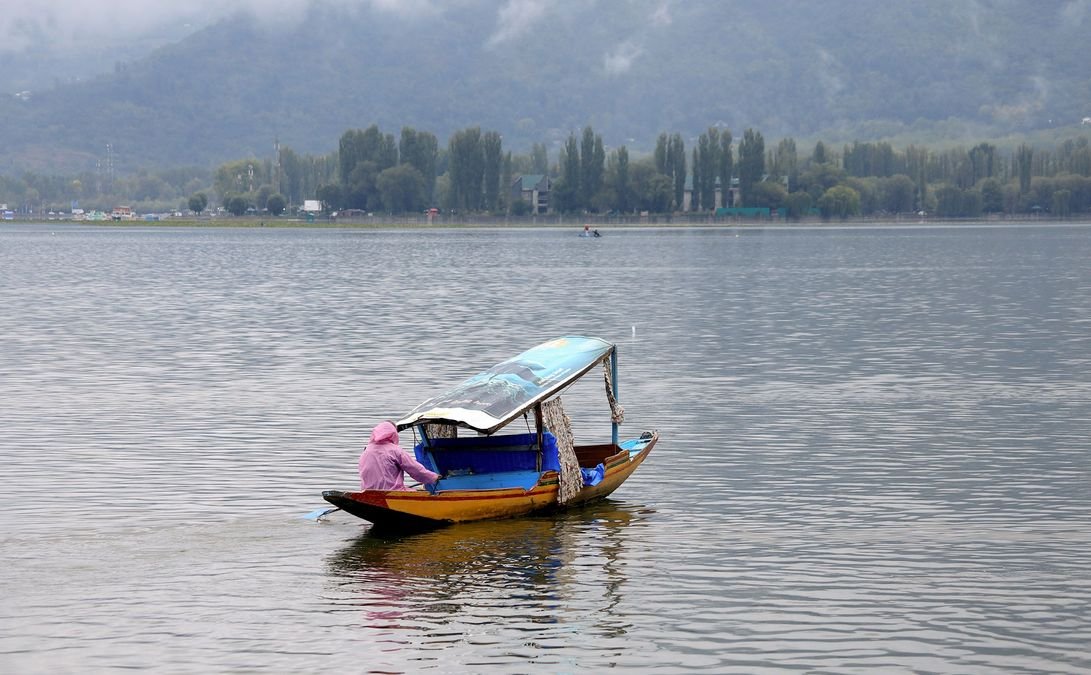
Srinagar, Sep 19: Winter appears to be knocking early in Kashmir, with temperatures dipping below normal across the Valley and the higher reaches turning distinctly colder, even as meteorologists caution that the present chill cannot be taken as an indication of how the entire winter will behave.
The latest data from the Meteorological Centre, Srinagar, show a widespread fall in temperatures. Srinagar recorded a minimum of 10.5°C on September 18, which was 1.5°C below normal. Gulmarg recorded 4.8°C, 3.1°C below normal, while Pahalgam settled at 5.2°C, 2.5°C below normal.
The chill was also pronounced at other stations, with Kokernag recording 7.4°C, 3.2°C below normal; Qazigund 8°C, 2°C below normal; and Kupwara 8.2°C, 2°C below normal.
Day temperatures also remained below normal at several places. Srinagar recorded a maximum of 26.5°C, 0.9°C below normal, while Gulmarg’s maximum of 15.2°C was 3.3°C below normal.
The early chill comes as attention turns towards the winter of 2026-27, with El Niño emerging as an important factor in the seasonal outlook. Director, Meteorological Centre J&K, Dr Mukhtar Ahmad, has said El Niño could favour a relatively mild and dry winter in Jammu and Kashmir, particularly during the latter part of 2026 and early 2027. However, he stressed that one or two strong Western Disturbances during the peak winter could significantly alter the precipitation picture.
“One or two active spells of Western Disturbances might reverse everything as far as precipitation is concerned,” Ahmad said, underlining that there is no one-to-one relationship between El Niño and winter precipitation in Jammu and Kashmir.
The Director MeT also noted that Kashmir has experienced relatively mild winters in recent years, with fewer cold days and longer dry periods, while stressing the importance of timely snowfall for the Himalayan region’s water resources and ecology.
Sonam Lotus, Director Meteorological Centre Ladakh, has sounded a similar note of caution, saying the El Niño influence has strengthened and global models point towards the possibility of a mild winter, but it is still too early to make a definite seasonal forecast.
“Although the El Niño effect is there and it has strengthened, we cannot say with certainty what the winter will be like two or three months in advance,” Lotus said, adding that a clearer picture is expected to emerge during October-November and with greater certainty closer to December.
Lotus has stressed that Kashmir’s winter cannot be explained by El Niño alone. The frequency and intensity of Western Disturbances, jet-stream configuration, moisture supply and other atmospheric circulation patterns will have a major bearing on snowfall and precipitation.
Climate expert Dr Touseef Ahmad Bhat links the changing weather behaviour to the broader climate changes being witnessed across the Himalayan region, where temperature and precipitation patterns are becoming increasingly variable.
The present weather therefore presents a striking contrast: Kashmir is already experiencing a taste of winter, even as the broader seasonal signals point towards the possibility of a warmer and drier winter.
Meteorologists say there is no contradiction. A few cold days in September cannot determine the character of the coming winter. The decisive phase will come later, when the winter circulation establishes itself and Western Disturbances begin to determine the Valley’s snowfall pattern.
For Kashmir, the stakes extend beyond the cold itself. Snowfall is an important source of water for rivers, streams and springs and contributes to groundwater recharge, while sustained snow cover supports agriculture, horticulture and hydropower.
As autumn deepens, Srinagar’s mornings are already carrying a sharper bite, while Gulmarg and Pahalgam have entered single-digit minimum temperatures. Winter may still be weeks away, but Kashmir has already felt its first chill. What remains uncertain is whether that chill will be followed by the snow the Valley needs.
