



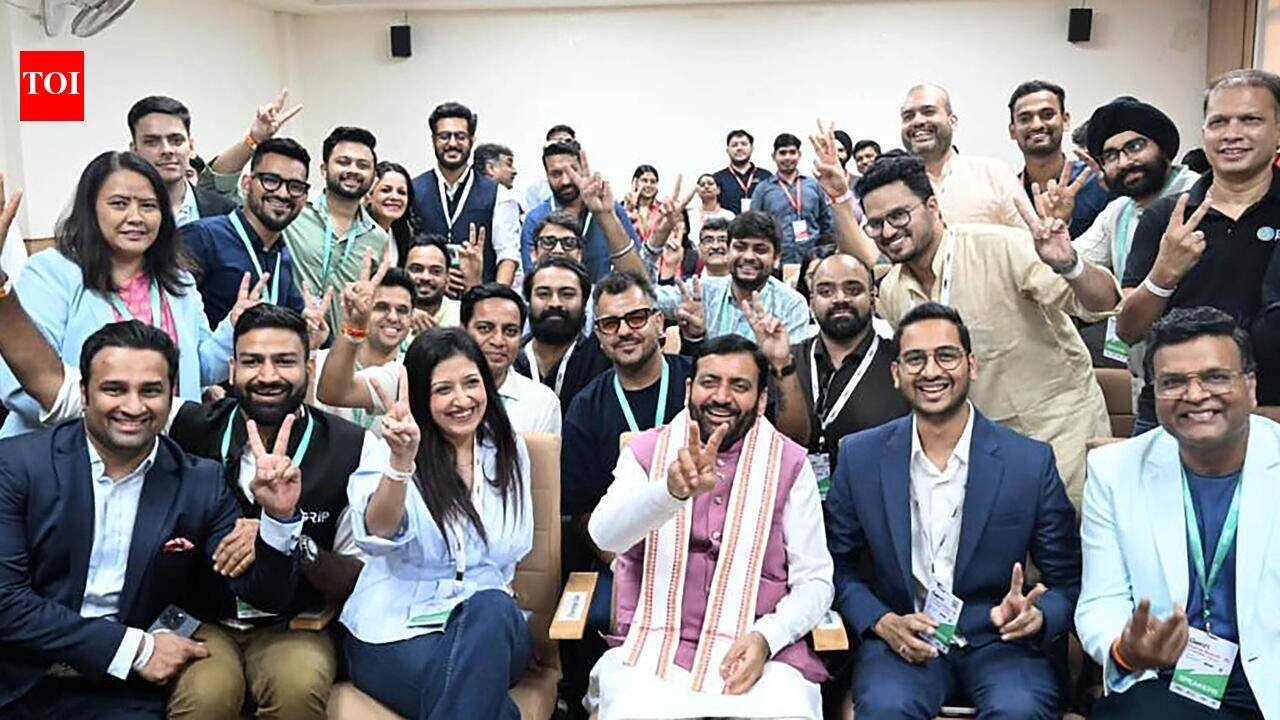
Gurgaon: Haryana is preparing to deploy a Rs 2,000-crore fund to plug a critical gap in its rapidly expanding startup ecosystem.Chief minister Nayab Singh Saini on Tuesday reviewed the progress of operationalising the proposed startup Fund of Funds (FoF) and directed officials to complete the process in a time-bound manner.Unlike a scheme under which govt directly gives money to individual startups, a FoF typically invests in professionally managed venture capital or alternative investment funds, which then invest in startups.Govt sees the FoF as a mechanism to support startups at “different stages of growth” while attracting private capital into the state.Govt is yet to disclose FoF’s detailed structure, including its fund managers, govt contribution, private-capital mobilisation target, investment criteria and the mechanism through which individual startups will ultimately receive funding. The scale of the proposed intervention is considerable against Haryana’s existing ecosystem.Startup Haryana currently puts the number of department of promotion of industry and internal trade (DPIIT)-recognised startups in the state at 11,000-plus, with eight govt-supported incubators/centres of excellence and more than 15 unicorns — the city has emerged as its dominant innovation hub, officials told TOI. A unicorn company is a privately owned startup that achieves a valuation of more than $1 billion.For the city’s ecosystem, FoF could be particularly important if it succeeds in attracting private venture funds and creating a deeper local funding pipeline.The concentration of startups in the city is particularly striking. A recent Startup India-register-based analysis puts the number of startups registered in the city at more than 10,000, underlining the district’s outsize role in Haryana’s entrepreneurial economy.An official told TOI, “The Rs 2,000-crore FoF could mark a shift from this grant-and-incentive approach towards institutional venture funding. Startups that have exhausted seed grants but are not yet large enough to attract major institutional investors often face a funding gap during the scale-up stage. A state-backed FoF could potentially address this by bringing more venture funds into Haryana and increasing the availability of follow-on capital.”Institutional venture funding refers to capital invested in high-growth startups by professional investment firms that raise and manage funds from large institutions such as pension funds, universities and other organisations.The move is significant because Haryana’s existing startup support framework has largely relied on relatively small-ticket grants and fiscal incentives.Under Haryana State Startup Policy 2022, eligible startups can get seed funding of up to Rs 10 lakh, while the policy also provides lease-rental subsidies, patent-cost reimbursement of up to Rs 25 lakh, 50% net SGST reimbursement for seven years and support for cloud storage and acceleration programmes.Govt has also been providing direct financial assistance through HSIIDC. In Jan, Saini said Rs 1.1 crore had recently been released to 22 startups, while early-stage ventures were being provided assistance of up to Rs 10 lakh each.This can help bring private investors alongside govt capital and potentially provide startups with larger pools of follow-on funding as they move from proof-of-concept and seed stages to scale-up.The state has been expanding its support architecture alongside the proposed fund.In Jan, govt announced entrepreneurship competitions in every district, with selected teams to receive Rs 1 lakh to turn ideas into business models.HSIIDC also plans incubation centres in its industrial estates, with land identified in three IMT areas.The state has also proposed a Rs 147-crore expansion of its startup-support framework.The proposed changes include 10% reservation in annual departmental procurement for eligible Haryana-based startups and matching grants of up to Rs 25 lakh for startups raising funds from private or angel investors.Women-led ventures have been proposed higher lease-rental support and thematic micro-grants.Govt has also sought to broaden the startup ecosystem beyond the city. It has proposed incubation facilities in HSIIDC industrial estates and entrepreneurship programmes across districts, while more than half of Haryana startups are reported by chief minister to have at least one woman director.
