


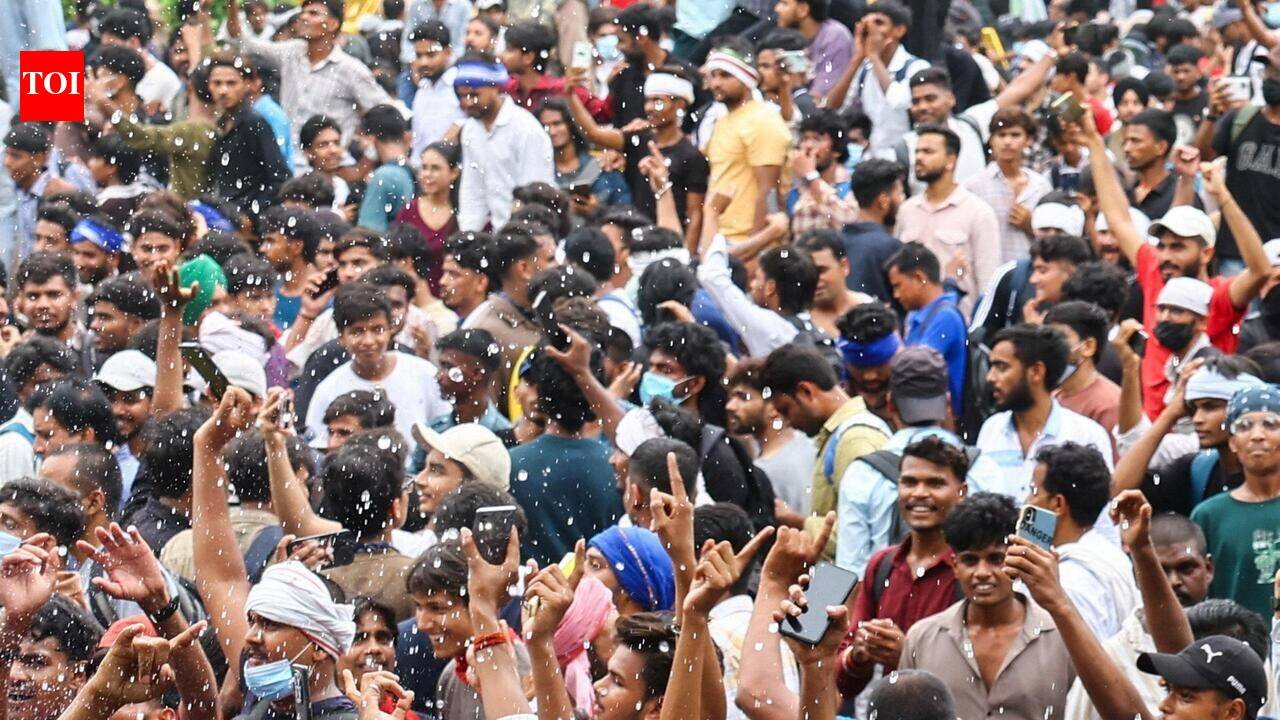
They slept on pavements through rain, humidity and heat, held their ground through lathi charges and tear gas, and refused to leave Jantar Mantar because, as one of them put it, “everyone knew this fight was bigger than one examination or one recruitment”.On Saturday, their primary demand was met. Union education minister Dharmendra Pradhan resigned in the midst of a storm over the NEET-UG paper leak — the latest in a series of examination controversies that brought hundreds of young people onto the streets since June 20. At the Cockroach Janata Party protest site at Jantar Mantar, founder Abhijeet Dipke announced his resignation was the movement’s “first victory”.
Jitendra Kumar Maurya from Prayagraj, who spent two nights sleeping on the street outside Jantar Mantar, said, Pradhan’s resignation was not the end, but only the beginning
“His resignation is not the end, but only the beginning,” Jitendra Kumar Maurya from Prayagraj, who spent two nights sleeping on the street outside Jantar Mantar, said.
CJP Jantar Mantar Protest Updates
“The movement started by Gen Z must continue until every deserving student in this country gets an equal opportunity based purely on merit.”Pradhan’s exit marked the first tangible institutional concession wrested by a protest movement that drew students from across the country — UPSC aspirants, UGC-NET candidates, state recruitment examinees — united by a shared experience of preparation undone by systemic failure. Paper leaks, cancelled examinations, opaque processes and the sense that merit no longer guaranteed anything accumulated into a collective grievance that found its voice on the streets of Delhi.A student pursuing economics honours at Delhi University, who joined the protest after watching people close to her navigate a system that had let them down, said, “I have a friend who wrote the May 3 NEET paper and then took a retest on July 16. She spent months preparing for the entrance exam. And I saw how frustrated she was after the first exam was cancelled.” Reforms, she said, should not be limited to just NEET, but also CUET and other competitive examinations.For many protesters from NCR, who had travelled to Jantar Mantar, the resignation was proof that their generation needs to speak up for themselves. “Pradhan’s resignation proves that sustained public pressure can force accountability,” said Arushi Bhargava (27), a communication professional from Noida who spent two days at the protest site. “The National Testing Agency, which has repeatedly found itself at the centre of controversies, must be fundamentally restructured. Students deserve an examination system that they can trust. This resignation should become the starting point for deeper reforms.”While the phrase “starting point” recurred in conversation after conversation, students at the protest site said it was now time to shift focus to the remaining demands — compensation for affected families and accountability for those responsible for the paper leak.Dhritiman Paul (24), a sociology postgraduate from Noida who has appeared for the UGC-NET multiple times, said the resignation felt like a victory because it acknowledged years of exhaustion among aspirants. “But a quiet resignation cannot replace accountability. We don’t want symbolic action. We want transparency,” he said.
Dhritiman Paul (24), a sociology postgraduate from Noida who has appeared for the UGC-NET multiple times, said the resignation felt like a victory because it acknowledged years of exhaustion among aspirants.
Paul said he has been at the receiving end of that missing transparency himself. “In June 2024, I travelled six hours to take the UGC-NET for sociology, only to return home and learn it was cancelled. This year, after preparing again, reports of another paper leak surfaced. It is heartbreaking and exhausting. These experiences are not just mine, but of thousands of us who have joined the movement. So, the protest is no longer about one exam or one paper leak anymore. It is about rebuilding trust in education and recruitment systems.”For Vikrant Rathi, a UPSC aspirant from Ghaziabad who was present at the protest on July 20, the resignation raised a more immediate question: who comes next? “It is important that the new minister genuinely understands education and is willing to make difficult but necessary reforms,” Rathi said.Late Saturday, the govt announced that cabinet minister Pralhad Joshi would take charge of the ministry of education. Joshi, a Lok Sabha MP from Karnataka’s Dharwad constituency, also holds the portfolios of new and renewable energy and consumer affairs, food and public distribution.
Arushi Bhargava, a communication professional from Noida who spent two days at the protest site, said the National Testing Agency, which has repeatedly found itself at the centre of controversies, must be fundamentally restructured
Maurya went further, tracing the movement’s demands beyond paper leaks to unequal access to quality education, caste-based discrimination in hiring, and financial pressure on families to pay for private schooling because govt schools lack basic facilities. “We need complete transparency from primary schools to higher education to recruitment for govt jobs. Discrimination based on caste, biased hiring practices and unequal access to quality education cannot continue. This resignation has opened the door, but unless the entire system changes, the movement cannot stop,” he said.Like her, DU student Samaira said, “I think this is the beginning of a domino effect. We’ve shown the govt that we can fight back.”Dev Anand from Prayagraj, who spent a night at the protest on July 24, put it simply. “For six years, my life has revolved around preparing for govt jobs. One resignation alone won’t change anything unless the system itself changes,” he said as he joined his friends to celebrate the “first win”.
