


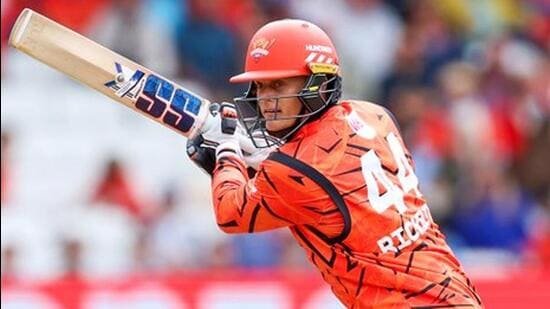
While IPL is a platform where ‘talent meets opportunity’, The Hundred’s position is less lofty. England’s answer to IPL is modest in scale, almost a knocked down budget version.
Customised to English conditions, The Hundred is more business-like and practical. Its tagline announces that ‘every ball counts’ and matches are shrunk, down from 120 to 100 balls. With matches scheduled on weekdays, the run time of Hundred games is three hours, the length of a movie or a music/theatre event. A 6.30 pm start is convenient from a television/broadcast and spectator viewpoint because people can leave office, drop in to watch cricket, and be home for dinner.
Like other leagues, The Hundred borrows generously from the IPL template – it’s essentially a copy-cut-paste job. The IPL model has been tweaked to make it look different, so bowlers bowl sets – not overs – of five or 10 balls. But the sameness is unmistakeable – the franchise owners are mostly Indians, the team names (MI Oval, Sunrisers Leeds, Manchester Super Giants) are carried over from India and even team jerseys look strikingly similar. This is what marketing gurus describe as clever brand extension.
Yet, for all the carbon copy attempts, The Hundred looks like a poor cousin of IPL. It lacks the noise and high energy of matches in India. During The Hundred games, both Lord’s and Oval looked as they always do – the elaborate ‘look and feel’ of IPL venues was missing and franchise branding was minimal, almost absent unless one searched for it with a sharp eye.
There was some music, some entertainment and attempts at crowd engagement at venues but spectators at Lord’s were attracted more to beer (Peroni, pint selling at £8) and traditional English sausage rolls costing £12. Flares went up to celebrate boundaries hit but the general feel, without cheerleaders and bhangra beats and dhols, was dull and unexciting.
Which isn’t surprising considering sport, especially cricket, in England sits within a different cultural and social space. In India an IPL game is essentially an entertainment option, an opportunity to eat, drink, take selfies and advertise your presence on social media. That’s why spectators keep one eye on the action in the middle, the other closely focused to catch the attention of roving television cameras.
This is a particularly unique Indian feature – for both ordinary fans and A list celebrities. An IPL game is a place to be seen, cricket is a place where fans and celebs shamelessly seek attention.
Cricket in England is vastly different. People go to watch, not to be seen. Good shots are applauded not by jumping and screaming but with polite clapping. Players receive generous praise and standing ovations but it’s unlikely that Dhoni–Kohli like chants will be heard for any player at Lord’s or the Oval. Initial evidence suggests The Hundred is only an upgraded version of the 20-over Vitality Blast (England’s Mushtaq Ali Trophy) because of the foreign players.
Cricket in England is a different ball game compared to India. Spectators have to be persuaded to attend games, ticket prices must be budget friendly and the stadium experience has to be friendly.
Will The Hundred transform English cricket’s commercial landscape and fast track its progress, as it happened in India with IPL? Looks unlikely, at least for some time. IPL was a game changer because it drenched cricket with money and masala to create an event that connected with fans and the corporate world. In England, sadly, these ingredients are not visible. The Hundred teams have struggled to find sponsors and commercial interest is low.
Franchise based leagues anywhere are cricket centric commercial, business initiatives. Teams and players are judged by stats recorded in the score book. But the balance sheet is no less important.
The big question then is: How will The Hundred rate on a scale of hundred?
