


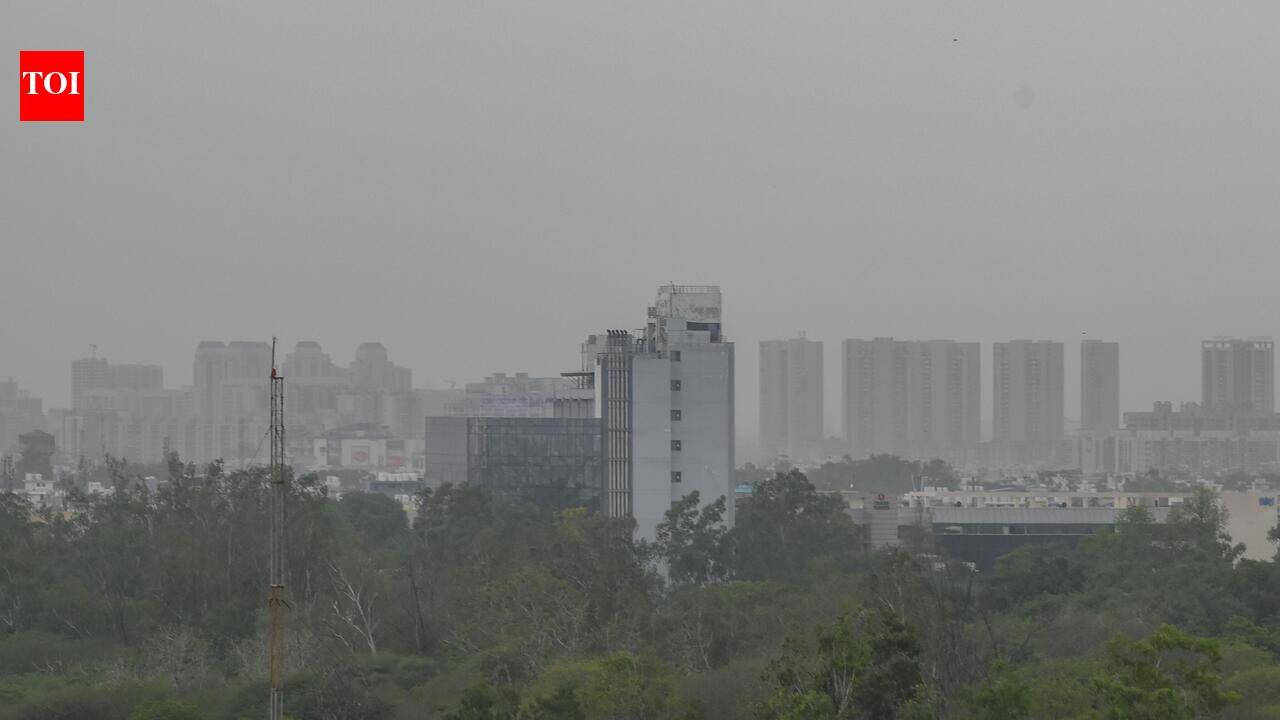
Gurgaon: Residents breathed ‘poor’ air for one in every three days in June. While June is typically among Gurgaon’s cleaner months before the peak monsoon sets in, pollution levels still worsened compared with last June even as the city escaped any ‘very poor’ air quality days this year.An analysis of daily air quality index (AQI) data from 2017 to 2026 shows Gurgaon recorded an average AQI of 175 in June this year, up from 161 in June 2025. More significantly, the city logged 10 ‘poor’ air days (AQI 201 -300), the highest for any June since 2022, when it recorded 12 such days.Air quality experts said the absence of ‘very poor’ days should not be mistaken for clean air. Experts said 10 days in the ‘poor’ category means residents were still exposed to pollution levels that can affect health, particularly children, older adults and people with respiratory or cardiovascular illnesses. The rise in the monthly average compared with last year also indicates that emission sources continue to exert pressure on the city’s air quality.Also, the comparison with last year is mixed. While June 2025 recorded a lower average AQI of 161, it also witnessed three ‘very poor’ air days (AQI 301 -400), compared with none this June. At the same time, June 2026 logged 10 ‘poor’ air days, more than double last year’s four, suggesting pollution remained persistent through much of the month even though it did not escalate into the ‘very poor’ category. Despite the deterioration, June 2026 did not witness a single ‘very poor’ (AQI 301 -400) or ‘severe’ (AQI above 400) day. The month’s highest AQI was 264, recorded on June 9 and June 10.The data suggests that while the city avoided prolonged episodes of hazardous pollution, improvements seen last year were not sustained. AQI remained in the ‘moderate’ category on 15 days and ‘satisfactory’ on five days, but repeated spikes pushed the index into the ‘poor’ category through the second half of the month.June averages over the past decade also reflect the city’s fluctuating summer air quality. The cleanest June in the period was recorded in 2021, with an average AQI of 121, followed by 2020 (135), 2023 (154) and 2025 (161). In contrast, June 2018 remained the most polluted, with an average AQI of 241, followed by 2017 (219) and 2022 (207).CREA air analyst Manoj Kumar told TOI, “In June 2025, only one monitoring station was operational and reported data, whereas this year all four stations reported data. The broader monitoring coverage provides a more representative assessment of air quality across the city and likely captures pollution levels that were underrepresented last year.”A senior Haryana State Pollution Control Board official said suspended road dust, vehicular emissions and construction activities continue to be major contributors to particulate pollution during summer. “Weather conditions may temporarily disperse pollutants, but unless dust control measures and emission reduction efforts are strengthened, the city will continue to witness pollution spikes even outside the winter season,” the official said.Experts said the findings reinforce that Gurgaon’s air quality remains highly vulnerable to local emissions. While winter continues to record the most severe pollution episodes because of stagnant atmospheric conditions, the increase in ‘poor’ air days this June suggests that cleaner summer air cannot be taken for granted without sustained action on road dust, construction emissions and transport pollution.According to Dr Abul Amir Khan, head, Amity Centre for Air Pollution Control (Amity University Haryana), this “decline in air quality coincided with a rainfall deficit”, as Gurgaon received only 29.8 mm of cumulative rainfall against the normal monthly average of 47.1 mm, along with a marked increase in the frequency and intensity of severe dust storms across Gurgaon and the wider Delhi-NCR.“June is typically one of Gurgaon’s cleaner months, preceding the onset of the peak southwest monsoon when rainfall and stronger atmospheric mixing help improve air quality. However, despite the absence of any ‘very poor’ air quality days in June 2026, overall air quality deteriorated compared with June of the previous year. According to available monitoring data, residents were exposed to ‘poor’ air quality on approximately one out of every three days during the month. The reduced rainfall likely limited the atmospheric scavenging of particulate matter, while enhanced dust storm activity contributed to elevated concentrations of airborne particles, collectively leading to poorer air quality despite June’s climatological tendency to remain relatively clean,” Dr Khan told TOI.
