


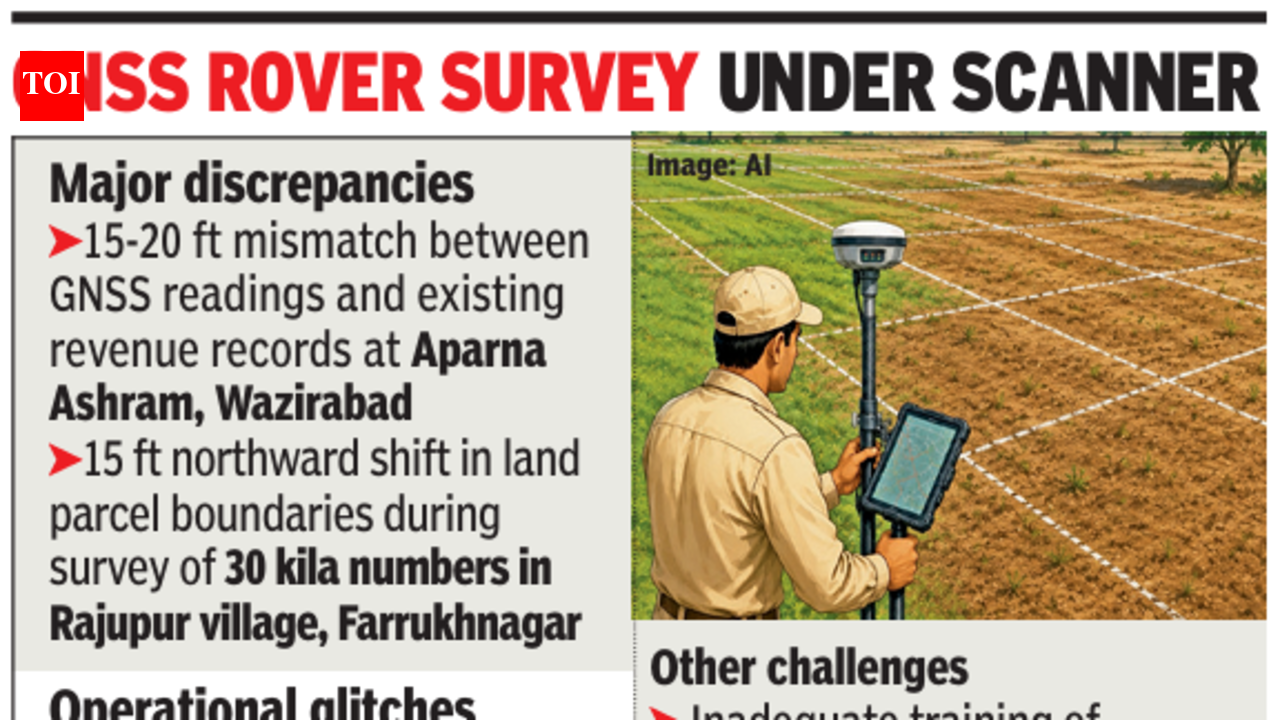
Gurgaon: Bought for several crores to settle land disputes with centimetre-level precision, the city’s satellite-based land survey machines have instead crash-landed into a maze of glitches, wrong readings and untrained hands.The fleet of 15 Global Navigation Satellite System (GNSS) rover machines — meant to modernise land mapping and bring accuracy to high-value property measurements — has been found throwing up errors not by inches, but by as much as 15 to 20 feet, during field checks, forcing the administration to seek urgent fixes.The discrepancies are significant in a city where land is among the costliest in the country and even a few feet can alter ownership claims worth crores.Deputy commissioner Uttam Singh has now sent a detailed report to the director of land records department, flagging serious flaws in both the machines and the way they are being operated.Gurgaon was given 15 GNSS rovers — two each for six tehsils and one each for sub-tehsils — to carry out satellite-linked surveys aimed at reducing property disputes and creating accurate digital land records. But field inspections between April 19 and 22 exposed major cracks in the plan.Under the supervision of district revenue officer Vijay Yadav, teams surveyed villages in Wazirabad, Badshapur, Manesar and Pataudi. The exercise tested the data accuracy of the machines, GPS and Continuously Operating Reference Stations (CORS) connectivity, geo-referencing and boundary demarcation.But what they found was worrying.In Wazirabad, a survey of land belonging to Aparna Ashram, conducted in the presence of tehsildar Gurudev, showed a mismatch of nearly 15 to 20 feet between GNSS readings and existing revenue records.A similar anomaly surfaced in Rajupur village in Farrukhnagar, where boundaries of several land parcels appeared shifted nearly 15 feet north in digital maps — at odds with both historical records and actual ground positions.Revenue officials warned such errors could trigger fresh disputes instead of resolving old ones.The problems were not limited to wrong measurements. Field teams claimed that the tablets were overheating under the sun, repeatedly losing GPS signals, taking longer to charge, getting sluggish at times and frequently crashing during surveys.Officials also pointed to a lack of training among officials operating them. Patwaris and kanungos said they struggled to operate the machines and interpret the data, sharply reducing their day-to-day utility.The administration has now recommended a complete hardware-software review and better training before the project is rolled out further.
