



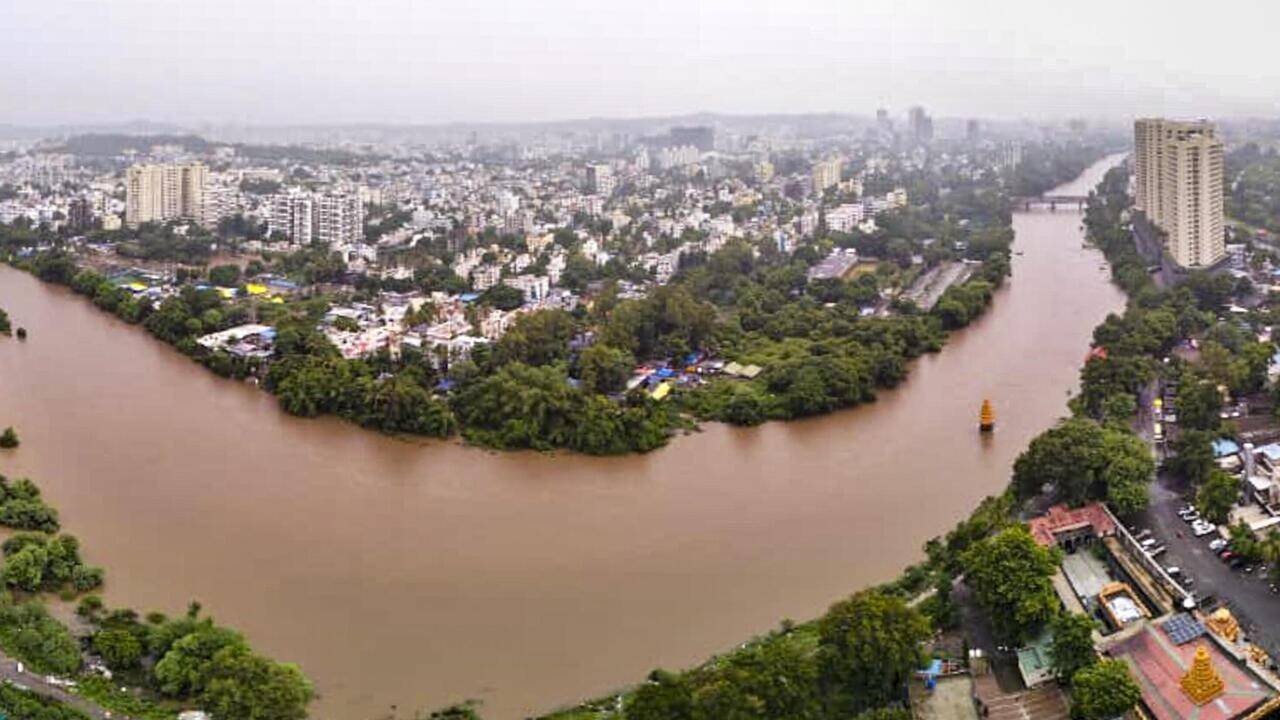
Pune: Just nine days after June ended with half its normal monsoon rainfall, Maharashtra has seen a complete turnaround — successive spells of heavy to extremely heavy rain wiping out the month’s deficit .The India Meteorological Department (IMD)’s seasonal rainfall summary for June 1-July 9 shows Maharashtra has received 315.4mm of rainfall against the normal of 300.4 mm, a surplus of 5%. The recovery follows an exceptionally wet first week of July, when widespread heavy rainfall lashed Konkan, the Western Ghats and parts of Madhya Maharashtra.The sharpest turnaround has been witnessed in Madhya Maharashtra, which moved from a 57% rainfall deficit at the end of June to a 20% surplus by July 9 after receiving 265.3 mm of rainfall against the normal of 221.9 mm. Konkan-Goa, which recorded several episodes of extremely heavy rainfall over the past week, has registered a 22% surplus, receiving 1,230.8mm against the normal of 1,012mm.Marathwada and Vidarbha, however, continued to lag and are still in the deficient category. Marathwada has received 129.4mm of rain against the normal of 181.6 mm, leaving it with a 29% deficit. Vidarbha has recorded a 16% shortfall with 216.6mm against the normal of 257.4 mm.Pune district has emerged as one of the biggest beneficiaries of the recent spell, recording 544.8mm of rainfall against the normal of 275.1mm — a 98% surplus. Palghar (105%), Mumbai suburban (90%), Mumbai city (73%), Nashik (59%), Raigad (55%) and Thane (42%) have also recorded excess or large excess rainfall.Several districts that were rain-deficient at the end of June have now returned to the normal category. Among them are Ahilyanagar (-5%), Dhule (-17%), Jalgaon (5%), Kolhapur (6%), Sangli (6%), Satara (4%) and Akola (10%).Hingoli continues to report a 52% deficit, followed by Gadchiroli (46%), Beed (44%), Solapur (39%), Jalna (36%) and Nanded (34%).Despite the sharp improvement in the state’s overall rainfall figures, the benefits of the recent downpour have been uneven.Achyut Patil, a farmer from Akola district which has entered the normal rainfall category with a 10% deficit, said the district-level figures “do not reflect the uneven distribution of rainfall” within the region. “We still need good rain. Crop germination has taken place, but the percentage is much lower than normal because of inadequate soil moisture. If the situation doesn’t improve, production could decline by around 20%. Everything now depends on how it rains over the coming weeks,” Patil said.“Rainfall has been extremely patchy, with some areas receiving torrential rain while others, just 40-50 km away, remaining largely dry,” he said.In contrast, Sachin Pawar, a farmer from Junnar taluka in Pune district, said the recent heavy rainfall has enabled farmers to finally begin sowing after weeks of waiting.“We had delayed sowing because there was not enough rain. There is no concept of sowing early or late if there is not adequate moisture in the soil. The temperatures remained very high till mid-June and the soil was too hot. Only after the recent rains did conditions become suitable for sowing,” Pawar said.He added that the rainfall over the past few days has improved soil moisture and lowered temperatures, allowing field operations to begin. “We have now received sufficient rain. and sowing has started. If there are one or two dry days, we can complete the sowing,” Pawar said.


