



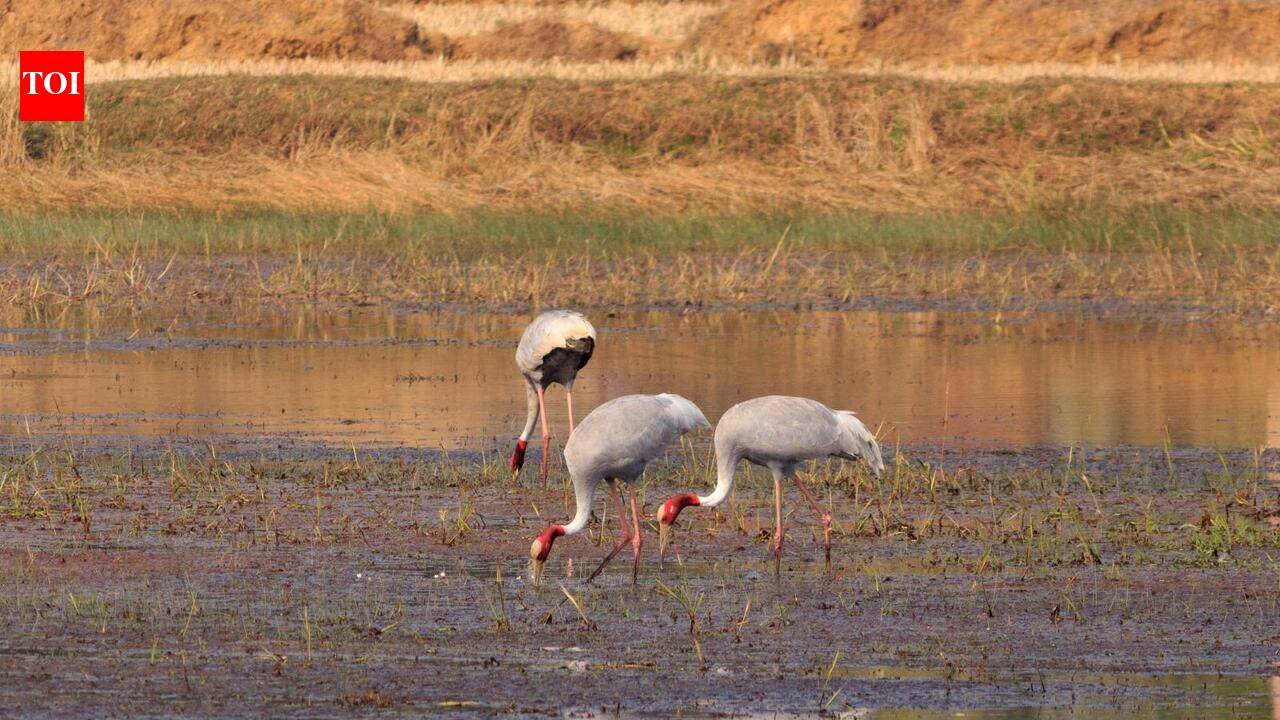
Chandrapur: A coordinated census conducted across the adjoining forest landscapes of eastern Maharashtra and Madhya Pradesh recorded a combined population of 82 sarus cranes, with 32 birds counted in Gondia district and 50 in the neighbouring Balaghat forest division.The synchronised exercise provided a clearer picture of the movement and distribution of the vulnerable wetland species across state boundaries.The latest figures indicated a notable rise from 2025, when Gondia recorded 30 sarus cranes and neighbouring Bhandara district reported four, taking the combined tally in the two Maharashtra districts to 34 birds. Balaghat district in neighbouring Madhya Pradesh recorded 48 sarus.The sarus crane, recognised as the world’s tallest flying bird, was considered an important indicator of healthy wetland ecosystems.The annual census was jointly organised by Gondia forest division and Seva Sanstha on June 20, covering 53 known sarus habitats across Gondia, Tirora and Amgaon talukas.Survey teams directly sighted 32 sarus cranes at 15 locations.Officials said some birds were observed flying into adjoining areas of Balaghat, prompting both states to coordinate their findings before finalising the count.A day earlier, Balaghat district in Madhya Pradesh, which shared ecological features with Gondia and was located immediately across the state boarder, recorded a healthy count of 50 sarus cranes under the supervision of senior forest officials, reinforcing the significance of transboundary conservation efforts between Maharashtra and Madhya Pradesh. The consecutive surveys enabled authorities to minimise duplication and improve the accuracy of the regional population estimate.A similar census was also conducted in Bhandara district at 18 locations under the supervision of DCF Yogendra Singh and simultaneously in Gondia, but its final figures were not available at the time of reporting.Around 35 survey teams, comprising forest personnel, Seva Sanstha members, sarus conservation volunteers and local farmers, participated in the Gondia exercise. Nearly 140 to 150 people carried out field observations between 4.45 am and 9 am at identified nesting and resting sites.“To improve accuracy, teams monitored selected habitats for two to three days before and after the official census, ensuring repeated sightings of the same birds were not counted twice. Human movement near riverbanks and known Sarus resting sites was also restricted during the survey period with the support of the district police,” said Sawan Bahekar, President of NGO Seva Sanstha, which actively participated in the census.Officials said the census served as an important scientific exercise for monitoring Sarus crane populations and planning future conservation measures.The survey in Gondia was conducted under the guidance of deputy conservator of forests Pawan Jong and Seva Sanstha president Sawan Bahekar, while the Balaghat exercise was supervised by CCF Gaurav Pardhi and DCF Nithiyanantham L.


