



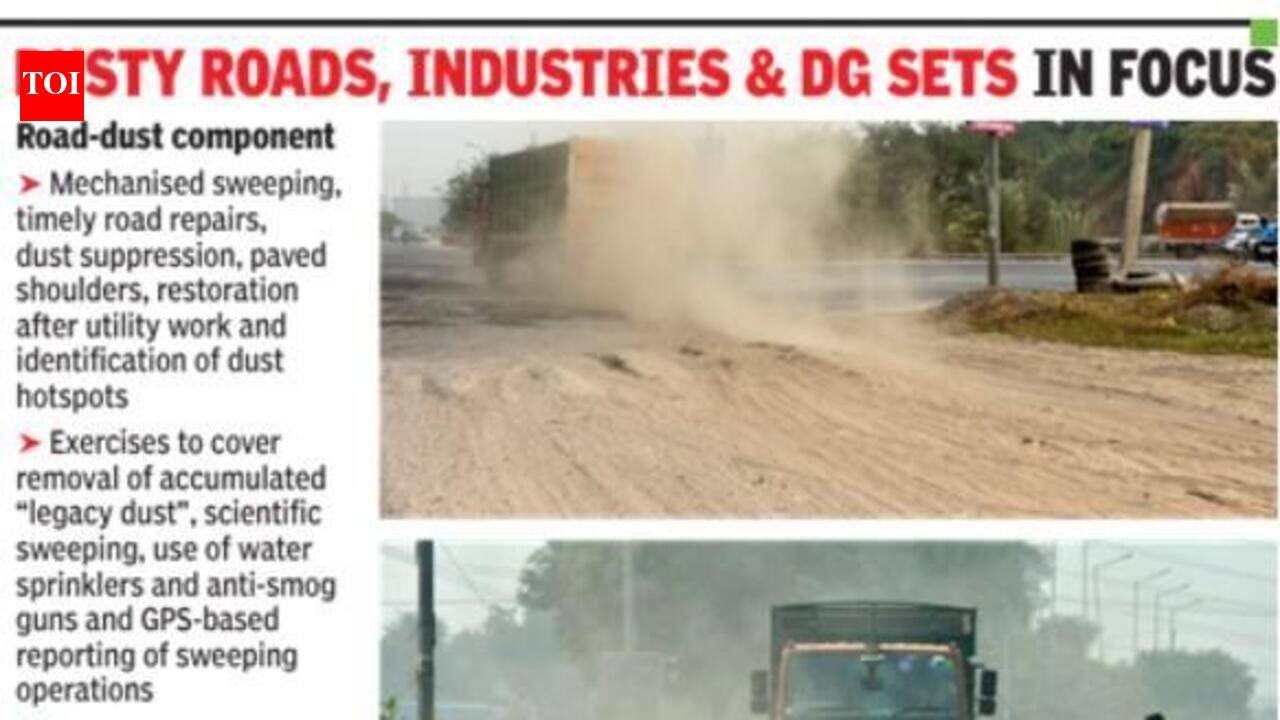
Gurgaon: The city will have to follow a seven-month calendar of pollution-prevention activities.The targets — for civic and other agencies — are unusually specific.They have been assigned specific monthly, weekly and quarterly targets for tackling road dust, industrial pollution and construction-related emissions from Sept through March.Road-owning agencies in the city and in other districts have been asked to hold one dust-control workshop every month, while on-ground demonstrations for mechanised sweeping and coordination meetings with utility agencies have been fixed for specific months.The schedule is part of Commission for Air Quality Management’s Haryana IEC Action Plan for Sept 2026 to March 2027, which sets out pollution-awareness and preparedness activities across the state.What sets the plan apart is not another list of pollution-control measures, but the frequency built into them.The first road-dust workshops are due in Sept, followed by another round of sweeping demonstrations in Dec and a third in Feb. Utility agencies are expected to meet in Sept, Jan and March, while weekly public messaging continues through the seven-month period.As per the plan, for the city, the road-dust component calls for monthly sessions on mechanised sweeping, timely road repairs, dust suppression, paved shoulders, restoration after utility work and identification of dust hotspots.The plan does not leave the sweeping component open-ended either. GMDA in the city and MCG in Manesar have to conduct three on-site demonstrations in Sept, Dec and Feb for sweeping-machine operators and supervisors.The exercises will cover removal of accumulated “legacy dust”, scientific sweeping, use of water sprinklers and anti-smog guns and GPS-based reporting of sweeping operations.Another three-point schedule targets a familiar source of road dust: utility cuts and excavation.Road agencies have to meet departments handling water, sewerage, gas, power and telecom in Sept, Jan and March to coordinate dust-free excavation, disposal of excavated material and immediate restoration of roads after utility work.The public messaging is also to continue throughout the period. Agencies have been asked to issue weekly public announcements asking residents and commuters not to litter or dump waste on roads and to report damaged roads and dust hotspots. Weekly road-dust awareness messages are also prescribed.The recurring schedule extends beyond roads. HSPCB’s regional office in the city has to conduct one industrial pollution workshop every month from Sept to March, covering approved fuels, emission standards, pollution-control equipment, online emission monitoring and preparedness for the winter pollution period.Priority sectors include food processing, metal and furnace units, textiles and industries using boilers and furnaces.Industrial DG-set users have a similar monthly workshop schedule, with sessions focusing on emission-control devices and dual-fuel kits, stack-height and emission norms, GRAP compliance and clean-fuel and backup-power preparedness.Construction activity has also been brought into the schedule.For every active road construction project, agencies have to conduct contractor orientation or digital compliance training on dust control, barricading and covered transportation of debris when work begins, with the exercise repeated during the project where required.TOI reported several times that the city is mostly covered with a cloud of dust and the phenomenon is exacerbated by the low-lying soil and the strong wind effect in the Indo-Gangetic plain.The problem is compounded by dry winters and summers.Also, the re-suspension of road dust because of vehicular traffic is of particular concern, as unpaved roads were cratered and cracked at certain points but still saw heavy traffic during peak hours, with thousands of cars and bikes kicking up a dust storm.


