






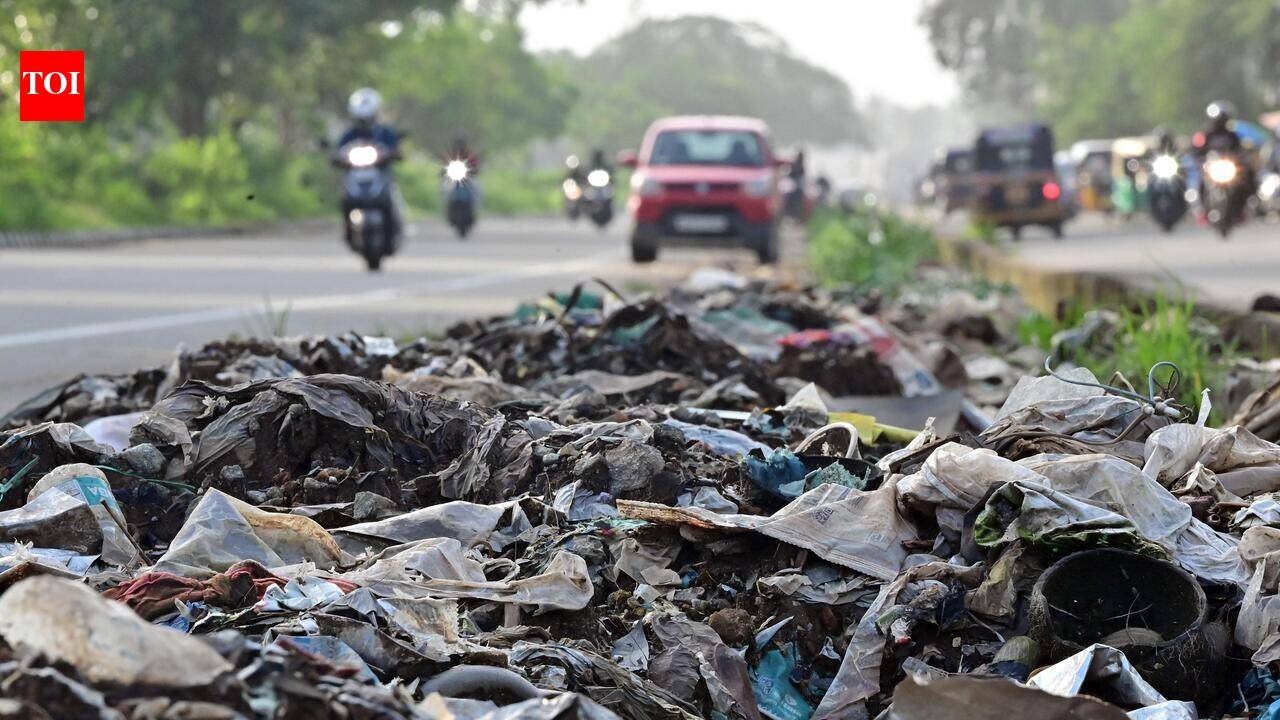
Hyderabad: Over 40% of the hazardous waste generated in the state was unaccounted for in official records in 2024-25, according to a report by Hyderabad-based Citizens Against Pollution, exposing major gaps in Telangana’s hazardous waste management system. In other words, Telangana generated 5,76,000 metric tonnes ( 7,03,045 MT, net quantity available for management) of hazardous waste, but there were no records for the disposal of 3,02,607 metric tonnes (43%) of the industrial refuse.Titled ‘Unaccounted: Telangana’s Hazardous Waste Governance Failure’, the report described the situation as a three-decade regulatory failure in managing hazardous industrial waste in Telangana. It said the system was opaque, structurally inadequate and lacked democratic accountability. The ‘net quantity available for management’ , 7,03,045 MT includes waste generated that year, opening stocks and waste received from other states.According to Dr D Narasimha Reddy, environmentalist and author of the report, the unaccounted waste represents a “ghost” flow equivalent to roughly 101 truckloads of hazardous waste vanishing every day without an official trail or manifest.Single TSDF Under StrainThe report said Telangana depends on a single authorised Treatment, Storage and Disposal Facility (TSDF) at Dundigal. It described the facility as inadequate due to capacity concerns, high transportation and disposal costs, and alleged regulatory shortcomings.The report said the Dundigal facility, after 24 years of operation, was nearing its designed lifetime capacity of 4.5 million tonnes, but no public disclosure had been made on residual capacity. It also said industries located far from Hyderabad faced transport costs of ₹12–18 per tonne per km and a tipping fee of up to ₹25,000 per tonne for incineration, making authorised disposal expensive compared to illegal alternatives.Citizens Against Pollution also referred to a history of leakages at the facility that had triggered a court visit, and said compliance reports on promised remediation remained unverified and private.The report said the state’s industrial base had grown by over 330% since 2009, but no new common TSDF facility was added.Illegal Disposal Routes FlaggedThe report flagged five routes through which hazardous waste allegedly moves outside official disposal systems: roadside and scrubland dumping, on-site burial within factory premises, open burning at night or during rain, mixing with municipal waste at open dump sites, and fictitious recycling claims where waste is recorded as “sold as scrap” to unverified dealers.It said roadside dumping was often discovered by police rather than regulators, while on-site burial was difficult to detect without soil or groundwater sampling. Mixing hazardous waste with municipal garbage, the report said, exposed vulnerable waste pickers to contamination risks.The report estimated that industries could be avoiding legitimate disposal costs between ₹605 crore and ₹7,565 crore annually. It termed this “environmental cost theft” and said it subsidised industrial growth at the cost of public health and future generations, in violation of the ‘Polluter Pays Principle’.It also alleged systemic failures, including underreporting by hazardous waste generating units. According to the report, over one-third, or 35%, of such units failed to submit mandated annual returns. It also criticised regulatory procedures under the “Ease of Doing Business” framework, saying compliance was being treated as a transaction to be expedited rather than a safety obligation.The report said its findings were based on the Central Pollution Control Board’s National Inventory on Generation and Management of Hazardous and Other Wastes for 2024-25, earlier CPCB inventories from 2009 and 2015–16, civil society records from public hearings at Dundigal and Damaracherla, field observations, legal and historical precedents, administrative and industry records, and enforcement data.It cited, among other material, community objection documents submitted during public hearings for hazardous waste facilities at Dundigal in 2004 and Damaracherla in 2005, a 2005 visit to Deccan Chromates that revealed over 10,000 tonnes of openly dumped hazardous waste, the 2001 High Powered Committee report commissioned by the Supreme Court that documented 80 illegal dump sites in the region, TGPCB Ease of Doing Business circular of 2017, and recent enforcement actions such as 2025 closure orders against firms.The report called for an independent technical audit of TSDF, Dundigal, public disclosure of all waste movement manifests through a real-time digital tracking system, creation of a post-closure financial assurance fund to deal with the long-term contamination legacy of buried waste, and accountability for the alleged 3,02,607 metric tonnes of unaccounted hazardous waste.Despite repeated attempts to reach him, Telangana PCB member secretary G Ravi was not available for comment.


