



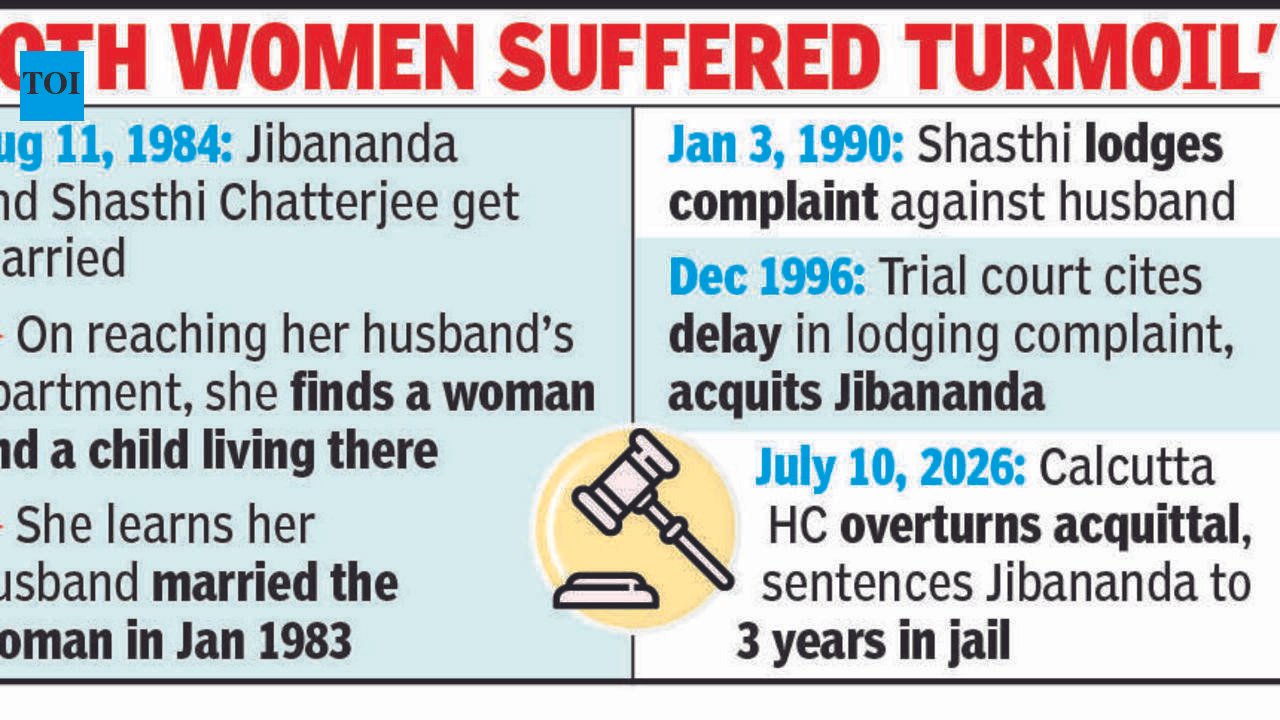
Kolkata: Calcutta High Court has overturned an almost 30-year-old acquittal in a case of bigamy and directed a 75-year-old former policeman to serve three years in prison and pay Rs 1 lakh as compensation to his second wife.The bench of justices Rajasekhar Mantha and Ananya Bandopadhyay, which delivered the ruling on Friday, observed that the convict, Jibananda Chatterjee, could not escape imprisonment merely by paying compensation, given the “serious emotional and mental turmoil” he inflicted on the two women.Though the maximum punishment for the crime is 10 years in jail, the bench reduced the duration of imprisonment to three years, keeping in mind Chatterjee’s age. The court directed the officer-in charge of Raghunathpur police station in Purulia to take Jibananda into custody.Jibananda and Shasthi Chatterjee got married on Aug 11, 1984. After marriage, Shasthi started staying with her in-laws in Purulia, while Jibananda lived in Kolaghat in East Midnapore, where he was posted.After repeated requests, Jibananda finally took Shasthi to Kolaghat. But on reaching there, she found another woman, Madhabi Roy, and a child living at her husband’s apartment. Jibananda told her that the woman was his colleague’s wife and the child was theirs.But after a few months, Shasthi came to know that her husband married Madhabi under the Special Marriage Act in Jan 1983, more than one-and-a-half years before their marriage. She walked out on her husband and returned to her parents’ home in Purulia in 1985.Shasthi lodged a police complaint against her husband five years later, on Jan 3, 1990. The trial judge questioned the delay in filing the complaint and acquitted Jibananda on Dec 20, 1996. The judge also held that Shasthi failed to prove the existence of her husband’s first marriage.Shasthi challenged the acquittal in Calcutta High Court in 1997. After 29 years, the division bench of justices Mantha and Bandopadhyay overturned the acquittal and criticised the trial judge’s “hypertechnical approach”.“It could take a lot of courage and gumption for a lady in a semi-urban area to muster support and initiative to file a complaint of this nature,” the bench said, while clarifying that the production of a copy of a marriage certificate issued under the Special Marriage Act is sufficient proof of the existence of the marriage.Stating that the first marriage was “clearly” proved, the bench held Jibananda guilty under Section 495 of Indian Penal Code (bigamy). “The trial judge, while having copiously written the judgment in his own handwriting, has unfortunately misdirected himself while appreciating the evidence on record and the undisputed facts,” the bench said.


