



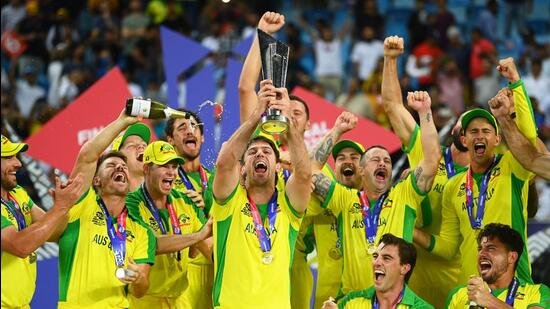
New Delhi: Given the wafer-thin attention spans, it is easy to forget that cricket, just about five years ago, was played in a bio-secure bubble. With the world still coming to terms with the havoc caused by the Covid-19 pandemic and the debate around vaccines, embracing what was called the ‘new normal’ became imperative.
Cricketers spoke of bubble fatigue, mental health and safety protocols, and you know things have come to a head when even the Indian Premier League (IPL) schedule is changed — IPL 2021 was suspended in India and moved to United Arab Emirates after much uproar. With the toll mounting, a sporting spectacle was not the priority anymore. The 2021 T20 World Cup was played amid such overarching moral dilemma.
The tournament was originally scheduled in Australia in October-November 2020, but was postponed by a year because of Covid. It was then moved to India due to entry restrictions in Australia, but considering the pandemic situation, it was moved to the UAE and Oman with Board of Control for Cricket in India (BCCI) remaining the official hosts.
A five-year gap after the previous T20 World Cup meant the format had undergone a sea change. As evidenced by the big-hitting West Indies batters in the 2016 edition, teams realised the merit in power-hitting. The hard lengths were not hard to hit anymore and as batters grew brave and inventive with stroke play, rival captains began to rely on mystery spin and slower ball variations to disrupt the rhythm. The event also set right an enduring anomaly — that of Australia not winning the trophy.
An unstoppable force in the 50-over World Cup, the Aussies had inexplicably failed to lift the T20 trophy despite their arsenal. They did come close — runners-up in 2010 and semi-finalists in 2007 and 2012 — but it was only in 2021 that they went all the way.
Led by an astute Aaron Finch, Australia won six of their seven matches, none more impressive than taking down an in-form Pakistan bowling attack in the semi-final. With Australia needing 62 runs in five overs, Pakistan would have fancied their chances. But left-handed Matthew Wade smashed Shaheen Shah Afridi for three sixes in the 19th over to take Australia into the final with an over to spare.
The final against New Zealand was a comprehensively one-sided affair. The Kiwis, riding on skipper Kane Williamson’s 48-ball 85, scored 172/4 on what was perhaps the best pitch Dubai had rolled out in the tournament. Australia, powered by a 50-ball 77* from Mitch Marsh, crossed the line with seven balls to spare and eight wickets in hand. Brimming with allrounders Marsh, Glenn Maxwell, Marcus Stoinis, and even Pat Cummins, Australia’s success underlined the value of multi-dimensional cricketers who could be used for specific match-ups and as cover for frontline practitioners having an off-day.
It was also sweet redemption for David Warner, who was adjudged Player of the Series. The aggressive opener was stripped of captaincy in the middle of IPL by Sunrisers Hyderabad and eventually lost his place in the eleven. Days later, he had hammered 289 runs in the World Cup to prove his mettle.
For ‘hosts’ India, the tournament was a bit of a nightmare with their proud, unblemished World Cup record against bitter rivals Pakistan ending on a tacky Dubai track. Shaheen Afridi exploited the early swing to perfection, getting the ball to swerve in beautifully to account for openers Rohit Sharma and KL Rahul inside the Powerplay. Jolted early, the Indian innings gasped for momentum, huffing and puffing to a below-par 151/7 in 20 overs.
That India got that much was down to skipper Virat Kohli’s 49-ball 57. He anchored the innings in the middle overs before a brief late assault. Rishabh Pant was the only other Indian batter to cross 30 that night.
India had a potent attack in Mohammed Shami, Bhuvneshwar Kumar, Hardik Pandya, Jasprit Bumrah, Varun Chakravarthy and Ravindra Jadeja, but Babar Azam and Mohammad Rizwan were impenetrable. Chakravarthy roped in ahead of R Ashwin for his mystery spin, struggled. The dew quickened the pitch and made life tough for the Indian spinners as they struggled to grip the ball. That shouldn’t take anything away from the Pakistan openers, who put up a masterclass to seal a 10-wicket win.
Days later, an eight-wicket hammering at the hands of New Zealand sealed India’s fate. Wins against Afghanistan, Scotland and Namibia followed but with only the top two progressing, India endured an early exit.
Kohli, having announced he would step down as T20I skipper before the tournament, lost his ODI captaincy months later. Other casualties included Chakravarthy, who didn’t play another T20I for three years, leggie Rahul Chahar, who hasn’t played a T20I since, and Shardul Thakur, who played only once since that World Cup.


