



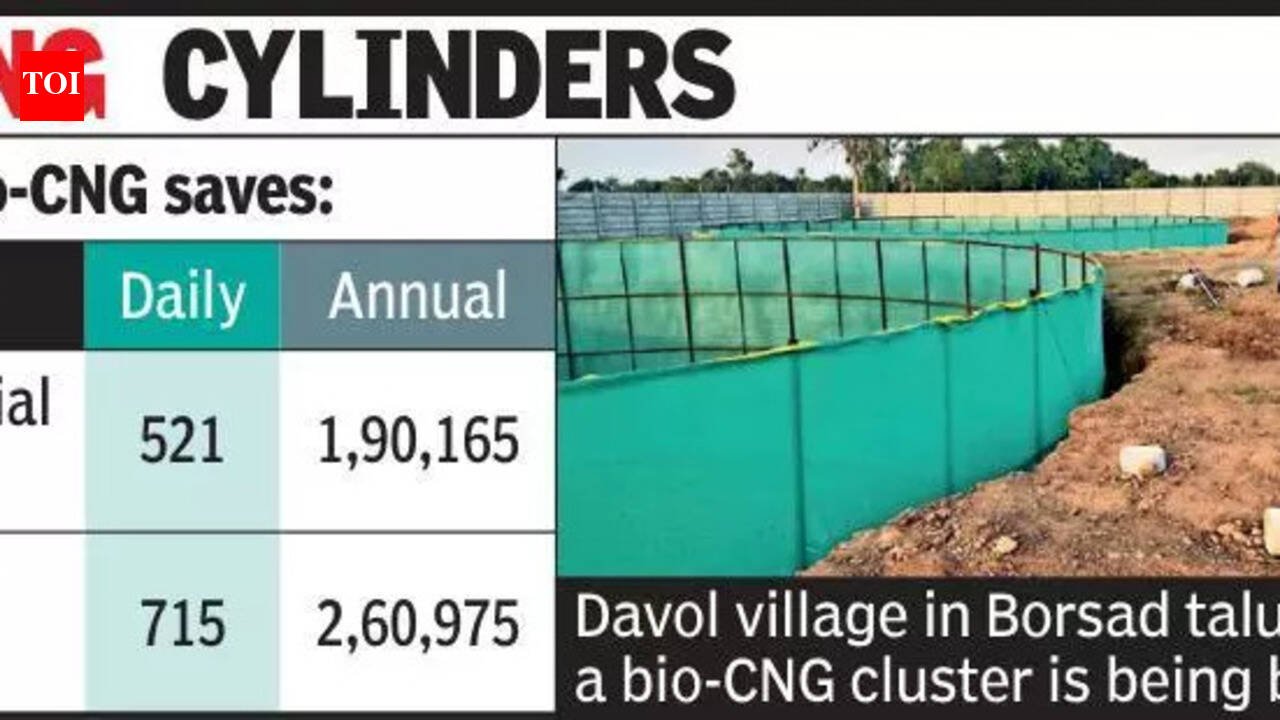
Vadodara: Amid the acute LPG crisis and black marketing that have left lakhs scrambling for cylinders, a ray of hope is emerging from the villages of Anand district.A large-scale bio-CNG cluster of 10 plants spread across 100 villages in the region promises not only a cheaper and more reliable alternative to LPG but also a step towards reducing India’s dependence on imported energy.Once operational, the cluster will produce 10 metric tonnes of bio-CNG daily — equivalent to 521 commercial LPG cylinders or 715 domestic cylinders — ensuring uninterrupted supply for schools, hostels, temples, hotels and highway eateries where menus have been slashed and some have shut down for want of cylinders.The project will be rolled out from Davol village in Borsad taluka and extend up to Pandoli in Petlad over a 31-km stretch.“This clean fuel will be 20% cheaper than LPG,” said project developer Sanjay Patel, CEO of S P Ecofuel, which promotes innovative and low-cost renewable energy solutions. The entire cluster, including refining and distribution infrastructure, will involve an investment of around Rs 60 crore.The project will convert cattle dung, food waste and agricultural biomass into clean fuel, helping tackle rural waste and create an extra income stream for farmers.The initiative will source raw material from nearly 100 villages through women-led farmer producer organisations (FPOs), processing around 500 metric tonnes of cattle dung, food waste, poultry waste and agricultural biomass daily.“At BAPS Gaushala in Dakor, we are generating around 100 kg of bio-CNG daily. This is transported through nano tankers to Premvati Bhojnalaya, where it is used to prepare meals for more than 1,000 devotees daily,” Patel said.The cluster will generate around 20,000 cubic metres of raw biogas daily, which will be refined into 10MT of bio-CNG. Waste from 100 villages will be scientifically processed, eliminating dumping and emissions, said Patel.Napier grass, a high-yield crop, will also be used as feedstock, opening up a new income stream for farmers.The Davol plant, estimated at Rs 4 crore, is expected to be commissioned by May. Around 400 households in villages like Davol, Pamol, Bodal, Nsiraya, Asodar and Mujkuva are already powered with biogas that has come up through various schemes of the National Dairy Development Board, Gujarat govt’s Gobardhan scheme and Swachh Bharat Mission. “More than 1,000 farmers, most of them women, have already shown interest in joining FPOs,” said Patel.Apart from fuel, the project will produce organic fertilisers. The processed slurry will be converted into liquid and solid organic manure, which can further be enriched into phosphate-rich fertiliser — offering an alternative to chemical inputs like urea and DAP.A govt official said the model provides a practical solution to enforce norms against open dumping of waste in villages, while creating additional income streams for farmers and panchayats.The environmental gains are significant. The cluster is expected to reduce over one lakh metric tonnes of carbon dioxide emissions annually, generating carbon credits while improving sanitation and public health in rural areas.Currently, Gujarat has around 20 metric tonnes of bio-CNG capacity, almost entirely used for automobiles under the Centre’s SATAT scheme.


