



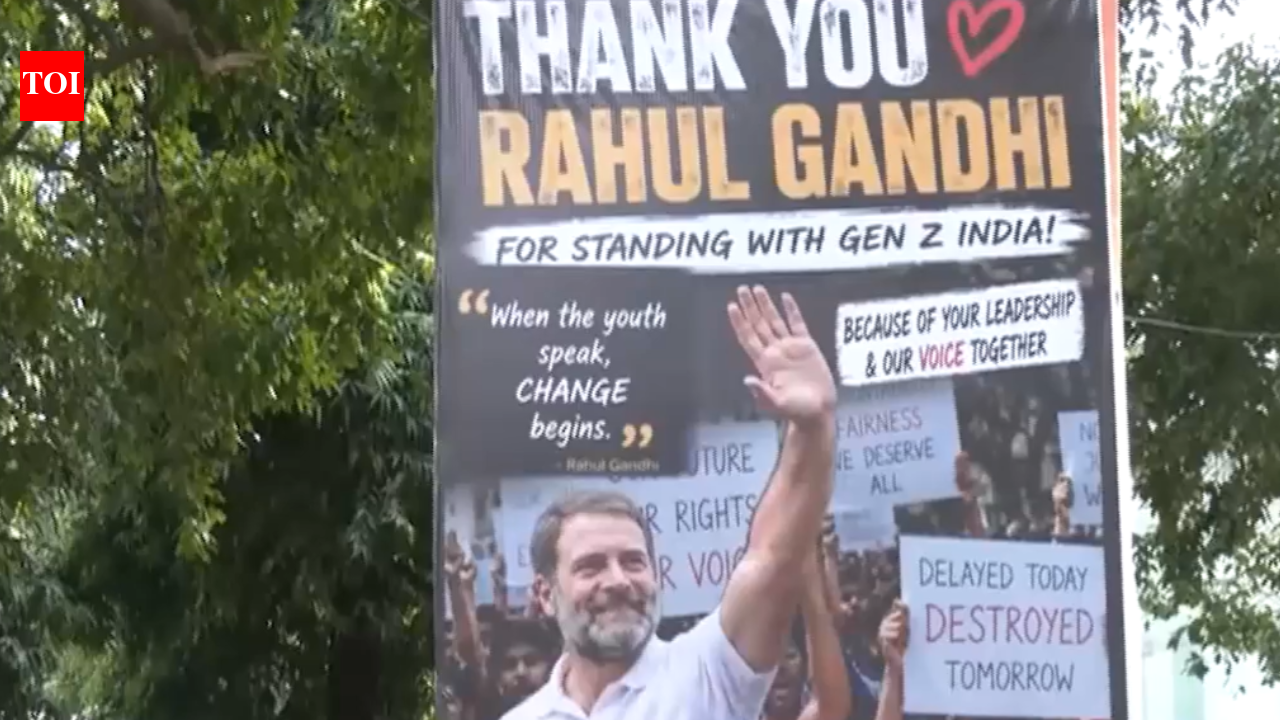
NEW DELHI: A poster appeared outside the Indian Youth Congress (IYC) office in Delhi on Sunday, reading “Thank You Rahul Gandhi For Standing With Gen Z India,” with IYC Delhi president Akshay Lakra thanking Congress leader Rahul Gandhi for consistently raising the NEET paper leak issue and supporting student protests. Speaking to the media, IYC Delhi president Akshay Lakra said, “There is a palpable sense of enthusiasm and gratitude towards Rahul ji—not just in Delhi, but across the entire country—because he fought the battle from the streets to Parliament.”“He sat in protest outside the Prime Minister’s residence and consistently raised the issue in Parliament,” IYC Delhi president said. “Under the Congress party’s campaign, ‘Chhatron ki Goonj’, this issue was raised repeatedly.
CJP Jantar Mantar Protest Updates
We ran programmes in other states demanding a law against paper leaks. Our primary demand was the resignation of Dharmendra Pradhan, followed by accountability for the officials who orchestrated the lathi-charge, pellet gun attacks, and use of tear gas against students,” IYC Delhi president added. “Home Minister Amit Shah must also apologise; that is our second demand. It isn’t just Gen Z; all the young students involved in this movement are thanking Rahul because he was the most vocal in raising this issue,” IYC Delhi president said. Earlier in the day, municipal workers painted over the graffiti-covered walls around Jantar Mantar, wiping away the visual traces of the student-led protest that culminated in the resignation of Union education minister Dharmendra Pradhan. Until Saturday evening, the white boundary wall of the Imperial Hotel along Tolstoy Marg had transformed from an ordinary stretch of Lutyens’ Delhi into a symbol of public anger and dissent. The walls surrounding Jantar Mantar, gates, and even tree trunks had been covered with layers of graffiti, slogans, sketches, and signatures, turning the area into a public display of frustration among young protesters over what they described as the failures of the NDA government. The graffiti reflected the mood and language of a youth-driven movement — sarcastic, rebellious, often blunt, and free from traditional political expressions. Messages referring to “godi media”, appeals for “revolution”, tributes to B R Ambedkar, and criticism of senior government officials appeared alongside doodles, memes, and personal messages. Painted in bright colours, the messages ranged from political statements to emotional expressions. Phrases such as “Democracy is premium” and “R’evol’ution” appeared alongside the anti-fascist anthem “Bella Ciao”, Gen Z’s declaration that it “keeps grudges”, and the Gandhian message, “Hamla chahe jaisa bhi ho, haanth hamaara nahin uthega”. Several slogans targeted the RSS, with some demanding it be “banned”, while others expressed gratitude towards Lok Sabha Leader of Opposition Rahul Gandhi for supporting student protesters and raising their concerns. While some graffiti appeared carefully planned, much of it seemed to have been written spontaneously, reflecting an emotional release by protesters during the movement. The walls also carried hundreds of handwritten notes, names, and social media handles of participants who wanted to leave behind a personal mark on the protest. However, by Sunday, most of these messages had disappeared after the New Delhi Municipal Council (NDMC) launched a clean-up drive around Jantar Mantar. More than 100 sanitation workers, along with heavy vehicles and mechanised equipment, were deployed to remove nearly 60 metric tonnes of waste left behind after the protest. Officials said approximately 52 metric tonnes of waste had been cleared by Sunday afternoon. “Roads were being washed with pressure-jetting machines, while walls bearing protest slogans were repainted and damaged footpaths and curbstones repaired to restore the area after protesters dispersed,” an NDMC official said.


