



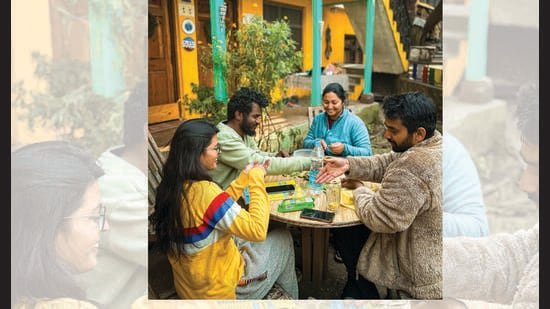
Milking a cow in Likir, 60km from Leh, was exactly the reset Sejal Luthra needed two years ago. She was 30, burnt out working her social-sector job in Delhi, and in no mood for a busy itinerary. But volunteering at a homestay in the hills? It sounded like a Ghibli adventure.
Luthra spent three weeks at Old Likir Traditional Farm Stay, chopping veggies, planting spinach, leading the animals to graze and helping to maintain the four-room property. Milking a cow, she learnt, is not as easy as movies make it look. It called for rhythm, a specific technique, and a ton of arm strength – at one point, the cows lost patience with her too. She also failed spectacularly at carrying a bale of hay, and lost her sunglasses in the stacks — a peak city-girl moment. In return, she got a room to herself, two meals a day and plenty of time to read, cycle through Likir and check out the nearby monastery and pottery studio. “It felt like a more meaningful way to travel,” she says.
If this seems like the IRL version of all those Insta posts inviting tourists to “manage a cafe in Spiti” or to “pitch in at an organic farm in Goa”, in exchange for free food and stay, it’s because volunteer vacationing is suddenly on everyone’s must-try list. There are requests to teach kindergarteners in Kumaon, help a Kutch homestay manage their social media, and DJ at a hostel in Goa.
The deal sounds simple, but like any exchange, it carries expectations, boundaries and a learning curve. Here’s the 360 degree-view.
It takes a village
Volunteer tourism has long been a Western gap-year student’s favourite way to spend the summer and pad up the resume. Global platforms such as Workaway and Worldpackers have been connecting travellers with barter gigs since the early 2000s. Backpackers have been teaching at schools in Dharamshala since the 1990s. Local interest, however, took off only after the pandemic, after young travellers began seeking holidays that felt a little less lonely, a bit more immersive, and a lot cheaper. Platforms such as Volunteer Yatra have been around since 2021, but networks are essentially spread across WhatsApp groups, Instagram pages, websites and by word-of-mouth.
Indians volunteer differently from guilt-ridden foreigners. They’re in their 20s to 40s – not gap-year kids. Volunteer Yatra steers clear of listing farming-related work. “Locals already know how to do that efficiently,” says founder Aakash Maan. And no consultancy gigs. “People love to come in and suggest what should be done, but not actually do it. Our idea is to bring in people who can add value on the ground.” So, the volunteer work includes building a better website, teaching a particular skillset to the community, painting a homestay’s signboard, even taking over the DJ console at a hostel.
The great upgrade
Yaarana Stay and Cafe, a hostel-style homestay in Manali, hosts musicians, painters and carpenters as volunteers. Harsh Bhatt, who founded the place with his sister Jhanvi in 2022, says that they’re flooded with requests, but only accept volunteers who “are very good at what they do”, match the vibe, and can communicate well with the other guests on the property.
In exchange, volunteers get a place to stay (rooms cost up to ₹3,000 a night), can chill at the café and tag along on “treks, mountaineering, snowboarding and more,” says Bhatt. There’s no contract. But it’s not bad, for about five hours of work a day.
In Goa, backpacker hostel Pappi Chulo is almost always on the lookout for volunteer bartenders, hosts, chefs and anyone who can keep the energy up during social mixers. Gigs run for three weeks. Most candidates reach out via Instagram and Dev Advani, the social media manager, screens their social media and also analyses their work experience, samples and references. “Above all, we want someone who is good with people,” he says.
At the Moustache hostels in Manali and Delhi too, the primary volunteer task is to bring the guests together. “They’re the social glue. They help break the ice and shape the vibe,” says Raj Kumar, who manages the volunteers and community. The job involves leading hikes, putting together a game night or organising a trip to the market. Hiring is informal and impromptu. If the gig goes well, volunteers can extend their free stay by a month or more. If not, both sides move on.
Panki Sood, who founded the Himalayan Volunteer Tourism (HVT) Facebook group with Mahima Mehra in 2018, says that unpaid work can create a real impact. The network has over 34,000 volunteers (artists, musicians, digital marketers, architects, even financial literacy experts) across seven Himalayan states, including Ladakh, where they work with nearly 160 schools. Some stay on longer at their own cost to teach students. “One volunteer recently gave finance lessons to village women as she travelled through Tirthan,” he says.
Do not disturb
Yes, it’s not a traditional job. Yes, you’re technically on holiday. But volunteering still comes with rules. The big one: Know your limits. “A major chunk of the volunteering roles is getting people together, and organising parties and mixers. That doesn’t mean you start getting over-familiar with guests,” says Bhatt.
The second rule: Don’t lie on your resume. Advani’s volunteers have included “so-called bartenders whose drinks customers kept sending back; event planners who couldn’t organise a party.” Bhatt recalls a foreign tourist, who volunteered to manage the hostel in 2022, but worked on his own schedule. “He’d wake up whenever he wanted, which was fine, but he’d also mess up tasks. If he focused on one thing, two others would fall through and we’d end up doing more work.”
Safe journey
Advani likens the volunteer system to a game of Russian roulette: “We never know who we’re going to get”. It’s the same for volunteers, some of whom have encountered rude hosts or were expected to work longer hours than discussed. “In rural India, volunteers also need to be aware of social realities — caste dynamics, gender roles. We can’t change that overnight,” says Maan. Quick briefings aren’t enough to counter culture shock.
Volunteer Yatra is helping both sides work better. “We vet all properties and ban anyone who engages in misconduct,” Maan says. The site has built a volunteer’s Code of Conduct and a Standard Operating Procedure that includes how much work a volunteer will do, the amount of output to be expected, along with curating the volunteer’s travel experience. “We even arrange pick-ups and drops, along with scooties or cycles so the volunteers can get around.” The app has an SOS button for unsafe situations, and WhatsApp groups for each region. And given that the network is wide, “there’s always physical help at hand,” claims Maan.
Luthra, who has volunteered at other places after her time in Likil, does her own checks too: How remote the place is, whether there’s access to markets, transport or even bicycles. “You don’t want to feel stuck.” She also reads reviews, speaks to hosts in advance and reaches out to past volunteers to get the full picture.
Be my guest
How to know if the free stay is worth it, and the free labour is actually making a difference? “Our primary goal is to see what shifts in the village,” says Maan. “If our volunteers have been teaching at a school, how have things changed for the children?” Some volunteers leave a lasting mark. For Bhatt, it was a guest named Sangram S from Mumbai, who painted their entire hostel in 2022. “Yaarana means friendship. He painted the entire property yellow, the colour of friendship.”
The best volunteers are the ones who stay on. Pappi Chulo’s first volunteer Josephine May, from England, signed on 10 years ago, when the place was “just three rooms and a sand floor”. She’s been a receptionist, tended bar, done housekeeping, trained their dogs to stay away from the rooms, “all sorts of things, really.” She keeps returning, staying two-three months at a stretch. “She’s practically family now,” says Advani.
Luthra returned from Likir in June 2024. She has since volunteered at hostels in Bangkok and Malaysia on her slow-paced breaks. “Sometimes, I pick a destination first and then look for volunteering opportunities there. Other times, I find a great opportunity and choose the destination because of it.”
From HT Brunch, April 4, 2026
Follow us on www.instagram.com/htbrunch


