



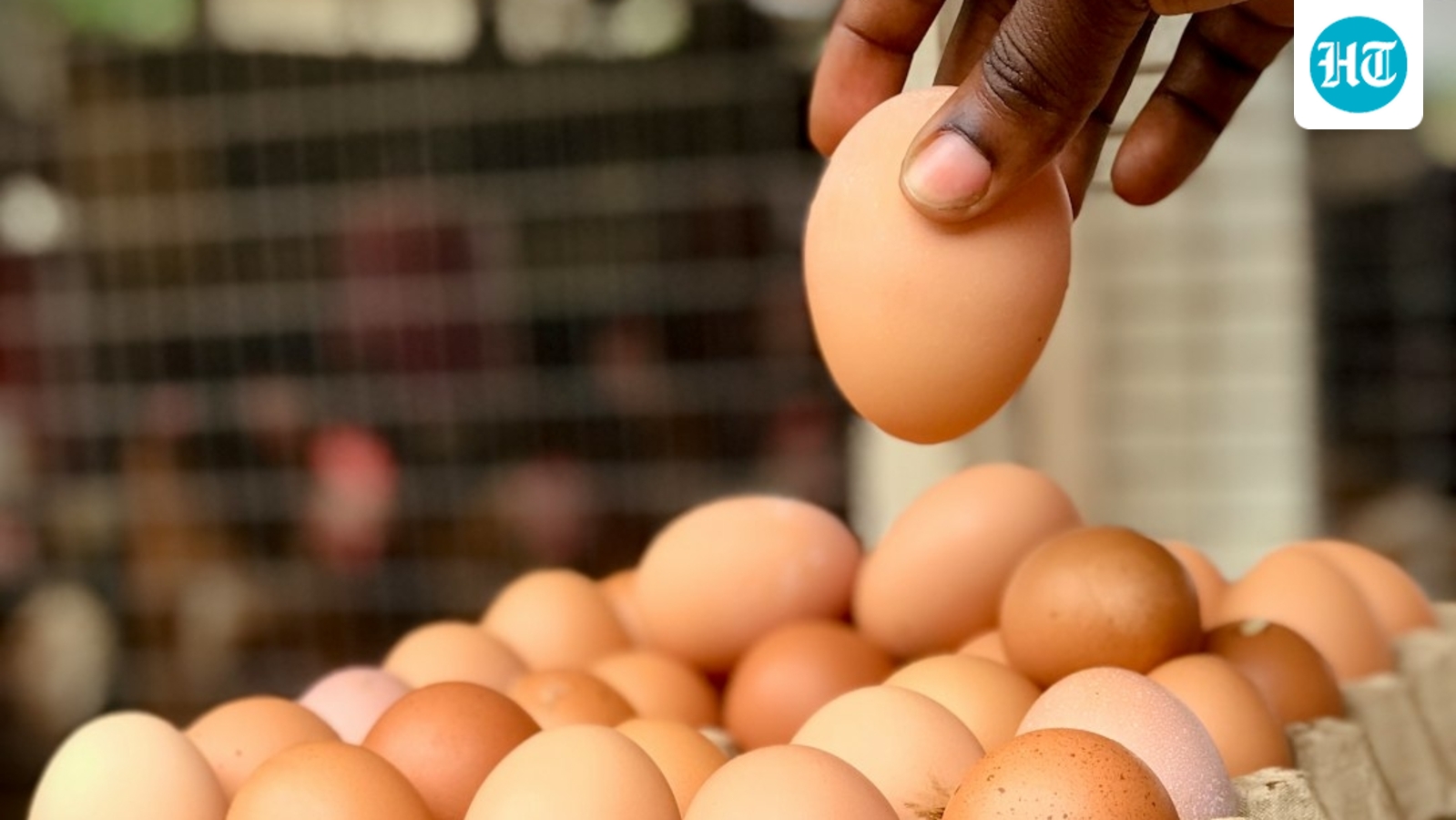
The old jingle — Sunday ho ya Monday, roz khao anday — is becoming more difficult to follow. Farm-gate egg prices are hovering around ₹7 a piece and retail prices are ₹8.50–9 across much of the country, as the cheap protein source has been squeezed by multiple pressures, among them the ethanol policy and the West Asia war.


Wholesale prices have also been volatile. The National Egg Coordination Committee’s average across its listed centres rose from ₹5.07 in April to ₹6.82 in July, before easing to ₹5.46 in August. In Delhi, the monthly average moved from ₹4.11 to ₹6.70 over the same stretch, and then settled at ₹5.47.
Maize, the same crop that feeds India’s laying hens and its ethanol blending programme, is at the heart of this churn. As more maize is diverted to distilleries, poultry farmers are left bidding for what remains. With feed making up more than 70% of the cost of producing an egg, there is little cushion.
The feed
Layer feed, a specialised diet high in calcium and protein, now costs ₹30,000–32,000 a tonne, up from about ₹24,000 in April, a jump of 20–25% in four months, said Ricky Thaper, joint secretary at the Poultry Federation of India.
Maize costs have also climbed from around ₹21,000 to ₹26,500–27,000 a tonne over the same period. De-oiled rice bran, another feed ingredient, has gone from ₹14,000 to ₹22,000.
In addition, lysine, methionine and other amino acids and vitamins used in the feed are largely imported from Europe, and freight rates have risen several-fold since the Iran war, pushing up landed costs, Thaper said.
Higher retail prices are not translating into higher profit margins. “Feed and other input costs have risen much faster. In many cases, farmers are operating at negative margins, while for others, margins have fallen to just 1–2%,” said SVV Dora Reddy, co-founder of Abhi Eggs.
A poultry farmer in Gurugram, who spoke on the condition of anonymity, said his unit had been operating at about 60% capacity for two years. Birds normally remain in the laying cycle for around 18 months and are replaced in batches three times a year. This year, he has managed only two rounds. “Maize prices have been volatile since ethanol demand picked up, and that has repeatedly squeezed our margins,” he said.
Also read: Farmers confront the vagaries of a patchy monsoon
Ethanol demand
India produced about 55 million tonnes of maize in 2025-26, of which roughly 16 million tonnes went to ethanol, according to industry estimates. Poultry, along with starch, alcohol and food uses, accounted for roughly 55% of maize consumption.
So, the same crop is increasingly being pulled in different directions. More maize for ethanol distilleries mean less for feed mills, unless production rises enough to cover all demands.
The government has encouraged the shift to use maize for ethanol production. It said in 2023 that ethanol made out of maize would increase demand for the crop and improve returns for farmers.
Arpit Jain, senior vice-president for energy procurement-grains at IB Group, said the tilt towards maize has sharpened this year because sugar availability is limited and Food Corporation of India (FCI) rice sales have been paused, leaving ethanol producers leaning harder on maize for the closing quarter of the supply year.
In August, an additional 149 crore litres of ethanol was allocated for the fourth quarter of Ethanol Supply Year (ESY) 2025-26, of which 135 crore litres — 91% — came from maize. Only 14 crore litres was drawn from foodgrains and sugar.
Weather has piled on. Kharif maize output is expected to fall to about 23.8 million tonnes from 24.8 million tonnes last year, Jain said. Prices have risen from around ₹2,100 per 100 kg in April to ₹2,700 now.
Some relief may be in sight.
New-harvest arrivals from the end of September could soften prices, and a resumption of FCI rice sales at revised reserve prices would ease demand from ethanol producers.
Also read: The challenges of workers in India’s poultry sector
More eggs, fewer birds
Consumption of eggs has risen even as disease and extreme heat have thinned flocks.
Per-capita egg availability rose to 106 in 2024-25, from 103 the year before and 101 in 2022-23, according to the Department of Animal Husbandry and Dairying. Total production reached about 149.1 billion eggs in 2024-25, up 4.4% year-on-year.
Three extra eggs per person may sound modest, but it isn’t for a country of more than a billion people.
“If consumption rises by even one egg per person, the industry has to produce that much more. An increase of three eggs per capita is huge,” Thaper said.
The industry had absorbed rising demand until recently because supply kept pace, Reddy said. That balance has tipped as bird flu, prolonged heat and higher mortality have cut productive bird numbers in several producing regions.
“Last year, nearly 20% of birds were affected. This year, production has fallen by an estimated 30–35% in some regions because of disease and extreme heat,” Reddy said.
Summer mortality, historically limited, has been unusually high this year.
Replacement birds will take time to lay. Reddy expects some moderation around December as new flocks come into production, but rules out a sharp fall in egg prices as the new ethanol supply year begins with less cane available as feedstock and protein demand still climbing.
The department of animal husbandry and dairying did not respond to requests for a comment till Friday afternoon.


