


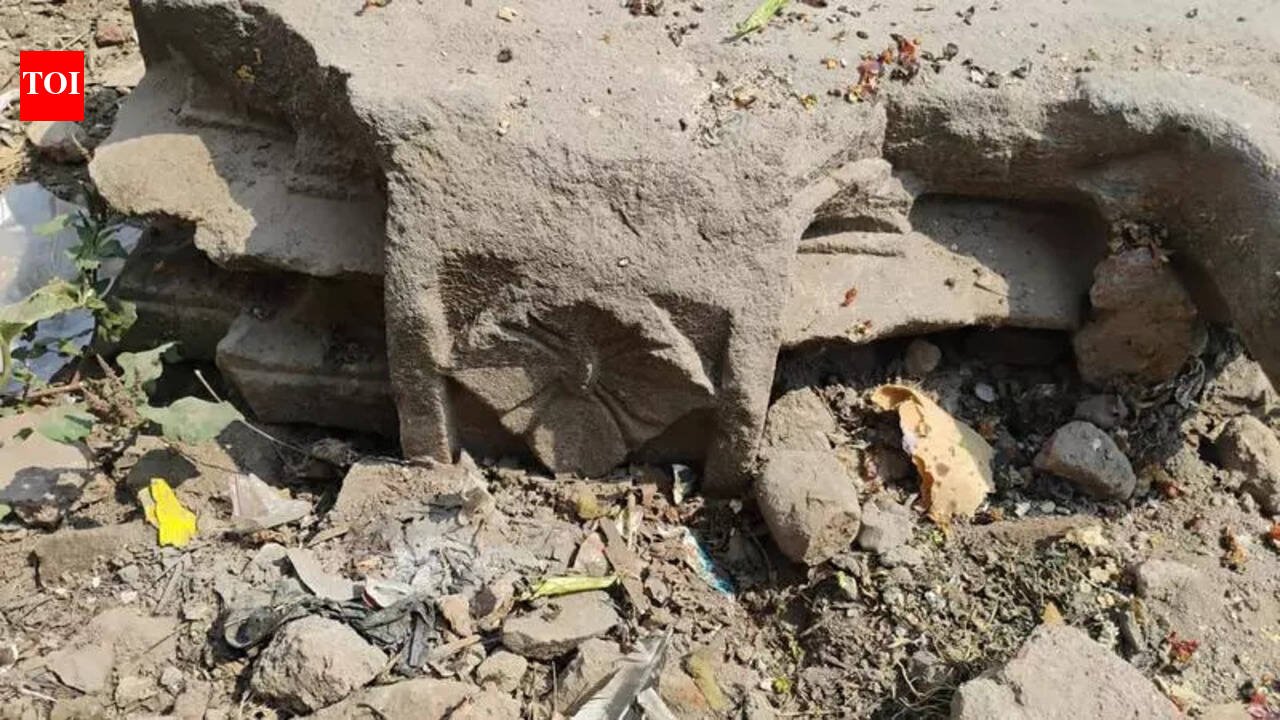
Wardha: Researchers claim to have found remains of a 12th-century Yadava-era temple-style stone pillar a couple of days ago near the Vena river banks at the edge of Wardha district’s Hinganghat, a town about 70kms from Nagpur. The finding is being viewed as fresh evidence of Hinganghat’s historical significance.Idol researcher Panchsheel Thul noticed some stone fragments lying in an open space while studying ancient temples along the riverbank. At first glance, the pieces appeared to be ordinary stones. However, intricate carvings on them drew his attention.After close inspection, Thul said he found the stones were linked to Yadava-era temple architecture. After a joint visit with another researcher, Pravin Kadu, they concluded that the remains dated back to the 12th century.As per the researchers, the stone fragments are carved from locally available black basalt. A finely carved lotus motif on the remains is particularly striking. Basalt is considered a very hard stone, and carving on it indicates skilled craftsmanship, they said. The researchers believe the pillar may have been part of an important section of a temple, such as the sabhamandap or a pillar in front of the garbhagriha.Another fragment is believed to be part of the temple’s base, or the pedestal of a main pillar. Researchers said that such carvings are typical of the Yadava-era Hemadpanti architectural style seen in 12th- and 13th-century temples. Hemadpanti style involved stone interlocking without the use of lime, they said.According to historians, several parts of Vidarbha flourished religiously, culturally and commercially during the Yadava rule. References to ancient settlements and temples along the Vena river appeared in various accounts.Thul and Kadu alerted the municipal council and submitted a memorandum to CEO Prashant Urkude, demanding that the stone fragments, currently lying in the open, be protected from degradation due to natural forces and human interference. Urkude told TOI that the researchers were asked to approach the Archaeological Survey of India (ASI) in this regard.Thul said, “There is a possibility that many more historical remains in the Hinganghat area are lying neglected. The archaeology department needs to conduct a detailed survey. These remains are not merely stones but living evidence of our cultural heritage.”“The remains of this stone pillar once again underline that Hinganghat was a prosperous city in ancient times. Religious and cultural life flourished here during the Yadava period,” said Kadu.Some citizens demanded the establishment of a small museum to ensure scientific preservation of such artefacts and to facilitate study for students and researchers.Experts stressed that proper archaeological excavation and scientific examination could reveal more about Hinganghat’s antiquity. Preservation of the heritage could also boost tourism in the city, they said.


