The other day, while stowing my laptop in its case ahead of a long trip, I was suddenly reminded of my trusty portable Olivetti electronic typewriter and its smart matching green case, both of which I used for years and sadly lost somewhere along the decades.
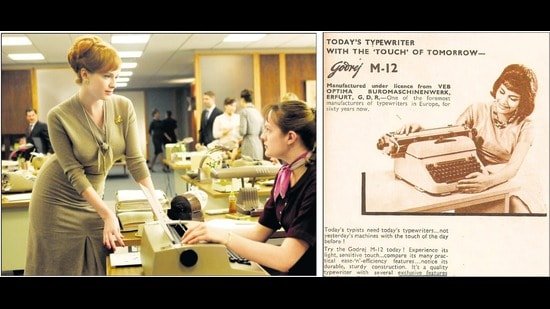
Snapshots from the ’60s: Elisabeth Moss is Peggy Olson, secretary-turned-copywriter, on the TV series Mad Men (2007-15). (Above right) An advertisement for a Godrej device.
As it happens, 2026 marks 15 years since Godrej officially closed its last typewriter production unit. The machines now live on as vintage curios. It is hard to believe they were once regarded as magical devices, offering speed and ease in the workplace.
Before they arrived, everything had to be handwritten. Indeed, many feared the typewriter would mean the death of the art of calligraphy (and they weren’t wrong).
Typewriters arrived in India in the early 1900s, usually imported from Britain or the US. As a result, they were very expensive. Even as late as the 1930s, a new Remington cost many times as much as a bicycle.
In his book Everyday Technology: Machines and the Making of India’s Modernity (2013), British historian David Arnold writes that there were barely 1,000 of these devices in the country in 1901-02. Then, of course, the typewriter became the mainstay of offices. Typing and secretarial schools mushroomed. Ads began to appear in newspapers, seeking people who could competently work these machines.
The typewriter helped create, in India and the rest of the world “the image of the stylish, independent and technologically savvy modern girl”, as Arnold points out. Unlike the other widely accepted professions of the time, such as teacher or nurse, this one was accessible to all, and crowds of women took to it.
By the time of independence, prime minister Jawaharlal Nehru was keen that India make its own machines and so, buoyed by government support, Godrej released its first commercial model in 1955.
I found a black-and-white ad for a Godrej device online and was transported back in time by its image, of a smiling, short-haired young woman in a dress perched next to the machine, and by its copy, which read: “Today’s typewriter with the ‘touch’ of tomorrow.”
The device showed up in films too, as a sign of the changing times. We see exactly this kind of smart office-goer in Mr & Mrs ’55 (1955), in which a bubbly young professional named Julie works in a newspaper office and is wooed assiduously by Johnny Walker. Decades before Mr & Mrs ’55, Typist Girl (1926), starred silent-era star Ruby Myers aka Sulochana.
It wasn’t always good news for the young working girl. The glamorous typist (or secretary) in a short skirt, cast as “the other woman” in the hero’s life, became something of a trope in Hindi films. But the typist was also a way to portray ordinary working women and their lives, dreams and struggles.
I have the softest corner for Hindi films that give us such heroines. I remember what it meant to walk into a theatre and see a story unfold in which a woman was capable, busy and independent; rather than simply waiting around to fall in love or marry. The very act of working in an office broke several social taboos of the time, including a key one: that of stepping out unchaperoned, and spending long hours unchaperoned in mixed company.
In an early scene in Paigham (1959), Manju (played by Vyjayanthimala) has just earned her Bachelor’s degree. A friend asks what she intends to do with her life now, and she replies that she must find a job. That’s why she has completed a course in shorthand and typing. Manju looks pleased at the thought of working. She is excited about claiming space in the world, and actively shaping the life she will lead.
Similarly, in Teen Devian (1965), set in Calcutta, Nanda plays a sincere young woman who works as a typist, meets the hero (played by Dev Anand) at her workplace, and wins his heart, despite the famous movie star and the wealthy socialite also vying for his affection.
She was a serious working girl, and he supported that. At one point, she talks about returning to her ancestral village for a time, and he asks her with some concern, “But what about your job?”
These were the women who blazed a trail in cinema, hard at work on machines that signified modernity and freedom. How far we have come, we would think with a thrill, watching their stories unfold.
(Email Poonam Saxena on poonamsaxena3555@ gmail.com. The views expressed are personal)