



The heatwave sapping Europe this June does not spare CERN (European Organisation for Nuclear Research), whose dull grey buildings give little hint of the underground that sets the lab apart from any other hive of colossal engineering on earth.
Here, in tunnels beneath the Franco-Swiss border, physicists drive protons — among the particles at the heart of every atom — to a hair below the speed of light and smash them together, reading the debris for clues to how the universe is built. At the ALICE (’A Large Ion Collider Experiment’) detector, one of four that give meaning to those collisions, scientists sit glued to monitors — the whole room not dissimilar to Hollywood renderings of an FBI nerve centre — watching the multicoloured swarms each collision leaves behind.
Somewhere in that mess, they hope, is a sign of new matter, a clue to why matter and not antimatter survived, or something that has eluded the smartest physicists probing the first fractions of a second after the Big Bang.
This July, that nerve centre goes quiet. After a short, densely packed final run, the LHC switches off its beams at the start of the month for its third ‘Long Shutdown,’ and there will be no collisions until June 2030, according to CERN. Unlike previous shutdowns, this one is a four-year job and a roughly $1.5 billion bill to turn it into the ‘High Luminosity’ LHC.
A scientist points at a screen on March 19, 2010, shortly after the LHC began operations.
| Photo Credit:
CERN
Future Circular Collider
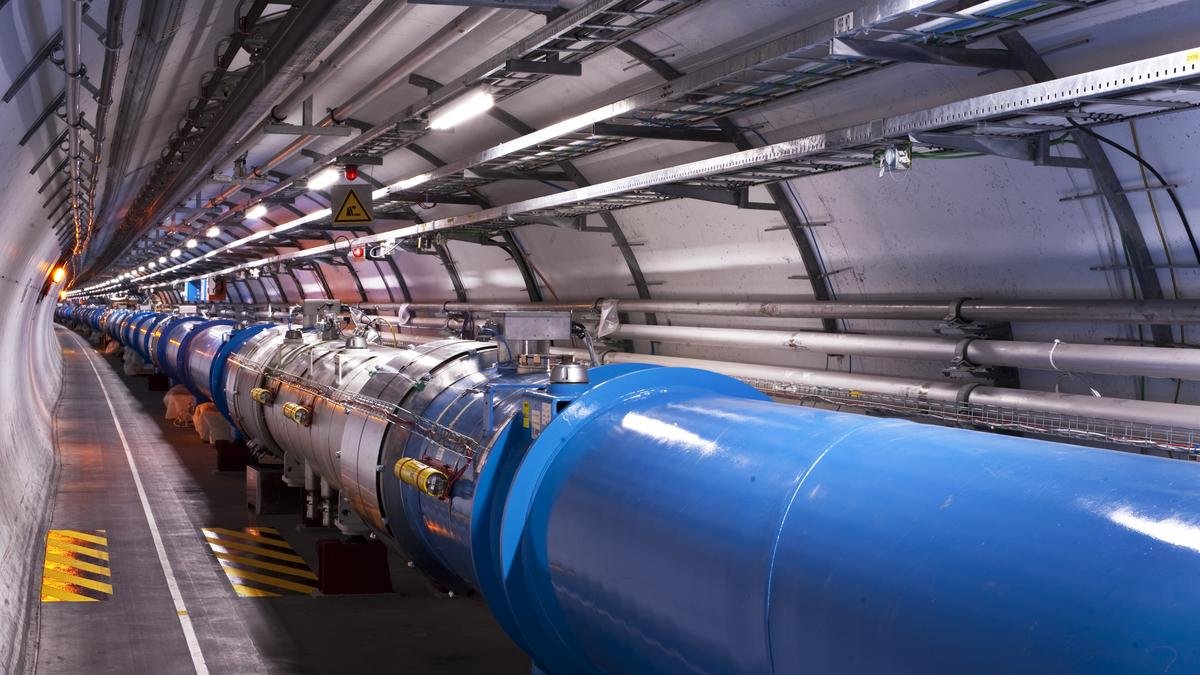
The classic image of the LHC is its ring of curved arcs that traverse a 27-km loop 100 metres underground. This however, is only the final leg of a relay. Protons are handed up a chain of smaller machines — Linac 4, the Booster, the Proton and Super Proton Synchrotrons — each lifting the beam to higher energy before passing it on, until the LHC drives it to 6.8 teraelectronvolts (TeV) per beam.
A TeV is a trillion electronvolts and about the energy of a flying mosquito. Trivial as that sounds, its ferocity lies in concentration: the LHC crams that whole mosquito’s-worth into one proton, a speck a trillion times smaller, packing the energy so densely that a single collision briefly recreates the furnace of the newborn universe.
A view of the LHC beam pipe (left) and the ALICE detector in 2024.
| Photo Credit:
CERN
If the upgrade goes to plan, the beams will zip at around the same TeV but with the rate of collisions rising roughly five times and – over the apparatus’ lifetime – a tenfold rise in the number of net collisions. This is literally more bang for buck as this translates to greater odds of sighting exotic particles and signatures to the as yet unknown undercurrents that birthed our universe.
Since its first collisions in 2009, the LHC’s high point remains the discovery of the Higgs boson in 2012 — the particle tied to the field that gives elementary particles their mass, and a hypothesis ever since it was conceived in 1964.
The find confirmed a theory that had earned Peter Higgs and François Englert the Nobel Prize in physics the year after.
“We were very lucky with the Higgs boson, that within the first few years of operation we found it,” Archana Sharma, a CERN physicist and among the first Indians the laboratory employed, told The Hindu. “Now, perhaps dark matter is around the corner, and we need more data, and this is exactly why we are upgrading the LHC.”
Fine detail
“It is also, alas, disappointing, that the Standard Model is so correct,” she added.
What this means is that the collider largely only confirmed the textbook. Ordinary matter is built from quarks — the elementary grains that bunch, in twos and threes, into the protons and neutrons of every atom — held together by the strong force, whose carrier particles, the gluons, are the glue.
The LHC has verified this architecture in fine detail; it has also filled in the family. It has bagged about 80 new hadrons, the composite particles quarks form, among them tetraquarks and pentaquarks — exotic four- and five-quark species rather than the usual two or three. Its heavy-ion collisions have briefly revived the quark–gluon plasma, the searing soup of unbound quarks and gluons that filled the universe in its first microseconds. It has drawn ever-tighter limits on where undiscovered particles cannot be hiding, probed why matter so narrowly outlasted its mirror-twin antimatter — the reason anything exists at all — and taken measurements that feed astrophysics.
Beyond physics, the effort advanced accelerator design, superconducting magnets, distributed computing and the craft of international collaboration, a CERN press statement notes.
A harder question
But the upgrades and future plans for an even bigger collider are in the hope of discovering signs of dark energy, dark matter, which make up 95% of our universe, and at the very least evidence of supersymmetry — the theory that every known particle has a heavier, undiscovered partner, the lightest of which could be dark matter — has stubbornly failed to appear.
This is the case as well as the counter-case for the next machine. CERN’s flagship runs to about 2041; a successor must be conceived now or not at all. In May 2026 the CERN Council endorsed the Future Circular Collider — an electron–positron “Higgs factory” in a 91-kilometre tunnel — as its preferred project. A build-or-abandon decision is due around 2028 with the current estimate at nearly $19 billion. A 100-TeV proton machine might follow later, perhaps in the 2070s.
A scientist works on the ALICE detector.
| Photo Credit:
ALICE/CERN
Not everyone is convinced, however. The FCC’s first phase would collide at lower energies than the LHC reaches today — built for precision, not raw power, with no promise of anything genuinely new there. The physicist Sabine Hossenfelder has long argued that such a machine would mostly pin down quantities already known to a few more decimal places.
Whether that ambition survives an age of war and frayed exchequers is the harder question. At CERN, Dr Sharma notes, “for every penny there is a huge discussion” — and then consensus. Her own laboratory has held fifteen nationalities at once, Indian and Pakistani, Chinese and European. “The desire to contribute,” she says, “is more important than the geographic location.” India has worked at CERN since the 1960s; her wish is that its industry join at the design stage rather than miss the boat.
The author was at CERN as part of a media visit organised by the Swiss Department of Foreign Affairs.
Published – July 04, 2026 09:00 am IST


