


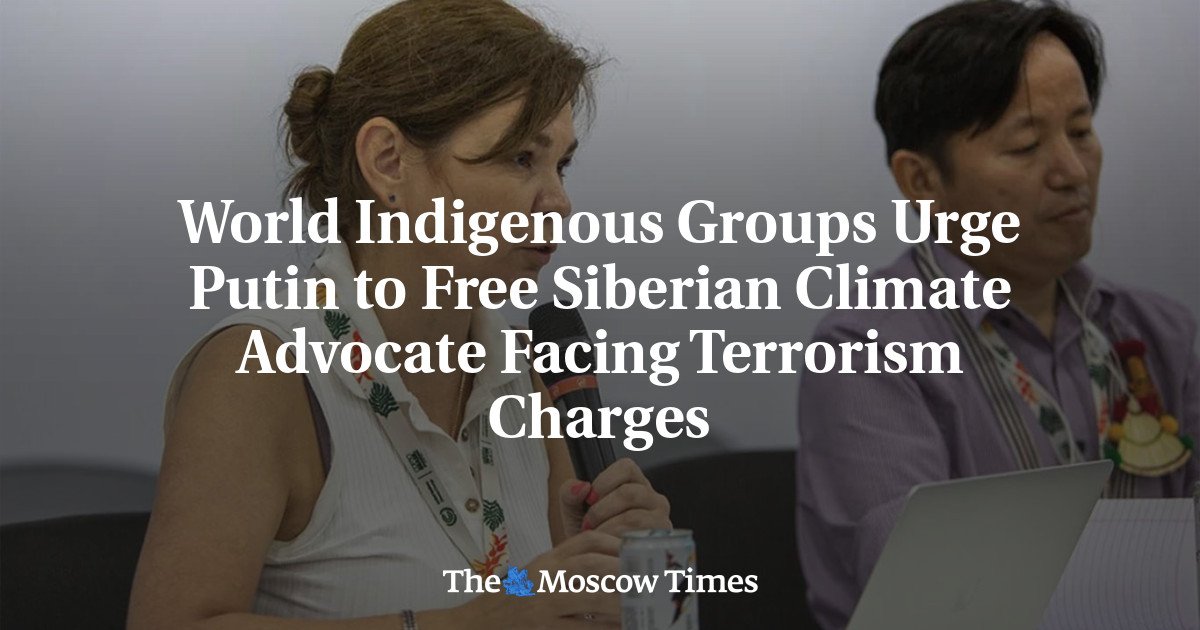
Dozens of entities representing Indigenous peoples around the world have called on Russian President Vladimir Putin to release a Siberian Indigenous climate advocate who is awaiting trial on terrorism charges in Russia.
Daria Yegereva, an Indigenous Selkup woman from the city of Tomsk, was arrested on Dec. 17 after police searched her home and confiscated her electronic devices. She was charged with “participating in the activities of a terrorist organization,” which carries a maximum sentence of 20 years in prison.
Exiled Russian media reported at the time that Yegereva’s arrest was linked to her previous membership in an Indigenous group that Russian authorities claim is part of the non-existent “anti-Russian separatist movement,” which was designated “extremist” in June 2024.
Authorities further claim that the Indigenous group is part of the Forum of Free States of Post-Russia, which was designated as a “terrorist” organization in November 2024.
An independent body representing Indigenous peoples at the United Nations, where Yegereva serves as a co-chair, said she was detained in “direct retaliation for her Indigenous rights advocacy.”
“Her arrest is completely unfounded,” the group, International Indigenous Peoples Forum on Climate Change (IIPFCC), said in a statement on Dec. 19. It said Yegereva’s arrest came as part of an FSB security service raid targeting 17 Indigenous leaders across Russia.
This week, nearly 40 global, regional and grassroots Indigenous caucuses and forums signed an open letter urging Putin to release Yegereva, citing “the professional and consultative character of her participation in international processes.”
“We do not question the competence of the relevant State authorities. [But] her detention undermines confidence that Indigenous Peoples are able to fully participate in recognized international and United Nations processes without fear of retribution,” the letter reads.
The signatories, including the global Indigenous representative bodies for collective UN advocacy known as Indigenous Caucuses, said Yegereva’s work was “conducted in full accordance with officially recognized procedures.”
A Message from The Moscow Times:
Dear readers,
We are facing unprecedented challenges. Russia’s Prosecutor General’s Office has designated The Moscow Times as an “undesirable” organization, criminalizing our work and putting our staff at risk of prosecution. This follows our earlier unjust labeling as a “foreign agent.”
These actions are direct attempts to silence independent journalism in Russia. The authorities claim our work “discredits the decisions of the Russian leadership.” We see things differently: we strive to provide accurate, unbiased reporting on Russia.
We, the journalists of The Moscow Times, refuse to be silenced. But to continue our work, we need your help.
Your support, no matter how small, makes a world of difference. If you can, please support us monthly starting from just $2. It’s quick to set up, and every contribution makes a significant impact.
By supporting The Moscow Times, you’re defending open, independent journalism in the face of repression. Thank you for standing with us.
Continue
Not ready to support today?
Remind me later.
×
Remind me next month
Thank you! Your reminder is set.


