



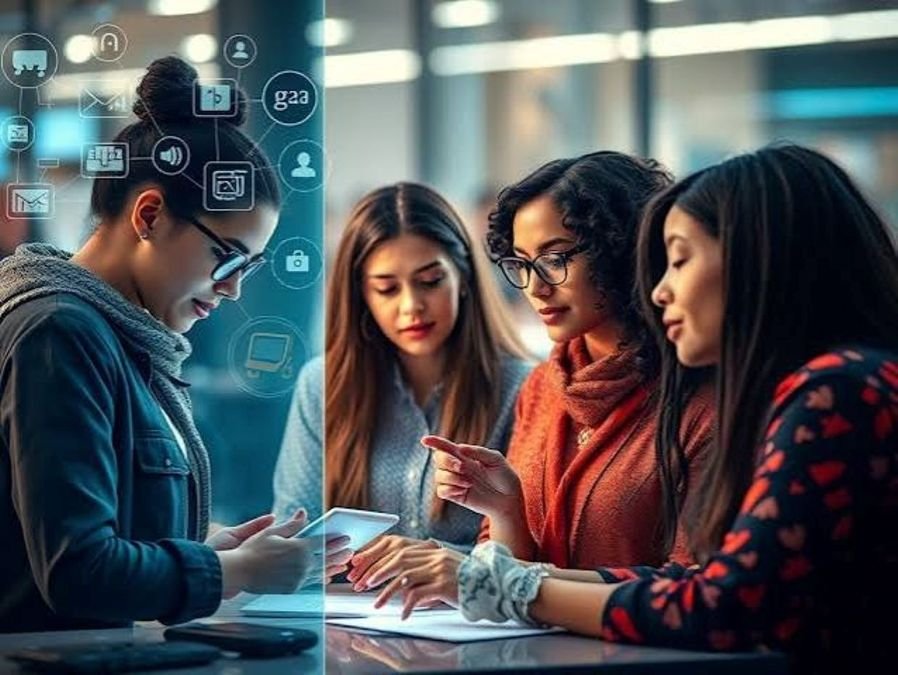
Artificial intelligence is changing the way the world works. It is entering classrooms, offices, hospitals, farms, newsrooms and government departments, promising faster decisions and wider access to knowledge. Yet every technological transformation also raises a fundamental question: who benefits from it, and who is left behind? For women, especially those living in rural, poor and conflict-affected communities, AI can become either a powerful instrument of empowerment or another layer of exclusion. The answer will depend less on the technology itself than on the choices society makes around it.
Women’s empowerment has never meant merely placing women inside existing systems. It means ensuring that women have education, economic independence, safety, dignity and an equal voice in decisions that shape their lives. AI can support each of these goals. It can make learning more accessible, connect women to markets, improve healthcare and create new forms of employment. But without deliberate safeguards, it can also reproduce old prejudices in a new and more powerful form.
Education is among the most promising areas. AI-enabled learning tools can provide women and girls with access to lessons, translations, tutoring and professional guidance beyond the limits of their immediate surroundings. A girl in a remote village can use digital platforms to learn subjects not offered in her school. A woman who had to discontinue formal education can acquire skills in languages, accounting, design, coding or entrepreneurship. For those constrained by mobility, household responsibilities or social restrictions, flexible digital learning can open a door that conventional institutions often fail to provide.
But access to a device and an internet connection cannot be mistaken for genuine inclusion. Many women still face barriers to owning phones, using digital services independently or accessing reliable electricity and affordable data. In some homes, a smartphone is treated as a privilege for men, while women are expected to share devices or remain dependent on someone else’s permission. Digital inequality is therefore also a question of household power. Unless women can access technology privately, confidently and regularly, the promises of AI will remain largely theoretical.
The employment landscape presents both opportunity and risk. AI can help women entrepreneurs identify customers, prepare business plans, improve branding, manage accounts and reach wider markets. It can support home-based enterprises, agricultural activities, handicrafts and professional services. Women who are unable to travel frequently may use digital platforms to sell products or work remotely. For many, this flexibility can be meaningful, particularly where transport, childcare or social restrictions limit participation in the formal economy.
At the same time, automation may threaten low-paid and routine jobs in which women are heavily represented. If reskilling programmes do not reach women, they may be pushed out of work as businesses adopt new systems. The future labour market will reward digital confidence, analytical thinking and adaptability. These skills must not be reserved for urban men or for those already privileged by education and income. Governments, schools and employers must invest in women’s training before technological change makes exclusion permanent.
AI also has implications for healthcare. Digital tools can help women receive information about maternal health, nutrition, reproductive care and mental wellbeing. In areas where specialists are scarce, AI-supported systems may assist health workers in identifying risks and directing patients to appropriate care. For women who hesitate to discuss sensitive issues openly, confidential digital services may provide an important first point of support.
However, healthcare technology must be designed with accuracy, privacy and human supervision. Poorly trained systems can give harmful advice or fail to recognise conditions that affect women differently. Sensitive health data must not be collected or shared without consent. Women’s privacy cannot be treated as a technical detail; it is a condition of trust.
There is also a serious concern about bias. AI systems learn from data, and data often reflects the inequalities of the societies that produce it. If women are underrepresented in training datasets, their voices, faces, health conditions and experiences may be poorly understood by automated systems. Algorithms used for recruitment, credit, policing or public services can quietly disadvantage women while appearing neutral. A machine does not become fair simply because it is a machine.
Women must therefore be present not only as users of AI but also as designers, researchers, regulators and decision-makers. Their participation can help identify risks that male-dominated teams may overlook. A technology built without women’s perspectives is likely to reproduce a narrow understanding of women’s needs. Empowerment requires moving women from the margins of technological consumption to the centre of technological creation.
Safety online is another urgent concern. Deepfakes, image-based abuse, cyberstalking and automated harassment are making digital spaces increasingly hostile. Women in public life, journalism, education and activism are often targeted with threats designed to silence them. If online abuse carries no consequences, AI can amplify existing violence and make participation more dangerous. Strong laws, responsive institutions, platform accountability and digital literacy are needed to protect women’s right to speak and work online.
In Jammu and Kashmir, the debate must be connected to local realities. Women in rural areas, students, entrepreneurs, educators and professionals can benefit from AI, but only if digital infrastructure and training reach beyond major towns. Local-language tools are essential. Training should be practical, affordable and linked to livelihood opportunities. Colleges and skill centres should encourage women to learn not only how to use AI applications but also how to question their accuracy, protect their data and develop solutions of their own.
Families and communities too must change their approach. A woman does not become less respectable because she is digitally skilled, financially independent or visible in a professional space. Nor should technology be used to monitor, restrict or control her. AI will empower women only when women are trusted to use it as independent citizens.
The central challenge is not whether women can adapt to artificial intelligence. Women have adapted to difficult circumstances throughout history. The challenge is whether institutions will create equal conditions for them to lead in the new age. AI can widen opportunity, but it cannot by itself dismantle patriarchy, poverty or discrimination. That responsibility remains with society.
If access is unequal, data is biased and safety is ignored, AI will deepen old injustices. If women are educated, protected and included in decision-making, it can become a powerful tool for economic independence, knowledge and public participation. The future of AI should not be designed around women as an afterthought. It should be built with women, for a more equal society.
(The Author is PhD in Sociology and Columnist)
