






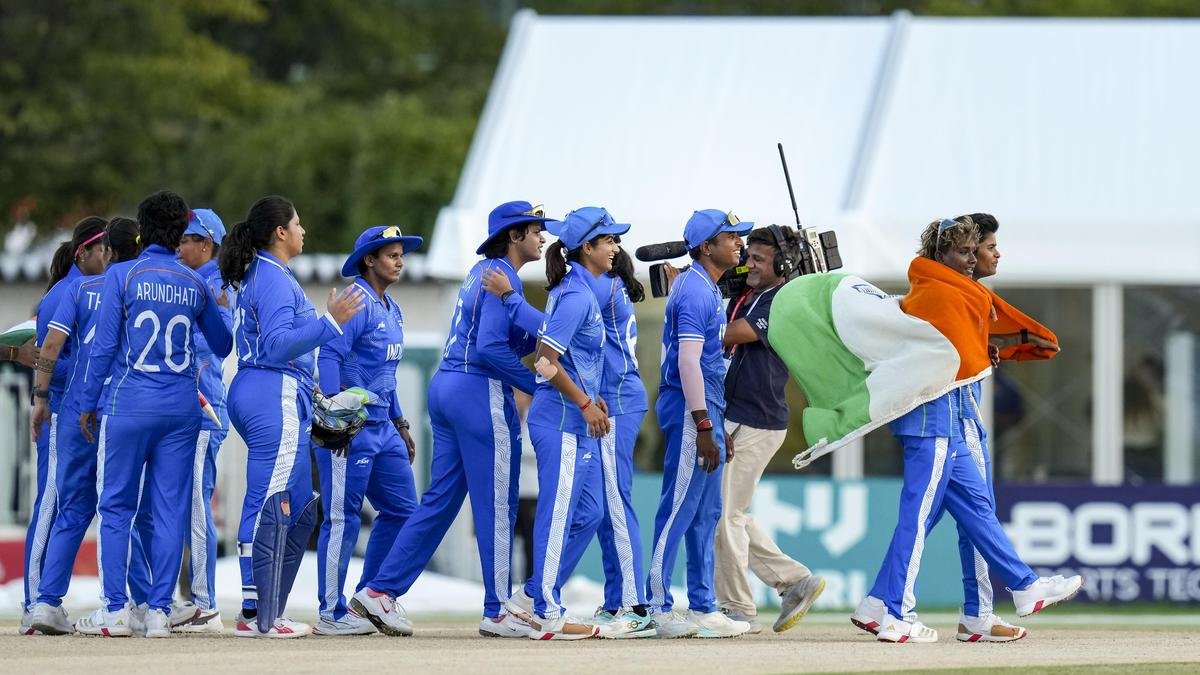
Over the last 10 days, Indian women have put up a formidable cricketing display against their Asian counterparts. In Dubai, they first secured their eighth Asia Cup title, and then went on to defend their place as the gold medallists at the Asian Games in Aichi-Nagoya, Japan.
However, women’s cricket in this country has had to prove its existence, in comparison to its men’s counterpart. They have had to ask for pay parity to match what the men earn, their matches have been denied prime cricketing venues, and broadcasters often give them second billing.
Yet, if one were to scrutinise the conversations surrounding the women’s team recently, they would be hard-pressed to find any difference in the way the men’s and women’s teams have been treated. The needle for Indian cricketing culture has barely moved between September 2025 and September 2026. This diminishes the different journeys that men and women have taken.
The Asia Cup final saw the team defeat defending champion Sri Lanka to secure a commanding win. Deepti Sharma concluded the competition by taking her 14th wicket — the most by any bowler in the tournament. Smriti Mandhana surpassed India’s Mithali Raj to become the leading run-scorer in international cricket, while also sprinting ahead of Australia’s Meg Lanning to gather the most number of centuries under her bat. These achievements didn’t garner as much media attention as the post-match non-presentation did.
The final wicket taken, a match won, but will the team take the trophy? The broadcasters knew well enough the monetary benefit of this anticipation, so the final overs delivered plenty of visuals of the VIP stand. The Asian Cricket Council (ACC) chairman Mohsin Naqvi, who is also Pakistan’s Interior Minister and the Pakistan Cricket Board’s chief, finally quenched the eager camera’s thirst. His appearance overshadowed even the joy of the final wicket, as the cameras fervently cut to Naqvi chatting with BCCI Secretary Devajit Saikia. How the story unfolded after that, is nothing to write home about.
A year of inheriting a socio-political cricketing legacy
Back in 2025, months after the deadly terrorist attack in Jammu and Kashmir’s Pahalgam, which was followed by a brief military skirmish between India and Pakistan, the Indian men played in the Asia Cup. As the team’s audience demanded a boycott of the fixture against Pakistan, the skipper Suryakumar Yadav’s answer came in the form of a refusal to shake hands. It was a paltry substitute against the calls to sacrifice the match.
Days later, the spectators cheered as the team lifted an imaginary trophy. The players had seemingly “humiliated” Naqvi by making him wait and refusing to accept the winner’s trophy from him. Since the final match had been against Pakistan, and the defeat had been extended to its highest cricketing official, Prime Minister Narendra Modi dubbed the victory “Operation Sindoor on the games field”.
Harmanpreet Kaur of India and Fatima Sana of Pakistan react at the coin toss prior to the ICC Women’s T20 World Cup match between India and Pakistan. File
| Photo Credit:
ICC via Getty Images
A couple of months later, this spectre of men’s cricket loomed large over the Indian women set to take part in the ODI World Cup. Before the tournament even got under way, journalists rushed to the women’s camp, which was playing another series altogether, and enquired about a handshake issue they were yet to encounter. “We are not focusing on the Asia Cup at the moment… our focus is on this series,” came Deepti Sharma’s response.
Out on the field against Pakistan, the Indian women didn’t shake hands with the opposing team.
A year later, in June 2026 during the T20 World Cup, Harmanpreet Kaur and Co., this time on English soil, refused to shake hands with the Fatima Sana-led team. Naqvi found himself waiting yet again, in September 2026, in the same Dubai stadium, to not present the winner’s trophy to the Indian side. “What the men had started, the women have continued,” the audience rejoiced. Even as they were receiving their gold medals for the Asian Games being hosted in Japan, the audience found itself obsessed with a particular scenario where Mohsin Naqvi could end up being part of the ceremony. He was not.
Over the past year, Indian women have added hugely to their fanbase. The new audience, previously loyal to only one gender, has lent its cheers and support. In return, the implicit demand has been to shoulder the political legacy of Indo-Pak cricket — shaped over decades by two cricketing boards that have taken their sweet time to give women their due.
Contrasting histories
The matches between the men of India and Pakistan have been held against the heavy despair of a partitioned subcontinent; they have been held joyously in the old cities of Delhi and Lahore, and they have been suspended altogether when the countries have been at war. These matches have been the mould in which the identity of the Indian men’s team, the temperament of its audience, and the business model of its Board have taken shape. For the men, this fixture carries a storied history that the new players inherit when they join the team.
Indian women, on the other hand, have not played a single bilateral match against the Pakistani side. The first time they faced each other was in 2005, and they have only ever played each other in international tournaments. In the less than 30 matches these two teams have played, the Indian side has maintained comfortable dominance. By comparison, Indian and Australian women have faced off over a 100 times, including in Test matches.
For Indian men, their matches against Pakistan now double as a theatre of jingoism. Both sides make gestures and indulge in non-handshakes. All await their own viral moment as the “most patriotic sportsboy”. For them, this is expected, and a natural consequence of how men’s cricket has been so deeply enmeshed within the contours of its cross-border relations. Women’s cricket, all this while, was being played away from this hybrid frontline.
The lack of a cricketing history between Indian and Pakistani women is less a consequence of the political history, and more a feature of the patriarchal mindsets both these teams have had to wrestle against. Women’s cricket in India didn’t start until the 1970s. Pakistani women had to wait 20 additional years before they could pick up the bat. Both these teams had to wait decades more before they even came close to becoming household names.
BCCI’s play
The no-handshake development is a BCCI decision and is applicable to all the teams that play under it against Pakistan. The decision also exposes BCCI’s nifty way of wanting to have its cake and eat it too. The lack of bilaterals means that the international matchups between the “traditional rivals” become dearer, emotionally and monetarily. These matches can’t be foregone to achieve more impactful nationalistic objectives. The next best solution is to play them, without respecting the player in front of you.
However, the BCCI only has its own past to look at if it is looking for alternatives — in the early 2000s, India refused to participate in tri-nation series and Asian Test Championships in the years following the Kargil War, and as unrest spread across the Kashmir valley.
As this Indian women’s team continues to add new metal to its trophy cabinet, it also enters a new kind of public sphere in which its cricket is viewed alongside its politics. If earlier the BCCI and its political masters were too busy to notice this team, now they are too eager to make use of another match where the cameras can capture the Indian players not shaking hands.
Published – September 26, 2026 03:35 pm IST


