






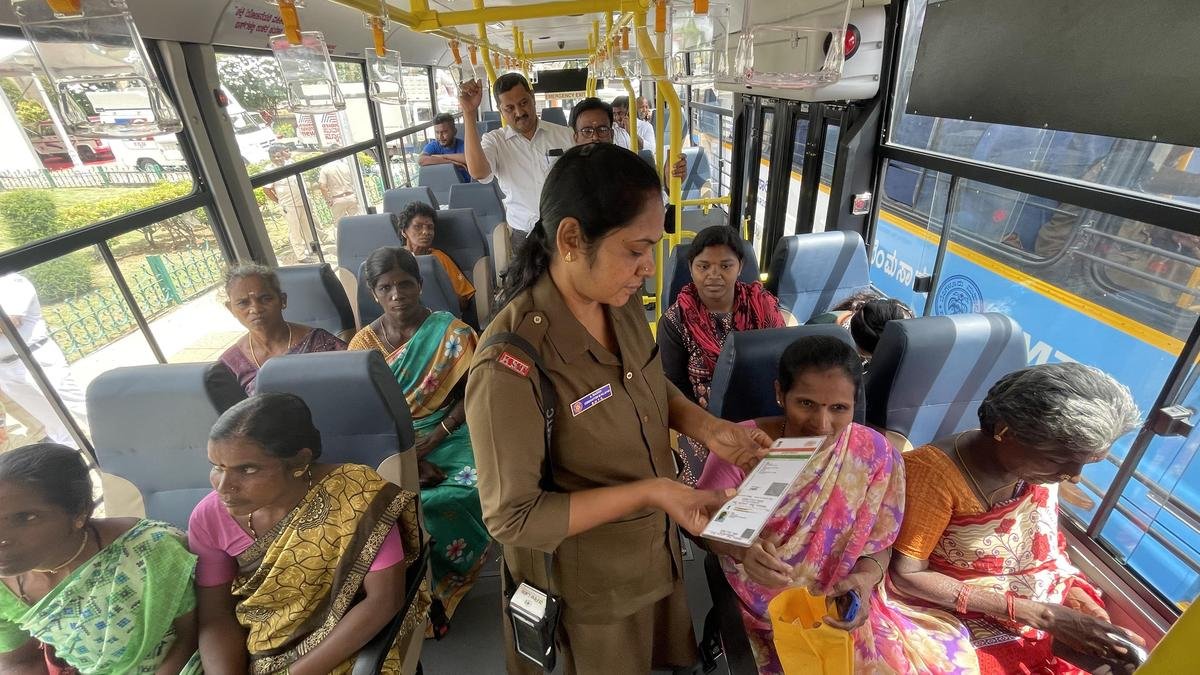
Women, during the launch of the free bus travel ‘Shakti’ scheme for Women at Vidhana Soudha, in Bengaluru on June 11, 2023.
| Photo Credit: MURALI KUMAR K
The National Household Travel Survey (NHTS), which captures how people in India travel to the workplace, shows a clear gender divide in mobility and the modes used to travel to work.
Data shows that women are twice as likely as men to commute to work using public transport such as buses or trains or on foot compared to men.
Nearly 67% of all women who commuted to work relied on walking or buses or other public transport. This figure was only 33% for all men who commuted to work.
In rural areas, more than half of all women who were working walked to their workplaces. However, a large share of men were dependent on two-wheelers.
While two-wheelers remained a major mode of transport for both men and women in urban areas, women were not solely reliant on two-wheelers.
A Statewise analysis shows that the share of women walking to work rather than relying on buses was higher than the national average in the central and northeastern States, including M.P., U.P. and Biharsignifying low public transport availability. In southern States such as Keralam, the gap between women taking buses in rural and urban areas reduced significantly.
In States like M.P, U.P., Bihar and Chhattisgarh, rural women are overwhelmingly dependent on walking. For instance, in Madhya Pradesh, 88.7% of rural women walked and only 2.0% used the bus. This could signal either limited access to public transport or workplaces being far away.
In Keralam, only 20.1% of rural women walked, while 48.6% used the bus. This is the highest bus usage share among rural women in the country. In general, the share of women walking to work reduces in urban areas
While women in urban areas also rely on other means such as autos and cars, they still take slightly longer than men to commute to work. In at least 13 major States, a higher share of men commuted to work in around 30 minutes compared to women. As the survey doesn’t provide details on ownership, a granular analysis is not possible.
The use of public transport reflects the cost of commuting too. Though women’s expenditure on commute is lower than that of men in rural areas, the gap is reducing in urban areas.
The data for the charts were sourced from the National Household Travel Survey conducted by the National Statistics Office (NSO) under the Ministry of Statistics and Programme Implementation (MoSPI). The survey was conducted between July 2025 and June 2026, covering 2,84,769 rural and 2,07,254 urban households. The analysis pertains only to the share of workers aged 15 and above, and a trip is defined as travel covering a distance of more than 1 km.
Published – October 07, 2026 08:00 am IST


