






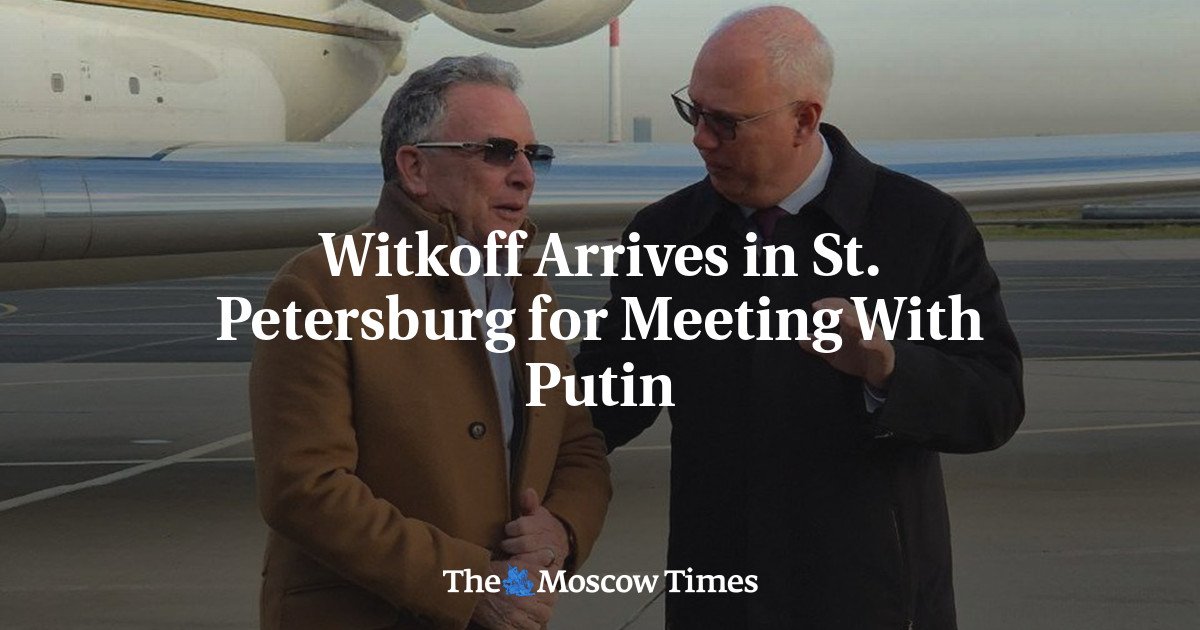
U.S. special envoy Steve Witkoff arrived in St. Petersburg on Wednesday to meet with President Vladimir Putin for talks on ending the war in Ukraine and the possible release of an American imprisoned in Russia.
Witkoff, who has engaged in a frenzy of shuttle diplomacy on both the wars in Ukraine and Iran in recent months, was met by Putin’s investment envoy Kirill Dmitriev at Pulkovo International Airport. Trump’s son-in-law, Jared Kushner, who is also involved in Ukraine peace negotiations, did not join Witkoff for the latest Russia visit after falling sick with the flu.
Earlier, a U.S. official told Reuters that Witkoff held “constructive” talks with Ukrainian President Volodymyr Zelensky during a meeting in Oslo, Norway, on Tuesday.
The official, who spoke on condition of anonymity, said Ukraine brought forward new ideas and proposals to the talks in Oslo, which also involved the leaders of Norway and Finland, as well as European and NATO representatives, and that participants made “meaningful progress” toward a coordinated approach to engaging Russia.
Those talks were said to have covered “key elements of a comprehensive peace framework,” including security guarantees for Ukraine, a post-war economic plan and a broader European security architecture.
Witkoff would aim to “create a pathway toward direct trilateral and broader multilateral negotiations,” the U.S. official said.
Zelensky traveled to Oslo in hopes of mending ties with the Trump administration, which have once again hit rocky waters in recent weeks after U.S. President Donald Trump blamed Ukrainian attacks on Russian oil refineries for soaring diesel costs in the United States, though analysts say the U.S.-Israeli war against Iran is the main cause of high energy prices globally.
Trump announced an “energy ceasefire” between Russia and Ukraine earlier this month, which neither side said they had agreed to beforehand. That apparent pause in strikes collapsed immediately as the Russian army continued its attacks against Ukraine’s power grid.
Ukraine had accused the United States in recent days of withholding critical military support and intelligence amid the renewed attacks on Russian refineries.
However, Zelensky told a news conference after the Oslo meeting and an earlier phone call with U.S. Secretary of State Marco Rubio that Ukraine was again receiving early warnings of Russian missile attacks.
“Now it works, it’s great,” he said, adding he and Rubio had discussed supplies of Patriot missile interceptors, as well as the satellite-based Starlink system, which Kyiv said had stopped working when mounted on fast-moving objects such as drones.
Norway’s Prime Minister Jonas Gahr Støre said that the Oslo meeting had been constructive. Finnish President Alexander Stubb said he believed Ukraine peace talks were “back on track.”
On Tuesday, Trump called on Ukraine to make a deal to settle the war and claimed Putin was interested in signing a peace agreement. “Ukraine has to want to settle this war,” he told reporters.
Trump suggested Russia had the upper hand on the battlefield since “Russia is a big machine — they just keep grinding forward, and that’s what they’ve done. They’ve taken a very large piece of land.”
The New York Times reported earlier this week that Witkoff plans to discuss the release of Stephen Hubbard, an American who is accused of fighting as a mercenary for Ukraine and being held in a Russian prison, when he meets with Putin on Wednesday.
Trump told reporters during an Oval Office meeting that “everybody’s been after Hubbard for a long time.”
Reuters contributed reporting.
A Message from The Moscow Times:
Dear readers,
We are facing unprecedented challenges. Russia’s Prosecutor General’s Office has designated The Moscow Times as an “undesirable” organization, criminalizing our work and putting our staff at risk of prosecution. This follows our earlier unjust labeling as a “foreign agent.”
These actions are direct attempts to silence independent journalism in Russia. The authorities claim our work “discredits the decisions of the Russian leadership.” We see things differently: we strive to provide accurate, unbiased reporting on Russia.
We, the journalists of The Moscow Times, refuse to be silenced. But to continue our work, we need your help.
Your support, no matter how small, makes a world of difference. If you can, please support us monthly starting from just $2. It’s quick to set up, and every contribution makes a significant impact.
By supporting The Moscow Times, you’re defending open, independent journalism in the face of repression. Thank you for standing with us.
Continue
Not ready to support today?
Remind me later.
×
Remind me next month
Thank you! Your reminder is set.


