



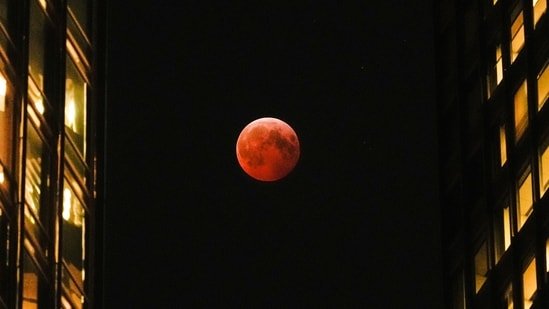
A total lunar eclipse is set to light up the skies on March 3, and skywatchers across the United States will be able to see it in the early morning hours.


According to NASA, a total lunar eclipse occurs when Earth passes between the sun and the moon, casting a shadow over the lunar surface. During totality, the moon can take on a reddish-orange glow, often called a “blood moon.”
Will it be visible in the US?
Yes. NASA says the eclipse will be visible in North and Central America in the early morning. In the United States, viewers can expect to see the eclipse between 4 am EST and around 7 am EST, with a partial phase continuing until roughly 9 am EST, according to NASA.
The space agency noted that the eclipse will also be visible in eastern Asia and Australia during the evening hours, and throughout the night in parts of the Pacific.
In central Asia and much of South America, only a partial eclipse will be visible, while there will be no visibility in Africa or Europe, NASA said.
Also Read: Holi 2026 meets a blood moon: What this rare eclipse means for your zodiac sign
How deep is this eclipse?
The India Meteorological Department (IMD) said in a post on X that the March 3 event will be a “deep, total eclipse” with a magnitude of 1.155, meaning the moon will pass fully into Earth’s umbral shadow.
IMD explained that “a total lunar eclipse will occur when the whole Moon comes under the umbral shadow of the Earth,” while a partial eclipse happens when only part of the moon enters the shadow.
The agency said the eclipse will be visible across India, eastern Asia, Australia and the Americas.
Also Read: Full moon, corn moon, blood moon: Here’s how they differ from each other
What to expect in the sky
NASA says a lunar eclipse can only occur during a full moon phase and can be observed from anywhere with a clear view of the moon.
During totality, Earth blocks most direct sunlight, but light filtered through Earth’s atmosphere gives the moon its reddish tint.
NASA also noted that during the March 3 eclipse, the moon will be in the constellation Leo. Binoculars or a telescope can enhance the view, though the event is visible to the naked eye under clear skies.


