



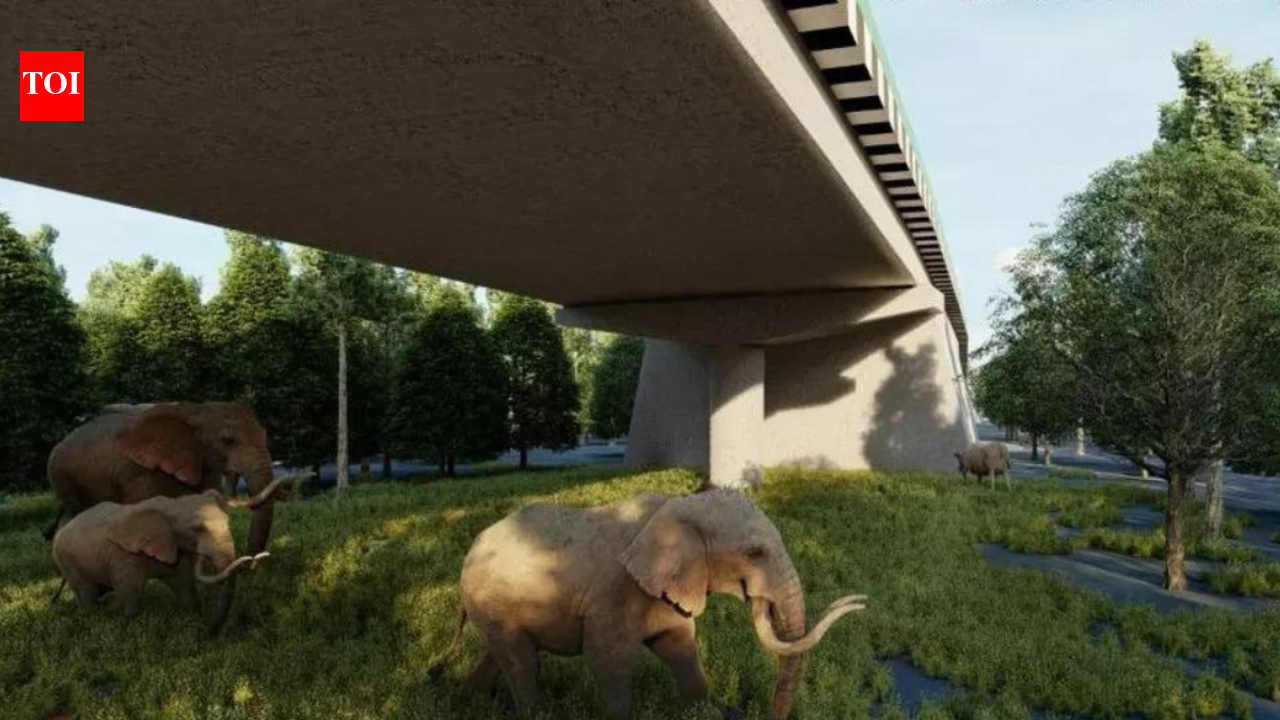
NEW DELHI: A 40-day observational study on a section of the Delhi–Dehradun economic corridor, passing through Uttarakhand’s Shivalik forest, has found that many wildlife species actively use underpasses on this section, showing that these passages are effective in helping animals move naturally around the road project.As per the recently published study by Dehradun-based Wildlife Institute of India, 150 camera traps (CTs) were systematically deployed along underpasses within a 3.5-km stretch — from Mohand village to Ganeshpur in Uttarakhand — and each unit was installed in a manner to ensure detection of a broad spectrum of terrestrial fauna, ranging from small to large-bodied species.Initial investigations revealed 40,444 camera trap images of 18 unique wild species using the viaduct with varying frequencies. The most frequent users were nilgais, sambars, chitals, hares, golden jackals and elephants. “Spatial and temporal patterns of viaduct use by wildlife reveal general avoidance of human presence and activity times. Continued long-term monitoring, including acoustic and behavioural assessments, will further strengthen our understanding of how such large-scale interventions can reduce barrier effects and guide future infrastructure design across India’s biodiversity-rich landscapes,” said Bilal Habib, the study’s principal investogator and a professor at WII.The findings gain significance considering that several highways projects are now built through forest areas.These need right interventions for safe passage of wild animals and ensuring minimal disturbance is caused to their natutral habitat.Considering the wildlife significance of the area, National Highway Authority of India (NHAI) had approached WII to carry out a rapid assessment of the wildlife use of this road and suggest mitigation measures to avoid its negative impact on wildlife of the area. With the suggested mitigations, the underpass, approximately 11 km, was developed.


