



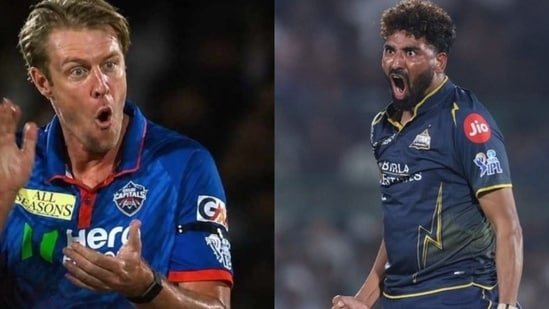
Mohammed Siraj’s roar after dismissing Vaibhav Sooryavanshi in Jaipur did not arrive in isolation. It came after the Gujarat Titans fast bowler had been taken on by the Rajasthan Royals opener, who struck him early, forced a tactical reset, and made the wicket feel larger than a routine powerplay breakthrough. Siraj’s reaction was loud, animated and loaded with release.


A few days earlier, Kyle Jamieson had produced a similarly sharp response after removing the same batter. Jamieson’s send-off drew official attention, with the Delhi Capitals pacer receiving a warning and one demerit point. Two senior international fast bowlers reacting that strongly to a 15-year-old batter has created one of the more revealing subplots of IPL 2026.
Why Vaibhav Sooryavanshi’s wicket has become a pressure-release moment
The easy way to read the Mohammed Siraj and Jamieson reactions is to frame them around Vaibhav’s age. That reading misses the cricket. Bowlers are celebrating him with that intensity because he is already making them defend their plans, their economy rates and their authority inside the powerplay.
Vaibhav Sooryavanshi’s season has moved beyond novelty. In the Rajasthan Royals’ campaign, he has scored 440 runs off 186 balls at a strike rate of 236.56. He has hit 38 fours and 40 sixes, which means 78 boundaries in 186 balls. His boundary frequency stands at one every 2.38 balls. For an opener, that changes the texture of an innings immediately.
The powerplay numbers explain the emotional temperature around his wicket. Of his 440 runs, 359 have come in the first six overs. He has faced 148 powerplay balls and scored at 242.57, with 65 boundaries in that phase alone. A bowler removing him is not merely taking out an inexperienced teenager. He is cutting off a batter who can distort a match before the field spreads.
That is what Siraj was responding to. Vaibhav’s 36 off 16 balls against Gujarat was short, but it was already damaging. He hit three fours and three sixes, scored at 225, and produced six boundaries in 16 balls. In the impact model used for this analysis, that innings still carried a match worth of ₹1.32 crore and a profit value of ₹1.24 crore despite lasting only 16 deliveries. The wicket had value because the innings was threatening to grow into another high-damage burst.
Vaibhav’s batting also creates a specific tactical headache. He is not a one-zone hitter waiting for bowler’s errors. His scoring map shows heavy output through long-on, mid-wicket and square leg, but he has also scored strongly through cover, third man, long-off and point. Bowlers cannot simply drag the ball wider outside off and expect the risk to drop.
The line-and-length data shows why. Against outside-off good length deliveries, he has scored 57 off 25 balls at a strike rate of 228. Against outside-off short-of-length bowling, he has made 54 off 23 at 234.78. Leg-stump good-length bowling has gone for 37 off 15. Off-stump full balls have gone for 27 off 12. Even traditionally safer zones are travelling when the execution is marginally off.
The one visible control point is the yorker. Off-stump yorkers have brought only one run from four balls and one dismissal. That small sample tells a larger story. Bowlers need extreme precision against Vaibhav. Length balls invite clean swings. Width can disappear. Anything on the pads becomes boundary access. Miss the yorker, and he can break open.
His impact profile supports the eye test. Vaibhav sits sixth in the season impact leaderboard in our method, with a player performance score of 1226.87 and a batting score of 494.57. His innings ledger includes 52 off 17, 39 off 14, 78 off 26, 103 off 37, 43 off 16 and 36 off 16. Those are not development knocks. They are match-altering powerplay interventions.
The price layer adds another dimension. Vaibhav’s auction value is ₹1.10 crore. His season worth in our monetary model is already ₹18.11 crore, with a profit of ₹17.25 crore. That return has been created almost entirely through batting violence at the top. Every early wicket against him now carries tactical, emotional and financial model weight.
This is why the celebrations have looked unusually fierce. Vaibhav has compressed the distance between promise and threat. Bowlers are no longer reacting to the idea of a 15-year-old prodigy. They are reacting to a batter who can turn a new-ball spell into damage control within ten deliveries.
Siraj’s roar and Jamieson’s send-off should be read as evidence of Vaibhav’s arrival inside the league’s competitive psychology. The IPL has already started treating his wicket as a premium event. At 15, Vaibhav Sooryavanshi remains young enough to be called a wonderkid. Senior fast bowlers have already started celebrating him like a match-winner.
Method note
This analysis uses a custom cricket impact model designed by the author. The model studies Vaibhav Sooryavanshi’s contribution through scoring rate, boundary frequency, phase value, role difficulty, match situation and dismissal impact, then converts that performance into a model-based valuation using his auction price and expected season usage.
The monetary figures are not salary calculations or official IPL numbers. They are analytical estimates meant to show how much value a player created against his cost within this model. The tactical conclusions are based on innings pattern, powerplay output, line-length response, wagon distribution and season impact data.


