



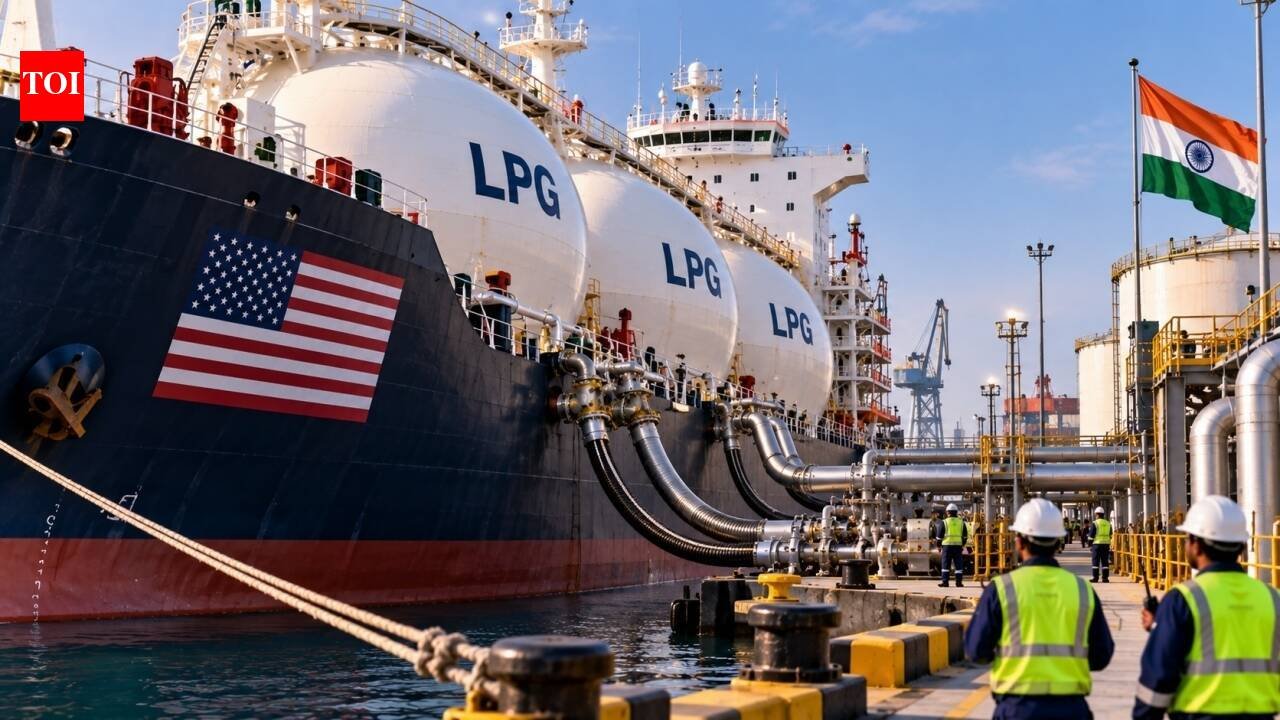
When US President Donald Trump announced that India would step up energy purchases from America, everyone thought of oil. But, the Middle East conflict has brought forward another energy stream from the US that is fast becoming important for India: Liquified Petroleum Gas or LPG.India is the world’s third largest oil importer and consumer, and it imported 21.85 million tonnes of LPG in 2025, with about 90% coming from the Middle East, while imports met around 66% of domestic LPG consumption.India is heavily dependent on Middle East countries for its LPG supply that is increasingly being used as a household fuel. With Strait of Hormuz closed and supplies choked, India has actively looked elsewhere to meet its needs while stepping up domestic production at refineries at the same time.Even as Russia remains India’s largest crude oil supplier, the US has emerged as the biggest LPG exporter for India and the trend is likely to continue despite higher costs if Middle East supplies remain uncertain.Long-term contracts are being forged and India is reportedly looking to get a notable chunk of its LPG needs from the US. In August, the US supplied over 50% of India’s LPG imports. Will such a high number continue?
Rising US share in India’s LPG imports
India’s LPG import mix has seen drastic changes as Middle East supplies stay disrupted due to the conflict.The supply mix has shifted sharply towards the US since the start of the conflict. In fact, from March onwards, the US has become the biggest supplier of LPG to India. Its share has risen from around 12% in January to 36.9% in March. It crossed 50% in May, and peaked at 73% in July, according to Kpler data.The UAE, Qatar and Saudi Arabia have all lost share as US supplies increased. The UAE fell from 36% in January to 7.6% in July, while Qatar dropped from 19% to 1.4% over the same period. Saudi Arabia’s share declined from 14.6% in January to zero by July.However, August has brought back some diversification back into the mix. The US remained the largest supplier at 55.4%, but UAE rose to 15.2% and Algeria to 11.9%, while Kuwait accounted for 8.8%.So, while the US has become the dominant source, the latest data suggests India is still drawing supplies from a wider set of countries.
Why the rise?
The reason is straightforward: India needed to make up for the loss of Gulf cargoes, which had represented around 85–90% of its LPG imports before the crisis, while the US had supply available.According to Natalia Katona, Commodity Analyst, the US was already the world’s largest LPG exporter, and its propane was cheaper than Asian alternatives even before the war.When the shortage emerged, India had few nearby alternatives and was prepared to pay the additional cost of sourcing LPG from farther afield, as maintaining cooking gas supplies was the overriding priority.“Freight costs for US LPG were not treated as much of a constraint because, with Middle Eastern cargoes unavailable and few alternatives on the market, India had to secure supplies wherever it could,” she explains.Before the crisis, LPG from Gulf countries reached India in three to four days; it now has to source some cargoes from Houston, with shipments to the west coast travelling through the Panama Canal, adding to both cost and journey time and taking around 30-45 days depending on canal traffic, she tells TOI.The LPG demand in India pre-war level was on average of 1042 thousand barrels per day from March 2025 till Feb 2026.Since war broke out, the supply crisis led to an increase in LPG prices and the government took measures to minimize LPG use in alternate industries except as cooking gas. This led to demand destruction. The current monthly average demand from March 2026 till August 2026 stands at 862 thousand barrels per day, almost 20% drop, according to Pankaj Srivastava, Senior Vice President, Commodity Market – Oil at Rystad Energy.Yet another side of the coin is the ramp up of LPG production from the refineries, which further dented import reliance.“If we see the pre-war import data from March 2025 till February 2026, the average import is 785 thousand barrels per day. Almost 70% of demand volume, however post war, the scenario changed as import averaged around 440 thousand per barrels, almost 50% of the demand,” shares Srivastava.The US import pre-war level was almost 10% of total imports. According to Srivastava, these have risen to more than 50% of total imports due the following reasons:1. US-India trade deal discussion emphasis on energy purchases2. Non-availability of short haul supply3. Upcoming gas based petrochemical plants in India looking for reliable supply4. US-India LPG deal for 2.2 MMTPA import in 20265. Rising production of LPG mainly propane in US
What about the higher cost of importing US LPG?
LPG cargoes from the Middle East reach India in shorter time and the longer transit times from the US place the latter at a cost disadvantage.In terms of cost, Pankaj Srivastava of Rystad Energy says that the main differentiator is the pricing mechanism used for Middle East supplied LPG versus US LPG.The Middle East uses Saudi announced contract prices at the start of the month while Mount Belivue is the daily spot price.“The Saudi CP is a rigid, monthly fixed price heavily tied to volatile global crude oil benchmarks. Conversely, Mont Belvieu relies on daily spot price fixing driven by North American shale production and export capacity,” he explains.So, while the Saudi CP exposes Indian Oil Marketing Companies to sudden monthly price cliffs, the daily visibility of the US benchmark allows buyers to leverage averages around loading dates, providing a natural price smoother and financial hedge.“The short 5 to 7-day voyage from the Middle East is heavily compromised by soaring war-risk insurance premiums in the Strait of Hormuz. In contrast, the 45+ day haul from the US requires more advanced planning, but the structurally lower Free-on-Board (FOB) prices at the US Gulf Coast are expected to minimize the impact of higher freight expenses,” Srivastava tells TOI.According to Natalia Katona, freight from Houston to India’s West coast has risen from $135/tonne in early March to around $290/tonne, while rates from Saudi Arabia’s Ras Tanura have increased from about $70/tonne before the crisis to roughly $235/tonne now.Freight rates for LPG cargoes from Saudi Arabia’s Ras Tanura should be treated as a rough indication of rates from the Gulf to India’s West coast, as Saudi LPG loadings stopped in May, and the market can no longer trace any cargoes coming from there, she tells TOI.Currently, LPG loadings in the Gulf are sparse and mainly take place in the UAE and Kuwait. Other LPG vessels were loaded in June and July and remained afloat in the Gulf until crossing Hormuz in August and early September.While Gulf supplies remain cheaper even at these elevated rates, availability is the issue.
Is the above 50% share for the US sustainable?
The current surge in volumes is driven by blockade of Middle East supplies, but once Hormuz disruptions ease, will the US continue to hold a significant share in India’s LPG import basket?Experts say long-term contracts with the US, evolving trade dynamics with the world’s largest economy will shape the way forward. The cost disadvantage to Middle East cargoes is a realistic issue, but supply security for India will continue to dictate decisions, they say.Katona notes that August showed a meaningful improvement in Gulf supplies to India. Deliveries rose to account for about 44% of LPG imports, while US shipments fell by 20% month-on-month.“If nearby suppliers can deliver reliably again, Indian buyers will have much less reason to pay the additional freight costs for American cargoes,” she believes.Looking ahead, Katona expects the US share to decline if Gulf supplies continue to recover. But security around the Strait of Hormuz remains the main uncertainty.But, the focus is now shifting to contracts for 2027. The government is said to have asked Indian Oil, BPCL and HPCL to source at least 15% of their LPG imports for next year through annual agreements with US suppliers.“While no decisions have been finalised, the move indicates that India is looking to diversify its procurement strategy. It could also have positive implications for trade talks, with increased purchases of US energy potentially helping support negotiations on the US-India trade deal,” Katona tells TOI.In July, Reuters reported that India plans to source up to 25% of its LPG imports from the US in 2027.India’s LPG consumption fell about 8% to 14.7 million tonnes in January-June 2026, while imports dropped 28% to around 7.5 million tonnes.Full-year consumption is expected to fall to 30 million tonnes this year because of supply constraints, but could recover to around 31 million tonnes in 2027, pushing imports up to about 20 million tonnes.According to US President Donald Trump, India has also pledged to increase US energy purchases by $10 billion to $25 billion and the two countries have set a target of $500 billion in bilateral trade by 2030.“Despite the significantly longer transit time, the Mont Belvieu pricing framework provides Indian OMCs with the operational flexibility, supply security, and cost insulation needed to weather regional Middle Eastern disruptions until mid-2027,” Srivastava concludes.The US is clearly emerging as a key supplier of LPG to India, and the trend is likely to continue in 2027 as well. But if the Strait of Hormuz opens up durably, the 50% share in India’s LPG imports is unlikely to sustain.
