




Sons of Darkness refuses the comfort of pure heroes and villains. Why was moral ambiguity essential to you when reinterpreting the Mahabharata?
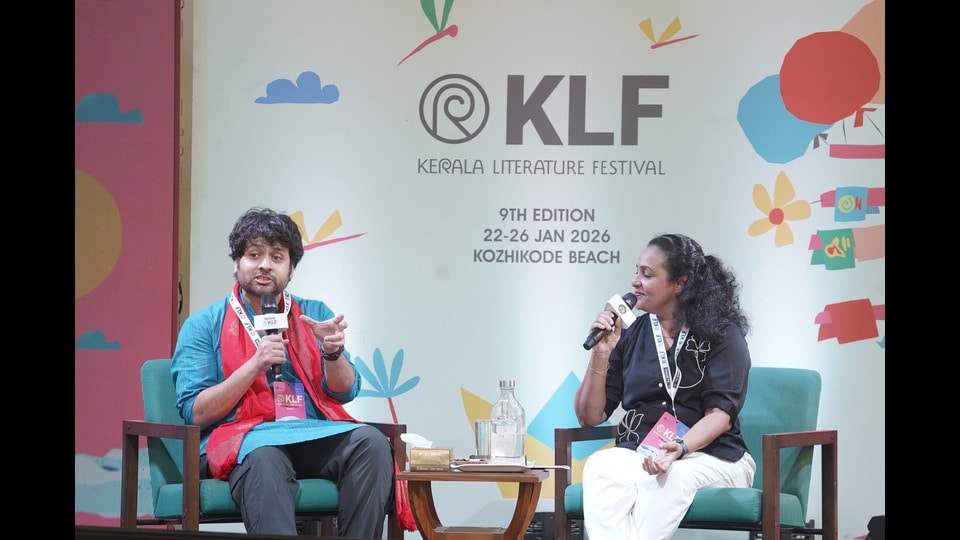
I think, as a lawyer, when you represent both sides over your career, you kind of realise that no one is a villain in the real story. There are two sides to every story.
So, I wanted to analyse The Mahabharata from the perspective of its so-called villains. The reason why The Mahabharata is so awesome is because each character has flaws. History is often written by the victors, so I thought it would be really cool to get into the mind of the vanquished, the footnote characters, because I don’t believe in black versus white. I think there are 50 shades of grey.
Indian mythological fiction often leans towards reverence, while your novel leans towards brutality. What do we gain when we stop treating epics as sacred objects?
I don’t think anything can actually get as brutal as The Mahabharata is. You have decapitations, heads flying everywhere, Bheem drinking blood, so I don’t think any brutality I write can match Ved Vyasji.
What we do when we reimagine epics, I think, we become mythological DJs, adding our own perspective to a timeless tale. The Mahabharata or the Ramayana, these tales are different in every state of India. For example, in some places, Raavan is the father of Sita, not an abductor. I think that is what we retellers and reimaginers do.
These are tales which will float till the end of time. A thousand years later, someone will still be reimagining the Mahabharata because it’s such a beautiful tale. I think the core remains the same; we just add our own flowers to it.
Many readers have compared Sons of Darkness to global epic fantasy rather than traditional retellings. Are you consciously writing The Mahabharata into a different literary lineage?
Absolutely. In fact, I was very careful not to give Sons of Darkness a typical mythological book name because I did not want it to be interpreted as that. I want to bring in epic fantasy. It is based on the foundation of the Mahabharata, but it takes its own journey.
Epic fantasy is not there in India, to the same extent. Nowadays, it’s slowly slipping in there. I wanted to bring that Game of Thrones, Wheel of Time, Lord of the Rings energy into an Indian setting, and that is why I did that.
Violence in Sons of Darkness is not ornamental. It is consequential and at times, exhausting. How do you decide what to show, what to withhold, and when restraint matters more than spectacle?
It’s all about being organic. As long as the violence is not there for the sake of it and it feels like a consequence of a person’s action, then the violence feels like — “Okay, this is something I can digest.” It feels natural and horrifying, but the readers should see why this happened. This is the North Star that controls me.
Whatever I write, I am very inspired by history. I am a student of history, and I read battles, study them, and then capture them in my books. Most of what I write, be it horrific or not, is based on true events. I feel like more than writing violence, I enjoy writing consequences.
Your characters often act out of duty rather than desire. Do you think duty is the most dangerous force in epic storytelling?
Absolutely, and not just in epics. The same duty can be misinterpreted by two different parties. If you look at the Crusades, everyone thought it was their duty to capture Jerusalem, and so many people lost their lives in those battles. All because of two differing ideas of what duty is.
Duty is a diabolical term that can have multiple qualities.
Perspective is everything in your novel, especially when it comes to characters historically framed as villains. Did inhabiting those voices change your own relationship with the epic?
Oh, yes. For example, take Shakuni. I really wanted to get into his mind and try to write a narrative from his perspective. He was in constant pain, and he’s plotting the demise of the same family he’s surrounded by. Getting into his headspace was pretty exciting for me, and I think it allowed me to respect Shakuni a lot more as well.
We have seen him as a villainous character, but the most villainous deeds that have taken place in The Mahabharata are not associated with Shakuni. He never pawned Draupadi off. He never ordered her disrobing. Those were the actions of Duryodhana and the Pandavas. All he was doing was cheating in a dice game, and plotting the destruction of the Kauravas.
There’s a strong political undercurrent in the book: questions of legitimacy, power, and inherited authority. Did contemporary politics in any way shape how you read the Mahabharata when you were writing?
Absolutely. One of the issues I dealt with in the book is marital rape, which has still not been criminalized in India.
When Draupadi gets married to the Pandavas, the rotation system comes a lot later. You have these five husbands with very different personalities. I am very closely associated with a case which is still pending before the Supreme Court of India, so I wanted to analyse and get into this. Using Draupadi, I was able to explore consent after marriage in my book.
Sons of Darkness seems less interested in moral instruction and more in moral inquiry. Do you believe epics should teach or trouble the reader?
I think sometimes the best teaching happens when you’re troubling the reader and forcing him or her to ask questions. When you try to find those answers, that’s how you gain wisdom.
If you look at all the sages in Hindu lore specifically, it’s always been sages posing questions to their shishyas, and then students experiencing those questions, finding their answers, and learning wisdom.
You have a background in law, a field built around argument, interpretation and competing versions of truth. Did that training shape how you approached a text like The Mahabharata? And how did you find your background helping or hindering your process?
There are a lot of similarities in practising law and being an author. As a lawyer, your job is to convince the judge to listen and believe your side of the story. It’s the same with writing. You’re trying to convince your reader to believe your version of the story.
Specifically, when it comes to reimaginings, when you already know a great, beautiful version, to convince them of something else – that’s where I feel the law skills help you.
There’s a murder trial in Sons of Darkness; my law background definitely helped me there.
After writing this series, has your understanding of righteousness changed or has it become even more unstable?
I think it has become more nuanced. As I said, there is no black and white; there are 50 shades of grey when it comes to humanity.
Also, I love that I can sympathise and empathise a lot better now. There’s a quote: ‘One man’s terrorist is another man’s freedom fighter.’ I think I am understanding this quote a lot better now.
What books and writers have influenced you?
George RR Martin is obviously the Dronacharya to my Eklavya. But there’s Joe Abercrombie as well, who writes grimdark fantasy. He deals with dark topics but with dry humour. Sons of Darkness is supposedly India’s first grimdark fantasy book. So, he’s been a big, big inspiration.
Rutvik Bhandari is an independent writer. He lives in Pune. You can find him talking about books on Instagram and YouTube (@themindlessmess).
