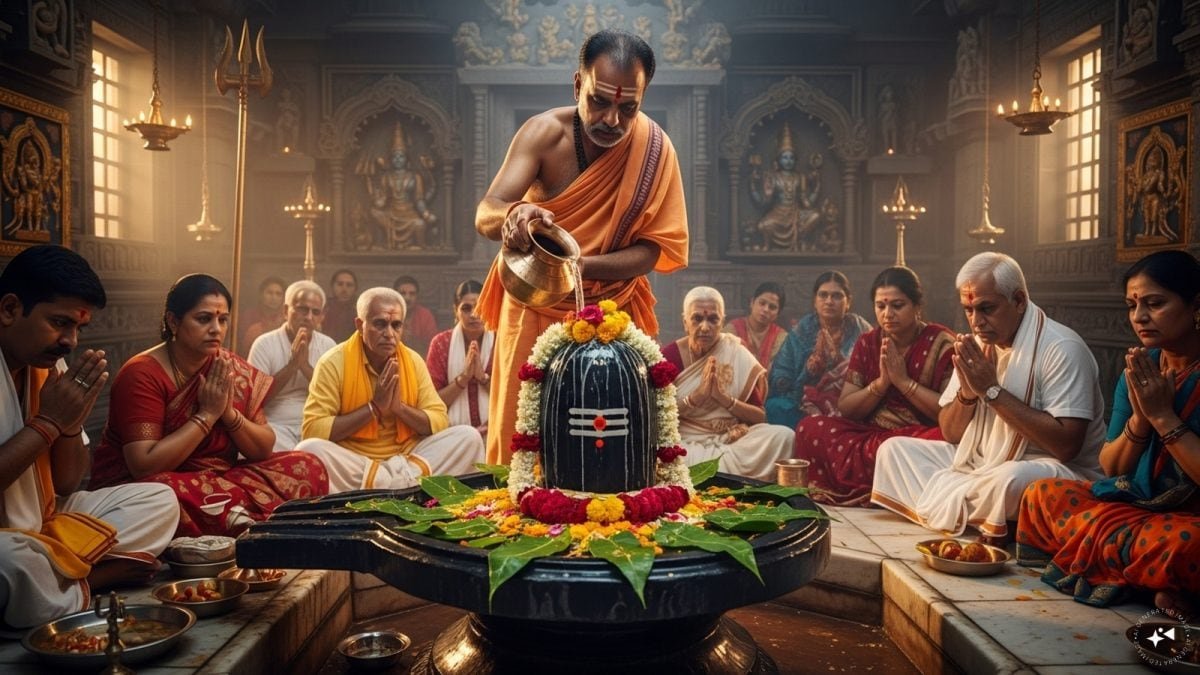
Why is Lord Shiva worshipped as the Shivling? Explore the spiritual, Vedic and Puranic significance behind this sacred symbol and its deep cosmic meaning.
Because Shiva has neither beginning nor end, the Shivling is seen as a symbol of his formless nature. While the anthropomorphic form of Lord Shankar represents his manifest aspect, the Shivling symbolises his unmanifest, cosmic form, the formless Brahman.As per the Vayu Purana, after the dissolution of each cosmic cycle (Yuga), the entire universe merges into this divine Lingam, from which creation begins again. In the Vedas, the term “Lingam” is also used to describe the subtle body, composed of 17 elements.Puranic lore narrates that once a dispute arose between Lord Brahma and Lord Vishnu over who was superior. Suddenly, an infinite pillar of light, the Lingam, appeared before them. Both gods tried to find their beginning and end, but failed even after thousands of years. Eventually, it was revealed that the pillar of light was Lord Shiva himself, the supreme source from whom all creation, including Brahma and Vishnu, originated.It is believed that after this divine revelation, Lord Shiva established himself in the formless state as the Shivling. Brahma and Vishnu were the first to worship it, marking the beginning of the tradition of Shivling worship that continues to this day.Disclaimer: The information provided here is based on religious texts and traditional beliefs. News18 does not independently verify these claims. Readers are advised to consult certified experts before making any decisions based on this information.
Stay Ahead, Read Faster
Scan the QR code to download the News18 app and enjoy a seamless news experience anytime, anywhere.
In Hinduism, the three principal deities are Brahma, Vishnu, and Mahesh (Shiva). Mahadev is considered eternal and infinite. Monday is dedicated to Lord Shiva, and several significant fasts and rituals are observed in his honour. Devotees regularly offer water to the Shivling as an act of faith and devotion.