


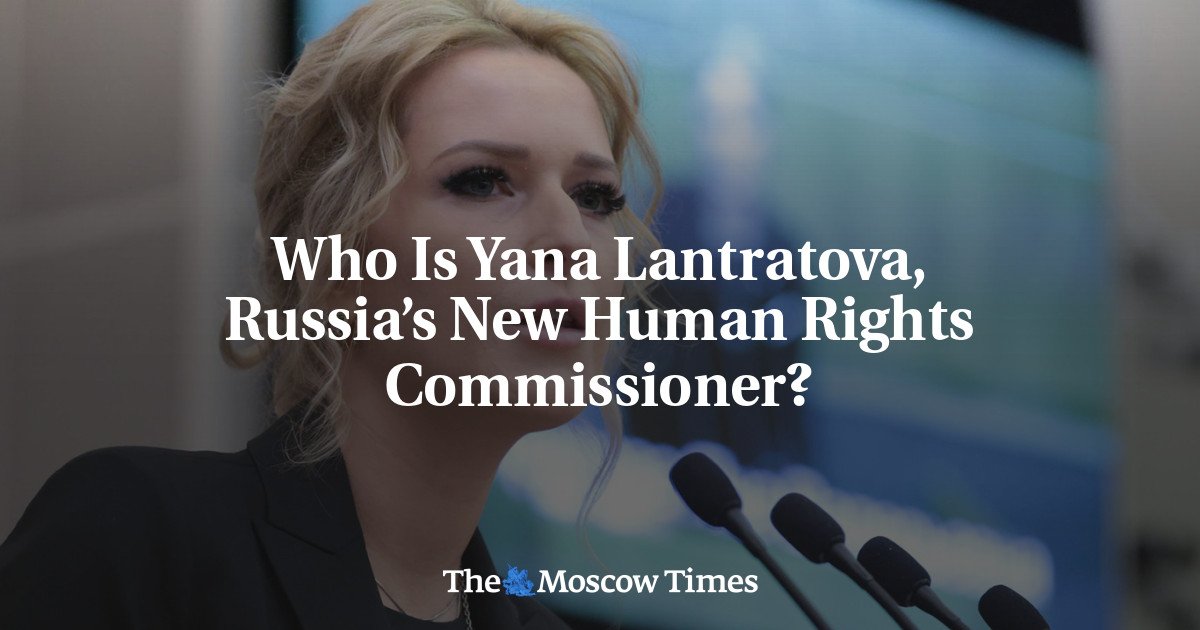
Russia has appointed State Duma lawmaker Yana Lantratova, an outspoken supporter of Russia’s conservative political turn, as its new human rights ombudsman — a move that human rights experts said reflects the state of civil liberties under President Vladimir Putin.
Lantratova, who was accused of involvement in the alleged forced transfer of Ukrainian children and known for advocating a ban on “LGBT propaganda,” was elected Russia’s next human rights commissioner last week.
She succeeds ex-police general Tatyana Moskalkova, who had served as ombudswoman since 2016 and was no longer eligible for another term.
Like Moskalkova, Lantratova was nominated by the Kremlin-loyal A Just Russia party and backed by the ruling United Russia party, where she began her political career.
Yet rights defenders who spoke to The Moscow Times described Lantratova as “a different type of figure” than her predecessor: a young careerist shaped entirely by the current political system.
The Moscow Times takes a closer look at the person who will now be overseeing rights and freedoms in Russia.
Who is Lantratova?
Lantratova, 37, entered politics in the late 2000s with the youth wing of United Russia. She later worked as an aide to Vitaly Milonov, an ultra-conservative St. Petersburg lawmaker known for championing Russia’s anti-LGBT legislation.
At that time, she also headed a monitoring center focused on alleged child rights violations, child pornography and pedophilia. The organization drew controversy after accusations that teenagers from a Moscow correctional boarding school had been used in so-called “pedophile hunting” operations. Lantratova denied involving minors directly, insisting that only trained volunteers cooperated with law enforcement.
duma.gov.ru
Between 2012 and 2018, Lantratova served on Russia’s presidential human rights council, including in a working group monitoring human rights in Ukraine.
In 2021, she joined A Just Russia and was elected to the State Duma the same year. She went on to serve as first deputy chair of the Duma’s Education Committee before heading its Social and Religious Organizations Committee.
Currently under U.S. and EU sanctions, Lantratova was also charged in absentia by Ukraine for allegedly helping organize the transfer of children from the occupied Kherson region alongside Inna Varlamova, the wife of A Just Russia party leader Sergei Mironov.
What are her political views?
Speaking of her appointment, Lantratova told lawmakers in the State Duma that “in my work as a civic activist, human rights advocate and lawmaker, I have always tried to see not statistics, but real people.”
“The main values for me are love for people, compassion, justice and the rule of law,” she said.
As she faced accusations of denouncing an organization helping anti-war priests, she said last year that “religion and faith have become an integral part” and “a shield against despair and evil” in the war against Ukraine.
In late 2025, Lantratova co-authored a bill proposing additional restrictions on Russians convicted in absentia on political charges, including for violating Russia’s wartime censorship laws.
She has called for banning so-called “LGBT propaganda” in video games, for restrictions on quadrobics, a youth subculture involving animal roleplay and for limiting free education for children of migrants.
Lantratova also warned about the spread among young people of the A.U.E. (“Prisoner’s Criminal Unity”) — a subculture later labeled extremist in Russia — and proposed that Russia’s Human Rights Council cooperate with the security services to solve “the problem.”
Experts say that the A.U.E. doesn’t exist as an organization and that the ban is used to put pressure on political prisoners and others.
“This was largely when the practice began of inventing and fabricating supposedly terrible anti-state and anti-Russian organizations that, in their view, needed to be banned,” lawyer Vadim Prokhorov told The Moscow Times, adding that Lantratova “latched onto a favorite theme” in building her career.
duma.gov.ru
How do rights defenders view her appointment?
In her new role, Lantratova pledges to continue supporting Russian soldiers fighting in Ukraine and what she calls legal education for young people, as well as the prevention of extremism and destructive behavior.
“The main task of the ombudsman is to help every single citizen of their country,” she said.
Yet experts expressed doubts that Lantratova’s appointment would lead to any improvement in Russia’s human rights situation.
Lantratova herself said last week that the war in Ukraine “has put many things into perspective.”
Referring to activists and human rights defenders who fled Russia to avoid repressions, she said: “Well-known ‘rights defenders’ quickly ended up abroad and began speaking out against their own country.”
“Russia is already in a deeply cemented totalitarian system under Putin,” Prokhorov said. “It would be strange to expect the ombudsman’s office to become some kind of oasis in the middle of a burned desert.”
Amnesty International, which is banned in Russia, said that “restrictions on the rights to freedom of expression, peaceful assembly and association intensified” in the country since the invasion of Ukraine.
The organization pointed to the escalation of internet censorship and “violations of the right to freedom of religion and belief,” and said that the country’s “legislation was weaponized to clamp down on dissenters.”
Some activists said that the post of human rights ombudsman has become “largely ceremonial” in recent years.
“It’s simply a nominal position that exists so the state can say it has an institution responsible for human rights. So this [appointment] will not change anything,” said Aleksandra Miroshnikova, press secretary of the NC SOS Crisis Group, which supports the LGBTQ+ community in Russia.
Oleg Orlov, a co-chair of the Nobel Peace Prize-winning Memorial human rights group, said he doesn’t expect “anything better” from Lantratova’s appointment.
Lawyer Prokhorov said he similarly “only expects the situation to get worse.”
“Moskalkova was a formally legal cog in the system — certainly not a guiding light — but someone who tried to do something within certain limits,” he said.
Lantratova is a product of the Putin regime, he said, “who in some sense runs ahead” and “contributes to creating moral panic in order to ensure the homogeneity and insulation of Putin’s society and system.”
A Message from The Moscow Times:
Dear readers,
We are facing unprecedented challenges. Russia’s Prosecutor General’s Office has designated The Moscow Times as an “undesirable” organization, criminalizing our work and putting our staff at risk of prosecution. This follows our earlier unjust labeling as a “foreign agent.”
These actions are direct attempts to silence independent journalism in Russia. The authorities claim our work “discredits the decisions of the Russian leadership.” We see things differently: we strive to provide accurate, unbiased reporting on Russia.
We, the journalists of The Moscow Times, refuse to be silenced. But to continue our work, we need your help.
Your support, no matter how small, makes a world of difference. If you can, please support us monthly starting from just $2. It’s quick to set up, and every contribution makes a significant impact.
By supporting The Moscow Times, you’re defending open, independent journalism in the face of repression. Thank you for standing with us.
Continue
Not ready to support today?
Remind me later.
×
Remind me next month
Thank you! Your reminder is set.
