






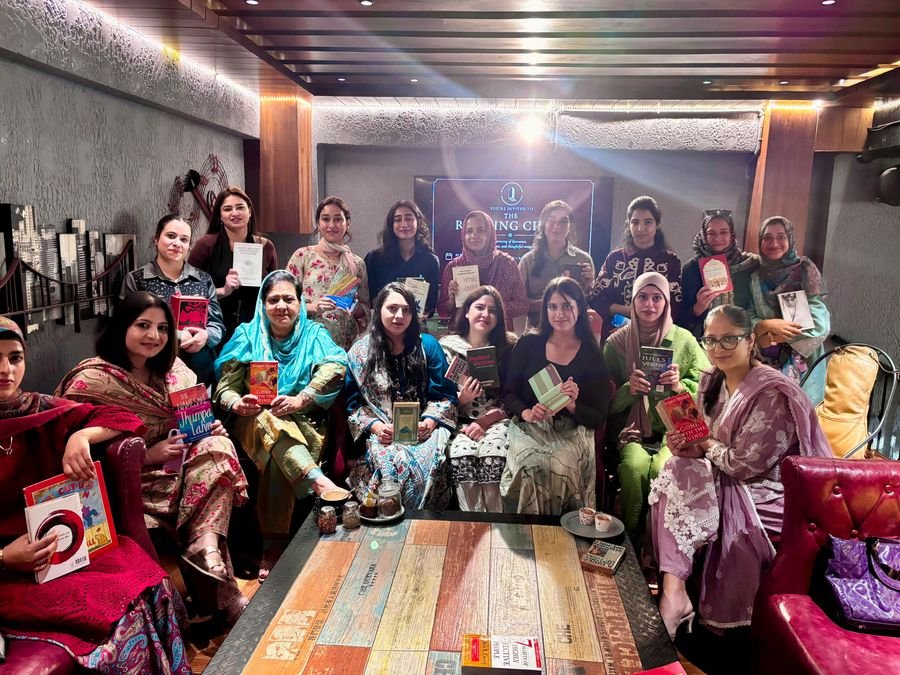
Srinagar, Sep 25: Every Saturday afternoon, a group of women sit together to talk about a text, a poem or an essay they have read that week. Nobody lectures, nobody is asked to raise a hand, and nobody is wiser than the other. This is the Reading Circle at Kabo, a reading group only for women that has quickly become one of the most talked-about literary spaces in Srinagar.
Founder Maumil Mehraj, 28, said the idea came from something she missed after moving back to Kashmir. She had spent most of her adult life in Delhi and abroad, studying literature and later peace and conflict studies, and was used to being around people who talked about books, history and society. When she returned to Kashmir, she felt that kind of space was missing.
“Reading is largely a solitary activity, but it is when you discuss what you have read with other people that you really begin to understand what a text is trying to say,” she told Rising Kashmir. “Discussing what you have read, forming new and different opinions, felt like a very natural next step. It was that need of occupying space, of developing intellectual curiosity together, that made me start the Circle.”
That is how it began, in June this year.
It did not start big. Only three people came to the first session, and Mehraj said she felt a little disheartened at the time. Then a reel about the group went up on Instagram and things changed. Now, between 20 and 25 women come every Saturday to the hotel The Kabo in Wazir Bagh, and around 10 of them never miss a session. For Mehraj, however, the growing numbers are not really the point. The Circle remains an attempt to protect a particular kind of room: one where women can arrive without having to perform expertise, read something carefully, disagree with one another and leave having thought about it a little differently.
What brings women back to the Circle each week, she said, is that nobody is treated as more important than anyone else in the room. She remembered a session where a Kashmir University professor sat across from her own student, and another where three students from Amar Singh College sat with their teacher, all as equals. She said such spaces are rare in Kashmir, where people usually cannot sit with their teachers outside of an institutional space and speak freely.
For Dr Yasmin Shoaib, 46, a dentist, the Circle has turned out to be about much more than books. “I have never been someone who was particularly fond of reading, but joining the Circle has given me something much more meaningful,” she said. “Every time I enter that space, I feel a different kind of happiness. I feel heard, respected, and, most importantly, not judged. I don’t have to be the person everyone expects me to be.” She said listening to younger members has taught her that people can learn just as much from conversation as from books. “I may not have fallen in love with books yet, but I have certainly fallen in love with what the Circle gives me: a sense of belonging, acceptance, and the freedom to simply be myself.”
16-year-old Hoor ul Nisa Behzad, a student and the youngest member of the group, said something similar in her own way. “I think I came here for books, but somewhere along the way, I found a little more than that,” she said. “I read because I love words, but I stay because I love what words do to people.”
The readings are at the heart of the Circle. The group has moved between writers as different as Kate Chopin, Joan Didion, Albert Camus, James Baldwin, Annie Ernaux and Rokeya Sakhawat Hossain. The conversations rarely stay confined to a single interpretation of a text. A story might lead to a discussion about marriage, motherhood or the expectations placed on women; another might open into questions of memory, class, politics or the ways people understand themselves. Mehraj says that is what she finds most interesting about reading together: the same text can mean something entirely different to different people in the room.
The Circle has hosted guest sessions with Nayeema Mehjoor, educationist Mahi Burza, writer Mehak Jamal and academic Dr Nyla Ali Khan. Author Anam Zakaria will join a session online on the 27th.


