



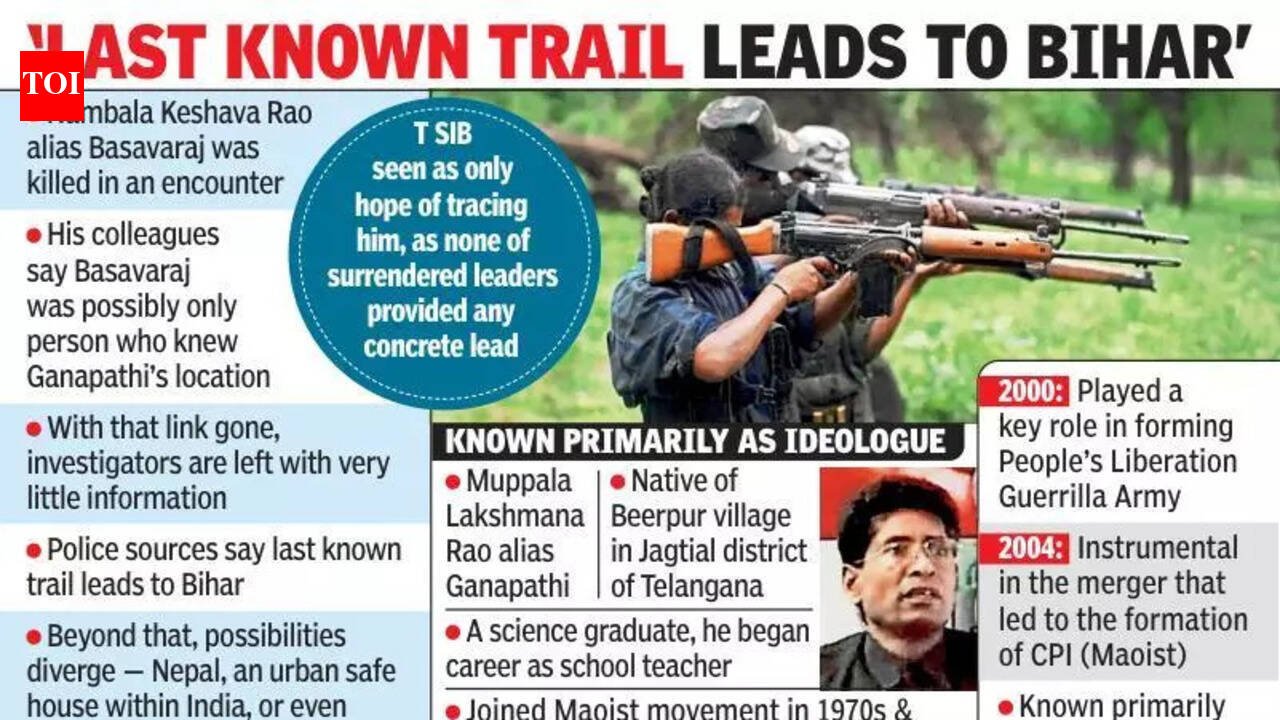
Hyderabad: The disappearance of Muppala Lakshmana Rao alias Ganapathi — once the ideological face and longest-serving general secretary of CPI (Maoist) — has turned into one of the most enduring mysteries surrounding the outlawed movement.Years after he faded from public view, even senior leaders who recently surfaced say they have no idea where he is, deepening the intrigue around a man who once operated at the very core of the organisation. The uncertainty sharpened after the death of his successor, Nambala Keshava Rao alias Basavaraj, in an encounter. His colleagues now say Basavaraj was possibly the only person who knew Ganapathi’s location. With that link gone, investigators are left with very little information. Police have ruled out his presence in forest zones and believe the ailing leader is likely in an urban hideout. Theories range from North India to Nepal and even the Philippines, but none has been confirmed.Ganapathi, a native of Beerpur village in Telangana’s Jagtial district, had stepped back from active operations due to ill health but continued as an advisor to the party’s central committee. As speculation grows over a possible surrender, there is still no concrete information. Telangana DGP B Shivadhar Reddy told TOI that Ganapathi is not in the forest but dismissed talk of any imminent surrender. Secret guarded at the top The mystery has been reinforced by the words of top surrendered leaders themselves. Thippiri Tirupathi alias Devji said he does not know Ganapathi’s whereabouts, describing it as a strictly guarded secret. According to him, the party followed a system where information about key leaders was shared only with the general secretary and kept even from central committee and politburo members. He said this arrangement was part of a deliberate security protocol, making it “not supposed to be known”. He also pointed to an Aug 2024 politburo meeting where stricter secrecy measures were adopted for select leaders — a decision that now assumes significance. Asked if he would appeal to Ganapathi to surrender, Devji said: “We won’t appeal”. He argued that such a call would be non-political and maintained that only if the govt recognised CPI (Maoist) as a legal political party would the leadership collectively ask underground members to return to public life.Devji confirmed that Ganapathi attended a key meeting in 2021 with Basavaraj but denied that any proposal to lay down arms was discussed. Last meetings, fading trail Another senior leader, Malla Raji Reddy alias Sangram, echoed similar uncertainty. He said he last met Ganapathi around two years ago, when the latter was in poor health and informed the central committee of his decision to leave the forest for medical treatment. Raji Reddy said Ganapathi, though one of the few remaining politburo members, had become inactive. He also recalled that Ganapathi had argued the party should have reassessed its strategy at least a decade earlier, stressing the need to adapt to changing social and political realities. According to him, Ganapathi believed that once the movement withstood pressures such as Operation Kagar, it would need fundamental shifts in tactics and methods. Police sources say the last known trail leads to Bihar. Beyond that, the possibilities diverge — Nepal, an urban safe house within India, or even the Philippines. None has been verified. The Telangana special intelligence branch is now seen as the only hope of tracing him, as none of the surrendered leaders has provided any concrete lead.Long shadow over movement Ganapathi’s journey began as a school teacher and science graduate who joined the movement in the 1970s. His rise became prominent in 1992 when he emerged as general secretary of CPI(ML) (People’s War). He later led key organisational milestones, including the formation of the People’s Liberation Guerrilla Army in 2000 and the merger that created CPI (Maoist) in 2004. Known more as an ideologue than a battlefield tactician, he shaped policy direction and organisational consolidation. He stepped down in 2018 due to ill health, with Basavaraj succeeding him. Even as Telangana police intensify efforts to bring him into the democratic mainstream, including outreach following recent surrenders, Ganapathi remains untraceable. Appeals have been made, rehabilitation promised, and operations stepped up — but without success. For the police, former comrades, and the movement he once led, Ganapathi is no longer just a missing leader. He is an unanswered question — one that continues to cast a long shadow over the organisation’s present and future.


