



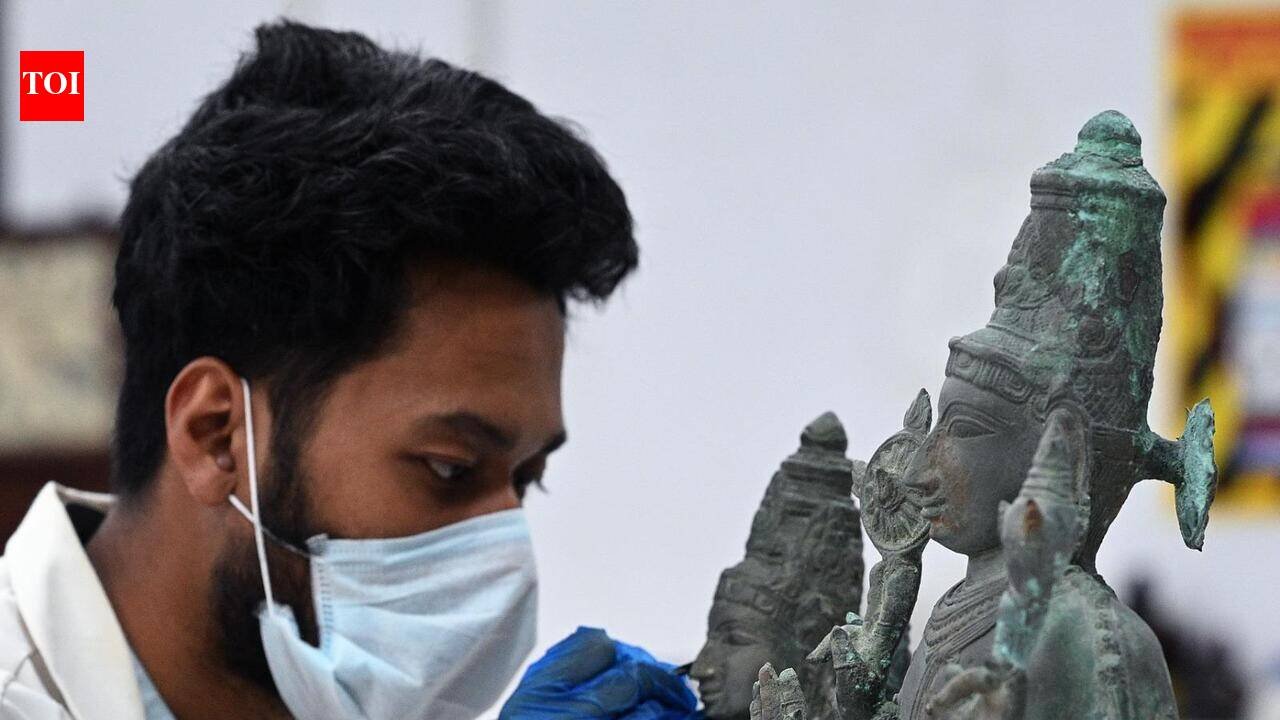
Tucked away in an obscure, rundown building far from the galleries of the Government Museum in Egmore is the oldest conservation laboratory in India and the fourth oldest in the world.Established in 1930, the Chemical Conservation and Research Laboratory is tasked with preserving the collection of 50 lakh artefacts, including coins, housed in museums across Tamil Nadu.Inside, at one table, Sayan Chakraborty, an intern, carefully scrapes greenish corrosion from a Chola bronze idol of Vishnu, millimetre by millimetre, peering through special magnifying glasses. “It will take a month or so to restore the idol,” he says.At the adjacent table, ‘Lady with a Mirror’ by Raja Ravi Varma is being taken off its frame. The 1894 painting had a patch of moisture which had to be removed, again an intricate job that must be done without damaging the original pigments.“We get artefacts from various sections such as archaeology, anthropology, zoology, botany, geology and natural history, says Gandhimathi J M, curator of the conservation lab. “We go around the galleries and see what needs to be done, or have a joint, periodic examination, to spot signs of moisture during monsoons.”Recently, a 1.3 tonne Nataraja bronze was transported to the lab in a forklift for restoration.“The stone artefacts rarely need repair. It’s mostly the bronzes and organic materials – anything derived from natural plantand animal-based sources such as organic textiles, leather and paper objects, which need frequent restoration,” says Gandhimathi.In the AnoxiPro (a nitrogen chamber) upstairs, a Lambadi tribal costume from Andhra Pradesh is stored and will be treated for moisture soon. “The chamber is filled with nitrogen instead of oxygen, which kills all organic matter including microbes and pests,” says Gandhimathi. The lab also has chemicals to treat corrosion and restore paintings and dry cabinets for storing sensitive objects.The set of bronzes being restored now is a recent treasure, not part of the museum’s permanent collection. There are mainly two kinds of corrosion in bronzes, says the curator. “We have to be careful not to remove the patina as it acts as a protective coat against further deterioration. It is also a measure of antiquity, taking hundreds of years to form a uniform layer. But bright green, powdery patches caused by reactions with moisture can eat away the metal and must be carefully removed,” says the curator.The level of corrosion also depends on the nature of the object and where it was found. “Some could be good-quality bronze; others, for example, those found near coastal areas such as Nagapattinam, would need extensive treatment owing to the salty air of the region.”After the moisture patches are removed, the bronzes are given a coating of the chemical benzotriazole to prevent further reaction.” However, the chemical is carcinogenic, so precautions are taken when using it. “Our techs wear gloves and masks.”Ironically, the Ravi Varmas are in better condition than contemporary paintings and even Mughal miniatures, as the former were executed on imported paper and pigments, Varma being a royal, says Gandhimathi.As we watch, the plywood frame of ‘Lady with a Mirror’ is removed because it is prone to expansion and contraction and to pest attacks. “It will be replaced by a polycarbonate frame which is waterproof and fireproof.”An oil painting has three layers — primer, pigments and varnish. The canvas might shrink and expand due to moisture variation, and the pigments might flake and develop minuscule cracks. “The cracks are an indication of the antiquity of the painting, just like the patina on bronzes,” says Gandhimathi.Any restoration they do has to be reversible and documented in a logbook with before-andafter photos, so that during future restorations they can identify which areas had problems in the past.Paintings from the adjacent National Art Gallery, which have yellowed with age, are also restored here. A lot of work gets done in this lab, but then, it has only three permanent staff, as the govt has sanctioned only three posts. The bulk of the work is outsourced to students and interns.Conservation, says Vinod Daniel, former board member of the International Council of Museums, should be carried out by specialised professionals. “Every conservation lab requires trained conservators who specialise in metals, stones and paintings. Labs also need collection care and specialists. The lab should be developed into a centre for excellence, where objects from across Tamil Nadu’s subsidiary museums can be restored.”There are no institutions in South India that offer a full-time degree in conservation, which makes it difficult to find trained personnel. But many from north India wish to work here but are unable to, as there are no permanent posts, says Gandhimathi, who has attended courses attached to The British Museum. “The building we have is spacious with thick walls, a high ceiling, teak furniture and sinks suitable for washing acids and other chemicals, so we don’t want this taken down, but we need separate labs for metals, paintings and paper; the dust from cleaning metal should not fall on paintings.”Gandhimathi says she tries to create more awareness of this lab and the work that goes on here through workshops and internship programmes, but primarily, courses on conservation should be introduced in South India. Tamil Nadu has a rich heritage, with antiques in every corner, and conservation can be done only manually. No machine can replace trained hands.”


