






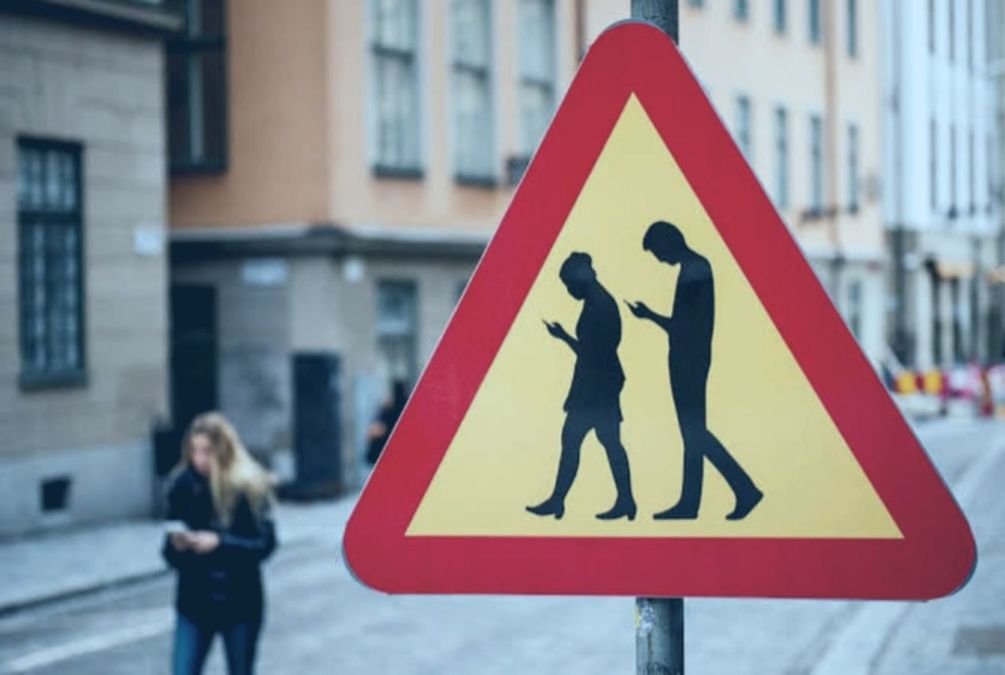
A man walking while intensely focused on his mobile phone recently fell into a construction area after apparently failing to notice the danger directly in front of him. The incident, although startling, is not merely another viral accident caught on camera. It offers a simple but increasingly important lesson: when we stop paying attention to where we are walking, even an ordinary journey can suddenly become dangerous.
The incident is particularly relevant in an age when the smartphone has become almost inseparable from everyday life. We walk while texting, scroll through social media while crossing roads, answer calls while navigating crowded streets and sometimes even watch videos while moving through public spaces. What appears to be a harmless habit can, within seconds, turn into a serious safety risk.
We often associate distracted driving with accidents. Governments, traffic authorities and road-safety organisations have repeatedly warned motorists about the dangers of using mobile phones behind the wheel. But there is another form of distracted behaviour that receives considerably less attention: distracted walking.
The human brain is remarkably capable, but it cannot give full attention to multiple demanding tasks simultaneously. Walking may appear automatic, yet navigating an unfamiliar or crowded environment requires continuous awareness. A pedestrian needs to notice uneven surfaces, open drains, vehicles, bicycles, construction barriers, steps, other pedestrians and sudden changes in the path ahead. When attention is absorbed by a phone screen, these environmental cues can easily be missed.
A notification may seem insignificant. A message may take only a few seconds to read. A social-media video may last less than a minute. But a pedestrian can cover a considerable distance in those few seconds. During that time, the person may be moving towards a pothole, an uncovered drain, a staircase, a roadside excavation or a moving vehicle without properly processing the danger.
This is what makes distracted walking particularly deceptive. The danger is not always in the phone itself; it is in what the phone takes our attention away from.
Construction zones are an obvious example. Roads and footpaths are frequently altered because of development, repairs, drainage work, utility installation and other infrastructure projects. Temporary diversions may not always be familiar to pedestrians. Barricades, excavated portions of roads, construction materials and uneven surfaces can create hazards even for an attentive person. For someone looking down at a screen, the risk increases substantially.
There is also a psychological dimension to smartphone distraction. Modern phones are designed to demand attention. Notifications, messages, short videos, social-media feeds and constant updates create an environment in which people feel compelled to check the screen repeatedly. The habit can become so automatic that some people reach for their phones without consciously deciding to do so. The result is a peculiar contradiction: we may be physically moving through the real world while mentally occupying a digital one.
This behaviour is becoming increasingly visible in public spaces. People walk through railway stations while typing messages, move across hospital corridors while watching videos, navigate shopping areas while scrolling through social-media feeds and cross streets while talking on their phones. Not every such incident ends in injury. That does not make the behaviour safe.
Sometimes the consequence is simply bumping into another person. At other times, it may mean falling down stairs or stepping into traffic. In more serious situations, a moment of distraction can result in fractures, head injuries or even loss of life.
There is another important concern: pedestrians are often considered the most vulnerable road users. Unlike motorists, they have no vehicle body protecting them. A small mistake can therefore have disproportionately serious consequences.
This is why awareness about distracted walking should become part of the broader road-safety conversation. The responsibility, however, does not rest entirely with individuals.
Urban planning and public infrastructure also play an important role. Construction sites should be properly barricaded and clearly marked. Pedestrian pathways should be maintained wherever possible. Excavated areas should have visible warning signs, adequate lighting and physical protection. Temporary diversions should be intuitive and safe.
A person using a phone irresponsibly should certainly be accountable for their attention, but a dangerous construction site should never be left inadequately protected on the assumption that everyone will notice it.
The same principle applies to footpaths and public spaces. Broken pavements, open manholes, poorly marked steps and unprotected roadside excavations can be dangerous even without mobile-phone distraction. Cities therefore need to develop infrastructure that anticipates human behaviour rather than assuming perfect attention from every pedestrian.
At the same time, individuals can adopt some very simple habits. The first is perhaps the easiest: look up while walking.
If a message requires concentration, stop at a safe place and read it. If a phone call is unavoidable, move away from traffic and other hazards before answering. Avoid watching videos while walking. Do not type messages while crossing a road. And when approaching a construction zone, railway crossing, intersection or crowded area, keep the phone away and pay attention to the surroundings.
Parents can teach these habits to children early. Schools and colleges can incorporate pedestrian safety into awareness programmes. Employers can remind staff about safe phone use during commuting. Public-awareness campaigns can expand the concept of distracted driving to include distracted walking. The message does not need to be complicated. A notification can wait. A message can wait. A video can wait. Your safety cannot.
There is also a broader social lesson here. Smartphones have made communication faster, but they have also changed the way we experience our surroundings. We increasingly document places instead of observing them, scroll instead of looking around and respond to virtual conversations while physically present somewhere else.
The challenge is not to reject technology. Smartphones are indispensable tools for communication, education, navigation, work and emergency assistance. The goal is to use them responsibly. Technology should remain a tool that serves us, not an object that constantly captures our attention.
Perhaps the most useful habit is to create simple “phone-free moments” during movement. When walking on a road, crossing a street, entering a construction area or navigating an unfamiliar place, the phone should take second place to environmental awareness.
The viral construction-site incident is therefore worth viewing as more than an unusual accident. It is a reminder of a modern behavioural problem that can affect almost anyone.
Most accidents do not announce themselves in advance. There is rarely a warning saying that the next step is the dangerous one. Safety often depends on noticing the small details around us before it is too late.
A few seconds of looking down at a screen may not seem important. But in those few seconds, the world continues moving around us.
A vehicle approaches. A cyclist passes. A pavement ends. A staircase begins. A drain remains uncovered. A construction barrier stands ahead. And if we are looking at our phones, we may not see any of it.
Perhaps the simplest road-safety rule for the smartphone age should therefore be one we teach as routinely as looking both ways before crossing a road: Before you look at your screen, look where you are going.
Because sometimes, the most important notification is the one our surroundings are already giving us: danger ahead.
(The Author works at a premier medical college in Jammu & Kashmir)


