



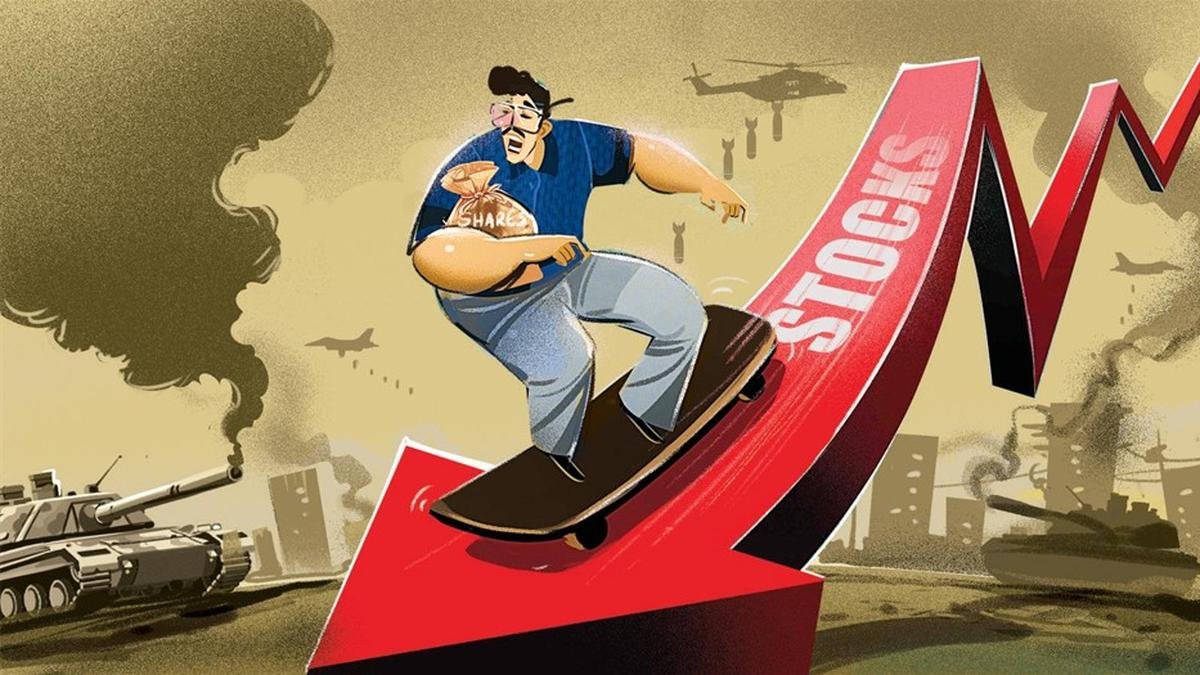
When cannons roar and nations descend into conflict, it sets off a cascading effect. The impact ripples far beyond battlefields, reaching deep into financial markets. Contrary to the conventional wisdom, war does not always trigger chaos or crashes.
History shows markets can plunge into volatility, remain resilient, or eventually recover after periods of intense sell-offs.
The hail of bullets have even brought down the curtains on markets for extended periods. So, no two conflicts affect markets alike. But regardless of how wars unfold, investors must stay prepared to protect their portfolios. Let’s rewind the clock of wars and markets…
World War I
On June 28, 1914, Archduke Franz Ferdinand, heir to the Austro-Hungarian throne, was assassinated, in Sarajevo (then part of Austro-Hungarian Empire). Following this, tensions escalated and Europe edged towards a wider conflict, which culminated in the outbreak of World War I.
The financial panic intensified so much and stock exchanges across Europe were shut. In the United States, the New York Stock Exchange (NYSE) downed its shutters for nearly 19 weeks from July 31 to December 11, 1914. This suspension is said to be the longest hiatus in the global financial system. Gripped by fear and uncertainty, investors rushed towards safety. The demand for gold surged, triggering heavy selloffs in stocks. To improve economic stability, the U.S. government invoked the Aldrich-Vreeland Act of 1908, allowing banks to issue emergency currency backed by securities rather than gold.
The War put an end to the international Gold Standard monetary system, as most warring nations halted the free conversion of currency into gold and began hoarding gold reserves. The U.S. continued to honour gold convertibility within the U.S while restricting the outflow of gold through an export embargo. Further, the disruption triggered an acute liquidity crunch, as banks struggled to supply cash.
World War II
In September 1939, World War II unfolded with a different economic impact when Adolf Hitler’s Nazi Germany invaded Poland. Markets remained open but the crisis shifted from liquidity to that of physical capacity, as widespread destruction of industry and infrastructure across Europe and East Asia crippled production. During World War II (1939-1945), the stock markets moved in phases rather than a straight line. Historical S&P index data indicated that the market initially surged around 14% in the month after Germany’s invasion of Poland in 1939, only to decline by about 6% in 1940 as fears of a wider war intensified. The market eventually bottomed in 1942, with the S&P 500 reaching its low.
1973 Yom Kippur War
During the Yom Kippur War, stock markets did not collapse immediately but the real damage came from the oil shock that followed. On October 6, 1973, during the Jewish holy day of Yom Kippur, Egyptian and Syrian forces launched a surprise offensive against Israel. In response, on October 17, 1973, Arab members of Organization of Arab Petroleum Exporting Countries (OAPEC) imposed an oil embargo on the West and slashed production, driving oil prices to quadruple from $3 to $12 per barrel approximately by early 1974. After the oil shock, oil exports were priced in U.S. dollars, increasing global demand for U.S. dollars. This triggered one of the worst bear markets in modern history, with the S&P 500 falling roughly 40-45% between 1973 and 1974, over a period of nearly two years.
War may come and go
Across a century of turmoil, stock markets have endured two World Wars, the Great Depression, Arab oil embargo, 2000s dot-com crash, U.S. 9/11 attack, 2008 financial crisis, inflationary spirals, hyperinflations, COVID-19 pandemic, political chaos, scams and scandals, bank collapses, black swan events and what not. War may come and war may go, but the stock markets go on for ever. But there’s a catch. Markets can fall, keep falling and remain bearish in the short term. However, this uncertainty is not a bug but a toll for long-term wealth creation. Investing is easy but staying invested when it bleeds red is the real magic.
‘Lost decades’
Beware! A stark counterexample: Japan’s index Nikkei 225 peaked at nearly 39,000 on December 29, 1989, and took nearly 34 years to bounce back to that level in February 2024 and crossing 40,000 in March 2024. The bursting of Japan’s late-1980s asset bubble led to deflation and decades of slow growth, known as the Lost Decades.
The stock market is a labyrinth that no brilliant mind can decode with complete accuracy. Yet one can navigate this ocean with planning and patience. Do not indulge in panic selling; if there is no immediate need for cash, do not exit in red; avoid making hurried changes to your portfolio; maintain adequate liquidity for emergencies; continue your SIPs and use declines as an opportunity to average your investments. Above all, be patient, stay disciplined, and diversify: never put all your eggs in one basket.
(The writer is an NISM & CRISIL-certified Wealth Manager and certified in NISM’s Research Analyst module)
Published – March 30, 2026 06:04 am IST


